Quartic Symmetroids and Spectrahedra Cynthia Vinzant, University of - - PowerPoint PPT Presentation

quartic symmetroids and spectrahedra
SMART_READER_LITE
LIVE PREVIEW

Quartic Symmetroids and Spectrahedra Cynthia Vinzant, University of - - PowerPoint PPT Presentation

Quartic Symmetroids and Spectrahedra Cynthia Vinzant, University of Michigan with John Christian Ottem, Kristian Ranestad, and Bernd Sturmfels Cynthia Vinzant Quartic Symmetroids and Spectrahedra Quartic Symmetroids A quartic symmetroid is

slide-1
SLIDE 1

Quartic Symmetroids and Spectrahedra

Cynthia Vinzant,

University of Michigan

with John Christian Ottem, Kristian Ranestad, and Bernd Sturmfels

Cynthia Vinzant Quartic Symmetroids and Spectrahedra

slide-2
SLIDE 2

Quartic Symmetroids

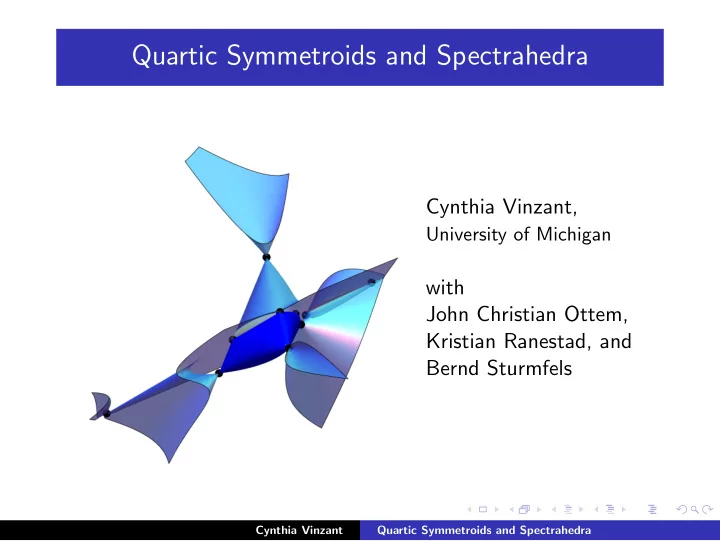
A quartic symmetroid is a surface V(f ) ⊂ P3(C) given by f = det(A(x)) = det(x0A0 + x1A1 + x2A2 + x3A3) where A0, A1, A2, A3 are 4 × 4 symmetric matrices. Fun facts:

◮ V(f ) has 10 nodes (of rank 2) ◮ co-dimension 10 in

P(C[x0, x1, x2, x3]4)

◮ studied by Cayley in a set of

memoirs 1869 - 1871

Cynthia Vinzant Quartic Symmetroids and Spectrahedra

slide-3
SLIDE 3

Real Spectrahedral Symmetroids

Here I’ll talk about in surfaces V(det(A(x))) where

◮ the matrices A0, A1, A2, A3 are real and ◮ their span contains a positive definite matrix.

Motivation 1: The convex sets {x ∈ R4 : A(x) 0} appear as feasible sets (spectrahedra) in semidefinite programming. Motivation 2: Having a positive definite matrix puts interesting constraints on the surface VR(f ). For example . . . Friedland et. al. (1984) showed that in this case V(det(A(x))) has a real node.

Cynthia Vinzant Quartic Symmetroids and Spectrahedra

slide-4
SLIDE 4

Linear spaces of matrices and spectrahedra

Let A0, A1, . . . , An be real symmetric d × d matrices and A(x) = x0A0 + x1A1 + . . . + xnAn. Spectrahedron: {x ∈ Rn+1 : A(x) is positive semidefinite} projectivize → {x ∈ Pn(R) : A(x) is semidefinite}

(bounded by the hypersurface V(det(A(x)))

Example: A(x) = x0 + x1 x2 x2 x0 − x1

  • Goal: Understand the algebraic and topological properties of

spectrahedra and their bounding polynomials.

Cynthia Vinzant Quartic Symmetroids and Spectrahedra

slide-5
SLIDE 5

Polynomials bounding spectrahedra

Spectrahedra are bounded by hyperbolic polynomials, det(A(x)). A polynomial f is hyperbolic with respect to a point p if every real line through p meets V(f ) in only real points. Theorem (Helton-Vinnikov 2007). A polynomial f ∈ R[x0, x1, x2]d bounds a spectrahedron if and only if f is hyperbolic.

Cynthia Vinzant Quartic Symmetroids and Spectrahedra

slide-6
SLIDE 6

Spectrahedra and interlacers

The diagonal (d − 1) × (d − 1) minors of A(x) interlace the determinant det(A(x)). Theorem (Plaumann-V. 2013). The matrix A(x) is definite at some point if and only if its minors interlace the determinant.

Cynthia Vinzant Quartic Symmetroids and Spectrahedra

slide-7
SLIDE 7

Determinantal surfaces and 3-dim’l spectrahedra (n = 3)

The variety of rank-(d − 2) matrices in Cd×d

sym has

codimension 3 and degree d+1

3

  • .

Generically, the spanC{A0, A1, A2, A3} meets this variety transversely and contains d+1

3

  • matrices of rank d − 2.

The complex surface V(det(A(x)) bounding a three-dimensional spectrahedron has d+1

3

  • nodes.

Cynthia Vinzant Quartic Symmetroids and Spectrahedra

slide-8
SLIDE 8

Three-dimensional spectrahedra bounded by cubics

Over C there are (generically) 4 nodes of rank one. Either 2 or 4 of them are real and lie on the spectrahedron.

Cynthia Vinzant Quartic Symmetroids and Spectrahedra

slide-9
SLIDE 9

Three-dimensional spectrahedra bounded by quartics

Over C there are generically 10 nodes of rank two. There are two flavors of real node (on or off the spectrahedron). What configurations are possible?

Cynthia Vinzant Quartic Symmetroids and Spectrahedra

slide-10
SLIDE 10

Theorem (Degtyarev-Itenberg, 2011)

There is a (transversal) quartic spectrahedron with α nodes on its boundary and β nodes on its real surface if and only if α, β are even and 2 ≤ α + β ≤ 10. α = 8 α = 0 α = 2 β = 2 β = 10 β = 0

Cynthia Vinzant Quartic Symmetroids and Spectrahedra

slide-11
SLIDE 11

Back to the classics (Cayley’s Symmetroids)

Idea of Cayley: Look at the projection of V(f ) from a node p. This projection πp : V(f ) → P2 from a node p is a double cover

  • f P2 whose branch locus is a sextic curve.

Why? If p = [1 : 0 : 0 : 0] then f = a · x2

0 + b · x0 + c

where a, b, c ∈ R[x1, x2, x3]. The branch locus of πp is V(b2 − 4ac).

Cynthia Vinzant Quartic Symmetroids and Spectrahedra

slide-12
SLIDE 12

Projection from a node

Theorem (Cayley 1869-71) A quartic f ∈ C[x0, x1, x2, x3]4 with node p is a symmetroid if and

  • nly if the branch locus of πp is the product of two cubics, b1 · b2.

Moreover the images of the other 9 nodes are V(b1) ∩ V(b2).

πp

− →

Cynthia Vinzant Quartic Symmetroids and Spectrahedra

slide-13
SLIDE 13

The view from a node on or off the spectrahedron

For p ∈ Spec, b1 = b2. The image πp(Spec) is the conic {a ≥ 0}. For p / ∈ Spec, b1, b2 are real and hyperbolic. The image πp(Spec) is the intersection of cubic ovals.

Cynthia Vinzant Quartic Symmetroids and Spectrahedra

slide-14
SLIDE 14

The view from a node: interlacing branch locus

If p = [1 : 0 : 0 : 0] and A(x) = x0   

1 1

  +

1 1 2 3 4 1 1 2 3 4

then the branch cubics b1, b2 are diagonal minors of A(0, x1, x2, x3).

Cynthia Vinzant Quartic Symmetroids and Spectrahedra

slide-15
SLIDE 15

The view from a node: interlacing branch locus

The image of the spectrahedron is the intersection of cubic ovals. → There are an even number of spectrahedral nodes.

To understand the other direction of the Degtyarev-Itenberg Theorem . . .

Cynthia Vinzant Quartic Symmetroids and Spectrahedra

slide-16
SLIDE 16

(A0 A1 A2 A3) giving different types of spectrahedra

(2, 2) :    3 4 1 −4 4 14 −6 −10 1 −6 9 2 −4 −10 2 8       11 2 2 6 −1 4 2 −1 6 2 2 4 2 4       17 −3 2 9 −3 6 −4 1 2 −4 13 10 9 1 10 17       9 −3 9 3 −3 10 6 −7 9 6 18 −3 3 −7 −3 5    (4, 4) :    18 3 9 6 3 5 −1 −3 9 −1 13 7 6 −3 7 6       17 −10 4 3 −10 14 −1 −3 4 −1 5 −4 3 −3 −4 6       8 6 10 10 6 18 6 15 10 6 14 9 10 15 9 22       8 −4 8 −4 10 −4 8 −4 8    (6, 6) :    10 8 2 6 8 14 2 2 5 7 6 2 7 11       11 −6 10 9 −6 10 −5 −5 10 −5 14 11 9 −5 11 9       6 2 6 −5 2 9 2 6 2 6 −5 −5 −5 5       8 6 2 −2 6 9 9 6 2 9 13 12 −2 6 12 13    (8, 8) :    5 3 −3 −4 3 6 −3 −2 −3 −3 6 4 −4 −2 4 4       19 10 12 17 10 14 10 7 12 10 10 11 17 7 11 17       5 1 3 −3 1 5 −7 −1 3 −7 22 7 −3 −1 7 10       1 1 2 1 1 2 4 4 2 2 4 8    (10, 10) :    18 6 6 −6 6 2 2 −2 6 2 2 −2 −6 −2 −2 4       4 −6 6 4 −6 13 −9 −8 6 −9 9 6 4 −8 6 5       1 −3 4 6 −3 9 6 9       9 −3 −3 10 9 −6 9 9 −6 −6 −6 4    (2, 0) :    20 6 −14 −4 6 18 3 −12 −14 3 17 −2 −4 −12 −2 8       54 −27 16 12 −27 18 −2 −15 16 −2 20 −10 12 −15 −10 21       42 −8 9 −3 −8 10 5 −11 9 5 29 7 −3 −11 7 29       9 3 −3 9 −9 −6 6 3 −6 −3 3 −3 6 3 −3    (4, 2) :    9 −4 1 1 −4 5 −3 −2 1 −3 3 1 1 −2 1 1       6 1 3 4 1 5 5 2 3 5 6 2 4 2 2 8       8 2 −6 4 2 5 1 3 −6 1 6 −2 4 3 −2 3       −4 4 −2 2 4 −2 −2 1 2 −2 1 −1    (6, 4) :    6 −1 5 5 −1 2 1 −3 5 1 6 2 5 −3 2 9       5 −5 5 −3 −5 6 −5 5 5 −5 5 −3 −3 5 −3 9       6 −3 5 2 −3 5 −3 2 5 −3 9 −4 2 2 −4 9       −2 −2 −2 1 2 1 −2 2 3 1 1 1    (8, 6) :    4 4 −2 5 −2 5 4 −2 8 −4 −2 5 −4 6       2 3 −1 −1 3 6 −1 −4 −1 −1 6 −3 −1 −4 −3 6       6 2 1 2 8 4 −2 4 8 −2 1 −2 −2 1       2 −3 1 −3 5 1 5    (10, 8) :    5 −1 −1 4 −1 6 −3 5 −1 −3 2 −4 4 5 −4 9       8 −4 1 −1 2 −4 −1 3       6 5 1 −2 5 9 −3 −4 1 −3 6 4 −2 −4 4 4       8 −4 8 4 4 4 2 2 −4 4 2 4   

Cynthia Vinzant Quartic Symmetroids and Spectrahedra

slide-17
SLIDE 17

Combinatorial types of quartic spectrahedra (11-20)

(4, 0) :    21 10 1 −6 10 10 −1 1 2 −3 −6 −1 −3 6       6 −6 2 6 3 −4 −6 −3 5 2 −4 5 −3       2 −1 −1 2 −1 −1 5       3 −1 1 3 −3 8 −5 −1 8 −5 4 1 −5 4 −3    (6, 2) :    7 −1 5 2 −1 5 −1 5 5 −1 4 1 2 5 1 7       −1 −2 1 −2 −2 −3 2 −6 1 2 −1 2 −2 −6 2       4 4 2 −2 4 4 −2 2 4 −1 −2 −2 −1 1       −1 1 2 1 1 −1 −2 −1 2 −2 −3 −1 1 −1 −1    (8, 4) :    16 −4 −16 10 −4 18 −13 −16 20 −9 10 −13 −9 19       1 −1 1 −5 6 1 −1 6 −7 −1 1 −1       −16 −8 −16 16 −16 16 8 −8 −16 8 −16       7 9 16 3 9 −9 −12 9 16 −12 −15 15 3 9 15    (10, 6) :    18 −13 15 1 −13 22 2 −16 15 2 30 −20 1 −16 −20 30       −15 7 8 5 7 −3 −4 −3 8 −4 −4 −2 5 −3 −2       1 1 −3 1 −8 −15 −3 −15 −7       −15 −6 2 15 6 8 −6 6 4 2 8 4 4    (6, 0) :    3 6 −4 −4 6 13 −5 −5 −4 −5 19 20 −4 −5 20 23       −1 −3 −1 3 6 −3 6 9       8 2 −2 2 2 −4 −2 2 −2 −2 2 2       1 −2 1 3 −2 −5 −11 −15 1 −11 −8 −6 3 −15 −6    (8, 2) :    3 −3 3 −1 −3 4 −3 2 3 −3 5 −1 2 2       −1 1 −1 −2 1 −1 −2       −1 −2 −1 1 −2 −4       −1 1 1 1 3 −1 2 1 −1 −1 2 1    (10, 4) :    5 −1 −3 1 −1 2 2 −3 2 4 −1 1 −1 3       −4 −4 −2 −4 −4 −2 −2 −2       4 −4 −6 4 2 1 −4 2 −4 −4 −6 1 −4 −3       −3 −1 −2 −1 −1 −2 −1 −1    (8, 0) :    9 −7 −10 5 2 −7 15 5 −10 2 5 13       8 6 5 8 6 −8 −5 −4 5 −5 −3 −2 8 −4 −2       8 4 11 4 4 10 11 10 5 10 4 10       −4 −4 2 4 −4 −4 2 4 2 2 4 4    (10, 2) :    29 −22 4 −4 −22 26 −7 5 4 −7 25 −6 −4 5 −6 5       −1 −4 −1 −4 −4 −12 −4 −14 −1 −4 −1 −4 −4 −14 −4 −15       −5 9 6 7 9 8 −2 5 6 −2 −4 −2 7 5 −2 3       −5 16 −1 −10 16 −12 20 4 −1 20 7 −14 −10 4 −14    (10, 0) :    51 −34 5 60 −34 147 30 −37 5 30 99 40 60 −37 40 135       15 97 64 36 97 −13 −50 76 64 −50 −63 40 36 76 40 48       −27 45 −27 51 45 −30 10 −27 −30 48 −44 51 10 −44 24       −60 30 10 −52 30 45 −55 −2 10 −55 40 32 −52 −2 32 −32   

Cynthia Vinzant Quartic Symmetroids and Spectrahedra

slide-18
SLIDE 18

Many flavors of quartic spectrahedra

Cynthia Vinzant Quartic Symmetroids and Spectrahedra

slide-19
SLIDE 19

Special Quartic Spectrahedra

Non-generically, the span of A0, A1, A2, A3 might contain a curve

  • f rank-two matrices.

    x0 x1 x2 x3    

    x0 + x1 x2 x2 x0 − x1 x0 + x3 x0 − x3    

    x0 x1 x2 x3 x1 x0 x1 x2 x2 x1 x0 x1 x3 x2 x1 x0    

Cynthia Vinzant Quartic Symmetroids and Spectrahedra

slide-20
SLIDE 20

Conclusions

Spectrahedra can be understood using beautiful and classical algebraic geometry. There is still lots to understand. What are the combinatorial types of spectrahedra of higher dimensions and degrees? Thanks for your attention!

Cynthia Vinzant Quartic Symmetroids and Spectrahedra