Improving light collection efficiency of silicon photomultipliers - - PowerPoint PPT Presentation

improving light collection efficiency of silicon
SMART_READER_LITE
LIVE PREVIEW

Improving light collection efficiency of silicon photomultipliers - - PowerPoint PPT Presentation

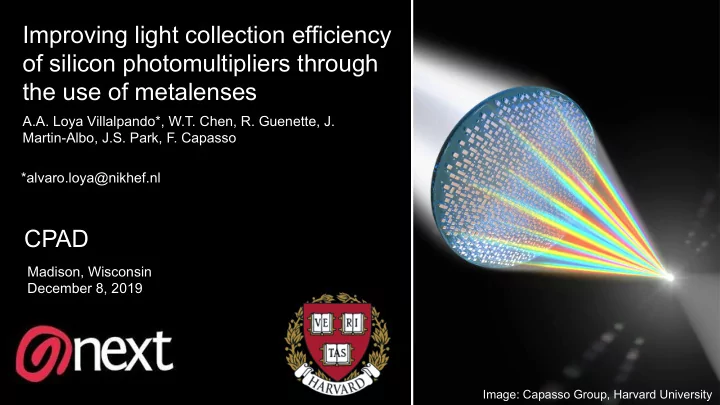
Improving light collection efficiency of silicon photomultipliers through the use of metalenses A.A. Loya Villalpando*, W.T. Chen, R. Guenette, J. Martin-Albo, J.S. Park, F. Capasso *alvaro.loya@nikhef.nl CPAD Madison, Wisconsin December 8,


slide-1
SLIDE 1

Improving light collection efficiency

  • f silicon photomultipliers through

the use of metalenses

A.A. Loya Villalpando*, W.T. Chen, R. Guenette, J. Martin-Albo, J.S. Park, F. Capasso Madison, Wisconsin December 8, 2019

CPAD

Image: Capasso Group, Harvard University

*alvaro.loya@nikhef.nl

slide-2
SLIDE 2

A.A. Loya Villalpando CPAD 2019 1

Outline

➢ Motivation ○ SiPM coverage in particle detectors ➢ Metalenses ○ introduction - what and why ○ working principle ➢ SiPMs with metalenses ○ experimental design ○ beam profiling and metalens efficiency ➢ Results and Outlook

slide-3
SLIDE 3

A.A. Loya Villalpando CPAD 2019 2

Motivation

slide-4
SLIDE 4

A.A. Loya Villalpando CPAD 2019 3

Particle detectors with SiPMs

  • Many experiments could benefit from increase in light collection by SiPMs

○ 0𝛏ββ, dark matter, event neutrino, etc.

DarkSide-20k

  • G. Giovanetti, CPAD 2018

arXiv:1806.02220

nEXO NEXT

arXiv:11307.3914

DARWIN

DARWIN Collaboration

slide-5
SLIDE 5

A.A. Loya Villalpando CPAD 2019 4

Light collection of SiPMs

Why SiPMs?

  • single p.e. resolution
  • low voltage + high gain
  • compact (radiopurity)
  • improving VUV sensitivity

Why fewer/smaller SiPMs?

  • cost
  • simpler electronics
  • fewer readout channels
  • recycle existing infrastructure

Why increase light collection of SiPMs?

  • track/position reconstruction
  • energy resolution/ threshold
  • trigger efficiency

~ 1% area coverage by SiPMs in NEXT

slide-6
SLIDE 6

A.A. Loya Villalpando CPAD 2019 5

Metalenses

slide-7
SLIDE 7

A.A. Loya Villalpando CPAD 2019 6

What are Metalenses?

  • multifocal diffractive lenses
  • ptimized for specific/ multiple wavelength(s)
  • nanostructures on thin substrate

Images: Khorasaninejad et al., Science 352, 6290 (2016) SEM image of nanofins (metasurfaces)

  • ptical image of single metalens

schematic of metalens nanostructures

click here for a video introduction!

slide-8
SLIDE 8

A.A. Loya Villalpando CPAD 2019 7

Why use metalenses?

Advantages

  • low cost

○ currently < $10 each ○ smaller SiPM + metalens < larger sipm (3 to 5X)

  • compact

○ radiopurity ○ simple mechanical integration

  • simple fabrication

○ single layer lithography ○ mass production ok Potential applications

  • replacement of refractive lenses
  • particle detectors!

array of 1 cm diameter metalenses λd = 632 nm (this work)

slide-9
SLIDE 9

A.A. Loya Villalpando CPAD 2019 8

Light diffraction by metalenses

1 2 3 …………………..11 Orders: … 3rd 2nd 1st 0th 1…………………………………....... 2…………………….... 3……………........ 4………..…... . . . . 11.. 0th 1st 2nd 3rd diffraction order projections

single metalens

increasing deflection angle

Further details: Yu et al., Science 334, 333 (2011)

. . . .

slide-10
SLIDE 10

A.A. Loya Villalpando CPAD 2019 9

Light focused by metalenses

metalens 0th order ( ~ 20% eff) 1st order (~ 38% eff) 2nd order (~15% eff) 3rd order (~ 5% eff) incident light

*

* efficiency and location of foci by design - adjustable

slide-11
SLIDE 11

A.A. Loya Villalpando CPAD 2019 10

SiPMs with Metalenses

slide-12
SLIDE 12

A.A. Loya Villalpando CPAD 2019 11

Concept & questions

incident light metalens array

  • concept

○ large photodetection area coverage by metalenses projected onto (small) SiPMs

  • questions

  • ptimal SiPM location?

○ dependence on SiPM size? ○ how much can the light collection be increased? ○ what influences this increase? ○ what is the light transmission efficiency of the metalenes?

SiPM behind each metalens

slide-13
SLIDE 13

A.A. Loya Villalpando CPAD 2019 12

Experimental design

  • 1.3 x 1.3, 3 x 3 and 6 x 6 mm2 SiPMs (Hamamatsu S13370)
  • signal as a function of distance from the metalens location

○ with and without metalens in place

LED metalenses SiPM ΔZ more focused 1st order focal point less focused

slide-14
SLIDE 14

A.A. Loya Villalpando CPAD 2019 13

SiPMs’ signals

SiPM signals with metalens SiPM signals without metalens

  • signal shape with metalens

○ projected beam profile + metalens efficiency

  • signal shape without metalens

○ 1/r2 dependence

slide-15
SLIDE 15

A.A. Loya Villalpando CPAD 2019 14

Signal shape with metalenses

D B A C E

A B C D E F

F

signal (beam diameter, intensity) SiPM

slide-16
SLIDE 16

A.A. Loya Villalpando CPAD 2019 15

Beam profiling

LED metalenses profiler ΔZ

beam width y (𝞶m) beam width x (𝞶m)

  • Thorlabs BP209

○ beam width ( > 13.5% of max intensity) x-profile y-profile

slide-17
SLIDE 17

A.A. Loya Villalpando CPAD 2019 16

Signal shape and beam width

measured beam width

1st

  • rder

2nd

  • rder

3rd

  • rder

1st

  • rder

2nd

  • rder

3rd

  • rder

SiPM signal with metalens

slide-18
SLIDE 18

A.A. Loya Villalpando CPAD 2019 17

Metalens efficiency measurements

power detector metalenses red laser Δ Z normal incidence efficiency

  • 10 mm diameter beam, variable

aperture power detector

  • measure transmitted power as a

function of distance from the metalens angular efficiency

  • 2 mm diameter beam centered on

metalens, 10 mm aperture power detector fixed at 5mm from metalens

  • measure transmitted power as a

function of metalens rotation angle rotation stage P through metalens Pat metalens

ε =

slide-19
SLIDE 19

A.A. Loya Villalpando CPAD 2019 18

Linear efficiency results

normal incidence efficiency

  • consequence of combined foci contributions

incident light “large” power detector aperture metalens ΔZ “small” power detector aperture metalens area 6 mm SiPM 3 mm SiPM 1.3 mm SiPM

slide-20
SLIDE 20

A.A. Loya Villalpando CPAD 2019 19

Angular efficiency results

angular efficiency

ε = 59 ± 1 %

metalens power detector laser

0o 20o 45o

  • Finite Distance Time Doming (FDTD)

simulation in progress

slide-21
SLIDE 21

A.A. Loya Villalpando CPAD 2019 20

Signal increase

  • signal multiplication factor = signal

with metalens divided by signal without metalens

  • signal increase improves with

decreasing SiPM area ○ increased area coverage (metalens area/ SiPM area)

6-7X signal increase for smallest SiPM!

slide-22
SLIDE 22

A.A. Loya Villalpando CPAD 2019 21

Conclusions and outlook

Outlook

  • Detector optimization/ implementation

○ size/shape of metalenses ○ location and spacing of metalenses and SiPMs ○ saturation effects ○ low temperature performance

  • Design and fabrication of metalenses

○ VUV ( currently down to ~260 nm, wavelength shifting substrate, other nanomaterials) ○ converging foci to maximize light collection Conclusions

  • Increasing light collection would

benefit several experiments

  • Metalenses are a practical and

cost-effective solution

  • Metalenses are most effective

when coupled with SiPMs of small active area, providing an increase of 6-7X in light collection at ~630 nm ○ similar expected at ~430 nm

slide-23
SLIDE 23

A.A. Loya Villalpando CPAD 2019 bonus

Bonus Material

slide-24
SLIDE 24

Metalens Equations

A.A. Loya Villalpando CPAD 2019 bonus

Φ = 𝜚 = phase profile 𝜄N = deflection angle of N order f = focal point N; N = 1,2,3,.. λd = design wavelength p = local periodicity on metalens

Further details: Yu et al., Science 334, 333 (2011)

slide-25
SLIDE 25

Local periodicity of metalens

periodicity

𝞭p 𝝱 1

increasing deflection angle A.A. Loya Villalpando CPAD 2019 bonus

slide-26
SLIDE 26

SEM image of nanofins with 11um periodicity

A.A. Loya Villalpando CPAD 2019 bonus

Image: Yu et al., Science 334, 333 (2011)

slide-27
SLIDE 27

A.A. Loya Villalpando CPAD 2019 bonus

Metalens vs ordinary lenses

Image: roadtovr.com

Image: Laptop Media

slide-28
SLIDE 28

Projected beam ellipticity

A.A. Loya Villalpando CPAD 2019 bonus

slide-29
SLIDE 29

Signal increase dividing all signals with metalens by signal without metalens at metalens location

A.A. Loya Villalpando CPAD 2019 bonus

slide-30
SLIDE 30

Light focused by metalenses

metalens 0th order ( ~ 20% eff) 1st order (~ 38% eff) 2nd order (~15% eff) 3rd order (~ 5% eff) incident light

*

* efficiency and location of foci by design - adjustable A.A. Loya Villalpando CPAD 2019 bonus