Potential & Field Potential & Field Chapter 30. Reading - - PowerPoint PPT Presentation

potential field potential field
SMART_READER_LITE
LIVE PREVIEW

Potential & Field Potential & Field Chapter 30. Reading - - PowerPoint PPT Presentation

Chapter 30 Potential & Field Potential & Field Chapter 30. Reading Quizzes Chapter 30. Reading Quizzes 2 1 What quantity is represented by What quantity is represented by the symbol ? the symbol ? A. Electronic potential A.


slide-1
SLIDE 1

Potential & Field

Chapter 30

1

Potential & Field

Chapter 30. Reading Quizzes Chapter 30. Reading Quizzes

2

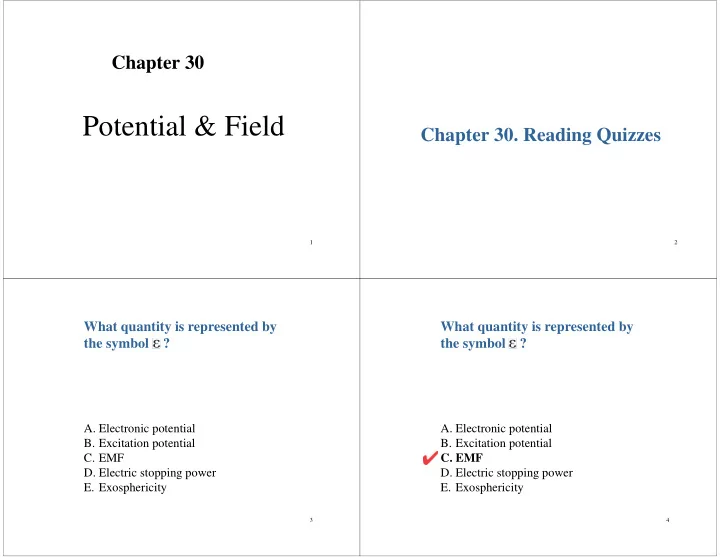
What quantity is represented by the symbol ?

  • A. Electronic potential
  • B. Excitation potential
  • C. EMF
  • D. Electric stopping power
  • E. Exosphericity

3

What quantity is represented by the symbol ?

  • A. Electronic potential
  • B. Excitation potential
  • C. EMF
  • D. Electric stopping power
  • E. Exosphericity

4

slide-2
SLIDE 2

What is the SI unit of capacitance?

  • A. Capaciton
  • A. Capaciton
  • B. Faraday
  • C. Hertz
  • D. Henry
  • E. Exciton

5

What is the SI unit of capacitance?

  • A. Capaciton
  • A. Capaciton
  • B. Faraday
  • C. Hertz
  • D. Henry
  • E. Exciton

6

The electric field

  • A. is always perpendicular to an

equipotential surface.

  • B. is always tangent to an

equipotential surface.

  • C. always bisects an equipotential

surface.

  • D. makes an angle to an equipotential

surface that depends on the amount

  • f charge.

7

The electric field

  • A. is always perpendicular to an

equipotential surface.

  • B. is always tangent to an

equipotential surface.

  • C. always bisects an equipotential

surface.

  • D. makes an angle to an equipotential

surface that depends on the amount

  • f charge.

8

slide-3
SLIDE 3

This chapter investigated

  • A. parallel capacitors
  • A. parallel capacitors
  • B. perpendicular capacitors
  • C. series capacitors.
  • D. Both a and b.
  • E. Both a and c.

9

This chapter investigated

  • A. parallel capacitors
  • A. parallel capacitors
  • B. perpendicular capacitors
  • C. series capacitors.
  • D. Both a and b.
  • E. Both a and c.

10

Connecting Potential and Field

11

Finding Electric Field from Potential and Vice Versa

12

slide-4
SLIDE 4

Finding the Electric Field from the Potential

In terms of the potential, the component of the electric field in the s-direction is Now we have reversed Equation 30.3 and have a way to find the electric field from the potential.

EXAMPLE 30.4 Finding E from the slope of V

QUESTION:

EXAMPLE 30.4 Finding E from the slope of V EXAMPLE 30.4 Finding E from the slope of V

slide-5
SLIDE 5

EXAMPLE 30.4 Finding E from the slope of V EXAMPLE 30.4 Finding E from the slope of V EXAMPLE 30.4 Finding E from the slope of V

20

slide-6
SLIDE 6

Batteries and emf

The potential difference between the terminals of an ideal battery is In other words, a battery constructed to have an emf of 1.5V creates a 1.5 V potential difference between its positive and negative terminals. The total potential difference of batteries in series is simply the sum of their individual terminal voltages:

21

Kirchoff’s Laws

  • =
  • ut

in

I I

  • 1. Junction Law. Net current at a junction is zero

(Conservation of Charge)

22

  • 1. Loop Law. The sum of all potential differences around a

closed path is zero (Conservation of Energy)

Potential and Current

where R = L/A

23

where R = L/A

Electrical Circuit

A circuit diagram is a simplified

representation of an actual circuit Circuit symbols are used to represent the various elements Lines are used to represent wires The battery’s positive terminal is

24

indicated by the longer line

slide-7
SLIDE 7

Electrical Circuit

25

+ − + − + − + −

Conducting wires. In equilibrium all the points of the wires have the same potential

Electrical Circuit

+ − + − The battery is characterized by the voltage – the potential difference between the contacts of the battery In equilibrium this potential difference is equal to the potential difference between the plates of the capacitor. V ∆

26

V ∆ capacitor. Then the charge of the capacitor is Q C V = ∆ If we disconnect the capacitor from the battery the capacitor will still have the charge Q and potential difference V ∆ + − V ∆

Electrical Circuit

+ − + − V ∆ Q C V = ∆ If we connect the wires the charge will disappear + − V ∆

27

V ∆ If we connect the wires the charge will disappear and there will be no potential difference V ∆ =

Capacitors in Parallel

+ − V ∆ + − V ∆

1

C

2

C

28

+ − V ∆

All the points have the same potential All the points have the same potential The capacitors 1 and 2 have the same potential difference

V ∆

Then the charge of capacitor 1 is

1 1

Q C V = ∆

The charge of capacitor 2 is

2 2

Q C V = ∆

slide-8
SLIDE 8

Capacitors in Parallel

+ − V ∆ + − V ∆

1

C

2

C

The total charge is

1 1

Q C V = ∆

2 2

Q C V = ∆

1 2

Q Q Q = +

1 2 1 2

( ) Q C V C V C C V = ∆ + ∆ = + ∆

29

+ − V ∆

eq

Q C V = ∆

This relation is equivalent to the following one

1 2 eq

C C C = + + − + −

eq

C

Capacitors in Parallel

The capacitors can be replaced with

  • ne capacitor with a capacitance of

The equivalent capacitor must have exactly the same external effect on the circuit as the original capacitors

eq

C

30

eq

Q C V = ∆

Capacitors

31

+ − + − V ∆

eq

Q C V = ∆

The equivalence means that

Capacitors in Series

+ −

1

V ∆ + −

2

V ∆

1

C

2

C

32

+ − V ∆

1

C

1 2

V V V ∆ = ∆ + ∆

slide-9
SLIDE 9

Capacitors in Series

+ −

1

V ∆ + −

2

V ∆ C

1 2 1 2

Q Q V V V C C ∆ = ∆ + ∆ = +

The total charge is equal to 0

1 2

Q Q Q = =

1 1

Q C V = ∆

2 2

Q C V = ∆

33

+ − V ∆

1

C

2

C

eq

Q V C ∆ =

1 2

1 1 1

eq

C C C = +

1 2 1 2 eq

C C C C C = +

Capacitors in Series

An equivalent capacitor can be found that performs the same function as the series combination The potential differences add up to the battery voltage

34

Quiz: Find the equivalent capacitance for the circuit.

in parallel

1 2

1 3 4

eq

C C C = + = + = 6 C C C = + = 35

in parallel

1 2

8

eq

C C C = + =

in series

1 2 1 2

8 8 4 8 8

eq

C C C C C ⋅ = = = + +

in parallel

1 2

6

eq

C C C = + =

Example

in parallel

1 2

1 3 4

eq

C C C = + = + = 6 C C C = + = 36

in parallel

1 2

8

eq

C C C = + =

in series

1 2 1 2

8 8 4 8 8

eq

C C C C C ⋅ = = = + +

in parallel

1 2

6

eq

C C C = + =

slide-10
SLIDE 10

Q C V = ∆

37

Quiz: what are the charges stored?

38 39

Assume the capacitor is being charged and, at some point, has a charge q on it The work needed to transfer a small charge from one plate to the other is equal to the change of potential energy

Energy Stored in a Capacitor

q A

q ∆

40

If the final charge of the capacitor is Q, then the total work required is

q − B

q dW Vdq dq C = ∆ =

2

2

Q q

Q W dq C C = =

slide-11
SLIDE 11

The work done in charging the capacitor is equal to the electric potential energy U of a capacitor

Energy Stored in a Capacitor

Q

2

2

Q q

Q W dq C C = =

  • Q

C V = ∆

41

This applies to a capacitor of any geometry

Q −

2 2

1 1 ( ) 2 2 2 Q U Q V C V C = = ∆ = ∆

One of the main application of capacitor:

capacitors act as energy reservoirs that can be

slowly charged and then discharged quickly to

Energy Stored in a Capacitor: Application

2 2

1 1 ( ) 2 2 2 Q U Q V C V C = = ∆ = ∆

42

provide large amounts of energy in a short pulse

Q Q −

Q C V = ∆

43

The Energy in the Electric Field

The energy density of an electric field, such as the one inside a capacitor, is The energy density has units J/m3.

44

slide-12
SLIDE 12

45

Dielectrics

  • The dielectric constant, like density or specific heat, is a

property of a material.

  • Easily polarized materials have larger dielectric constants

than materials not easily polarized.

  • Vacuum has = 1 exactly.
  • Vacuum has = 1 exactly.
  • Filling a capacitor with a dielectric increases the

capacitance by a factor equal to the dielectric constant.

46

Chapter 30. Summary Slides Chapter 30. Summary Slides General Principles

slide-13
SLIDE 13

General Principles General Principles Important Concepts Important Concepts

slide-14
SLIDE 14

Applications Applications Chapter 30. Questions Chapter 30. Questions

What total potential difference is created by these three batteries?

  • A. 1.0 V
  • B. 2.0 V
  • C. 5.0 V
  • D. 6.0 V
  • E. 7.0 V
slide-15
SLIDE 15

What total potential difference is created by these three batteries?

  • A. 1.0 V
  • B. 2.0 V
  • C. 5.0 V
  • D. 6.0 V
  • E. 7.0 V

Which potential-energy graph describes this electric field? Which potential-energy graph describes this electric field? Which set of equipotential surfaces matches this electric field?

slide-16
SLIDE 16

Which set of equipotential surfaces matches this electric field?

Three charged, metal spheres of different radii are connected by a thin metal wire. The potential and electric field at the surface of each sphere are V and E. Which of the following is true?

  • A. V1 = V2 = V3 and E1 > E2 > E3
  • B. V1 > V2 > V3 and E1 = E2 = E3
  • C. V1 = V2 = V3 and E1 = E2 = E3
  • D. V1 > V2 > V3 and E1 > E2 > E3
  • E. V3 > V2 > V1 and E1 = E2 = E3

the following is true? Three charged, metal spheres of different radii are connected by a thin metal wire. The potential and electric field at the surface of each sphere are V and E. Which of the following is true?

  • A. V1 = V2 = V3 and E1 > E2 > E3
  • B. V1 > V2 > V3 and E1 = E2 = E3
  • C. V1 = V2 = V3 and E1 = E2 = E3
  • D. V1 > V2 > V3 and E1 > E2 > E3
  • E. V3 > V2 > V1 and E1 = E2 = E3

the following is true?

Rank in order, from largest to smallest, the equivalent capacitance (Ceq)a to (Ceq)d of circuits a to d.

  • A. (Ceq)d > (Ceq)b > (Ceq)a > (Ceq)c
  • B. (Ceq)d > (Ceq)b = (Ceq)c > (Ceq)a
  • C. (Ceq)a > (Ceq)b = (Ceq)c > (Ceq)d
  • D. (Ceq)b > (Ceq)a = (Ceq)d > (Ceq)c
  • E. (Ceq)c > (Ceq)a = (Ceq)d > (Ceq)b
slide-17
SLIDE 17

Rank in order, from largest to smallest, the

  • A. (Ceq)d > (Ceq)b > (Ceq)a > (Ceq)c
  • B. (Ceq)d > (Ceq)b = (Ceq)c > (Ceq)a
  • C. (Ceq)a > (Ceq)b = (Ceq)c > (Ceq)d
  • D. (Ceq)b > (Ceq)a = (Ceq)d > (Ceq)c
  • E. (Ceq)c > (Ceq)a = (Ceq)d > (Ceq)b

equivalent capacitance (Ceq)a to (Ceq)d of circuits a to d.