
SLIDE 1
/ 31-Oct-18 1
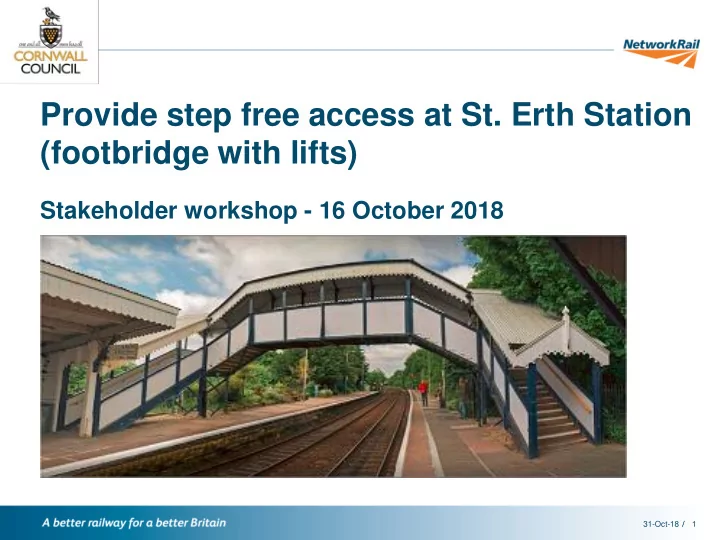
Provide step free access at St. Erth Station (footbridge with lifts) - - PowerPoint PPT Presentation
Provide step free access at St. Erth Station (footbridge with lifts) Stakeholder workshop - 16 October 2018 31-Oct-18 / 1 Agenda Start time Topic Leading 11:00-11:10 Welcome and introductions Facilitator 11:10-11:35 Setting the scene
/ 31-Oct-18 1
/
31-Oct-18 2
Start time Topic Leading 11:00-11:10 Welcome and introductions Facilitator 11:10-11:35 Setting the scene Sponsor & Client & Contractor 11:35-12:05 GRIP 3 options Contractor & DPE 12:05-12:35 Lunch 12:35-13:50 Discussion about options and finishes Facilitator 13:50-14:05 Short break 14:05-14:50 Decide option to take forward and finishes to be explored for next workshop Facilitator 14:50-15:00 Next steps Sponsor & Client
/
31-Oct-18 3
/ 31-Oct-18 4
/
The station building and the footbridge at St. Erth station are listed. The footbridge doesn’t offer step-free access. Wheelchair users have to travel to Penzance and return to St. Erth in order to change
31-Oct-18 5
The size of the footbridge is not adequate for the large numbers of people who use the station during the summer. Crowding occurs at the bottom of the stairs; this poses safety concerns and affects passenger experience. The footbridge also limits the development of the railway. A solution must be found to improve accessibility and passenger experience and to increase
/
31-Oct-18 6
/ Presentation Title: View > Header & Footer 31-Oct-18 7
➢ To develop options for a footbridge with lifts and stairs at St. Erth Station aiming to get Listed Building Consent to replace the current Grade II listed footbridge ➢ To select the option to progress to Approval in Principle design and Listed Building Consent (full GRIP 4) ➢ To support the case for the introduction
Access for All programme for CP6. Announcement of list for AfA funding is expected by April 2019 The development phase for the footbridge project is funded by Cornwall Council.
/
31-Oct-18 8
/ Presentation Title: View > Header & Footer 9
/ Presentation Title: View > Header & Footer 10
/ Presentation Title: View > Header & Footer 11
➢ Built c.1852 in the Third phase of national railway development ➢ Station building and terminus platforms at the east (NE) of the station are original. The station stopped just west of the building’s frontage with a level crossing close to where the bridge is now. ➢ Between 1888 and 1908 the original platform was extended south, the wrought iron framed bridge was built and Treloweth Lane was diverted under a railway
to the north. The south platform and stone hut were also built at the same time. ➢ Between 1908 and 1936 the two platform canopies nearest the bridge were built in a sympathetic simple style, largely in timber, with some ironwork. ➢ Recently the small stone and timber faced building east (NE) of the station building was added. ➢ The main platforms remain relatively unaltered since the 1930s. ➢ The setting has changed dramatically over time, with views of the bridge from the north now filtered through tree screening and the former marshalling yard to the north removed
/
➢ Fairly intact surviving example of a modest station, of the Third phase, that developed in the mid-19th to early 20th century ➢ Changing station orientation, platforms and buildings were added as needed and tell the story of the phased development of the station and its changing uses/needs over time ➢ Functional single storey rock faced granite and slate roofed buildings, with lightweight simple largely timber canopies and simple framed bridge-in the lightweight elements the structure is visible. ➢ Throughout its development the materials have been the standard materials of their period, used simply, with
cast iron and timber in 1850s, wrought iron and timber 1888-1908, and iron/steel and timber post 1908).
31-Oct-18 12
/
➢ Structures are relatively functional and structure is legible and lightweight-except the main station building makes a statement through its arched openings and solid construction. ➢ The fascias of the railway canopies and bridge with vertical boarding and decoration are characteristic of railway canopies and unify the design, thus making the structures legible as railway structures. ➢ The chamfered timber of the platform canopies also provides unifying character. ➢ Ironwork is painted a consistent colour, further unifying the design. ➢ The existing bridge is large compared with the earlier structures, but its lightweight nature and contrasting construction make it subordinate to the rest of the station, which has been designed to harmonise with its mid-19th century features.
31-Oct-18 13
/
31-Oct-18 14
/ Presentation Title: View > Header & Footer 15
Subway ➢ Discarded due to high cost, suitability of ramps for disabled people (due to difference in levels, several turns required); sense of security Walkaround ➢ Route out of the station, under the bridge. Gradients not suitable for disabled people; to provide acceptable footpath width, the road under the bridge needed to be narrowed, impacting traffic. Connection to platforms either side of road underbridge from Station Road ➢ This was proposed to access the footway under the road bridge with ramps approx. running parallel to the railway. Gradients too
railway, as construction required structures to support the rail line.
/ Presentation Title: View > Header & Footer 16
Footbridge options which didn’t get Listed Building Consent Footbridge with ramps (2013): mass and balance would be unacceptable for this location Footbridge with lifts (2014): reduced the mass by replacing the ramps with a lift.
/ Presentation Title: View > Header & Footer 17
Other footbridge options which were discarded (as discussed at stakeholder meeting July 2016) ➢ Option 1 - Do nothing – retain the current footbridge; it will not resolve the pressing issue of providing access for all at the station. Rejected ➢ Option 2 – East end of platform, lift only footbridge & retain current footbridge ➢ Option 3 – East end of platform, lift and stairs footbridge and removal of existing structure Both Option 2 & 3 were rejected. Due to differences in levels, to land the bridge on P3 would require the removal of railings which separate St Ives branch line from the main line platform. P3 will need to increase in height and it will not be possible to align it with the building or the existing canopies. Safety concerns about operation; links to station and car parks; signal sighting concerns.
/ Presentation Title: View > Header & Footer 18
Other footbridge options which were discarded (as discussed at stakeholder meeting July 2016) ➢ Option 4 – West end of platform – lift only footbridge behind existing - Rejected ➢ Option 5 – West end of platform – lift and stairs footbridge to replace the existing structure – Agreed to be taken forward
Option 4 - Concerns about how the station would look if the existing bridge was left in place and another one located behind it; concerns that the current footbridge will eventually need to be replaced – and this will mean a disconnect between the station area and the new footbridge; costs for maintaining two structures. One structure will be more aesthetically pleasing. OPTION 5 – Replace the existing structure with a footbridge provided with both lifts and stairs: this was the option which was agreed to be progressed. ➢ A series of design principles were identified to reduce visual intrusion ➢ Stakeholder consultation was seen as the key for the success of a new attempt to get Listed Building Consent. ➢ Participants opted for a modern, light structure – not pastiche and not a replica.
/ Presentation Title: View > Header & Footer 19
# Accessible Footbridge Design Requirements 1 A bridge with 2.7m wide stairs (including handrails) and a deck with 2.5m clear width should be provided. 2 A lift with 3.8m2 of floor space will have sufficient capacity to accommodate demand efficiently. It will provide capacity for up to 9 passengers at a reasonable level of comfort, compared to 6 passengers in a lift with a 2.6m2 floor space (assumed for an NR 16-person plated capacity lift). It will also be more help to reduce delay for passengers if the lift serves both the platform and South Car Park. 3 Ideally the lift should be located alongside the stairs at platform level to increase its visibility. If this is not possible, it should be positioned behind the stairs to maximise run-off space. If located to serve the car park level in the new Multi- Modal Hub southern car park, this would enable lift users to have a more direct journey between the South Car Park and Platform 2 and 3. 4 Canopied lift waiting areas providing 3.8 m2 space should be located clear of the platform edges and stair run-offs. 5 Clear, adequately sized run-offs should be provided at the base of the stairs, as a minimum, a run-off of at least 4m should be provided. Ideally the stairs should be positioned so as to reduce the amount of queuing occurring towards the edges of the platforms. Relocating the ramped entrance onto P2 away from the run-off area will also reduce the conflict between passengers using the entrance and those using the footbridge. 6 Lift should lead from the South Car Park to both platform and deck level.
Following the recordings over a few days in August 2018 of pedestrian flows at St. Erth Station and Lelant Saltings, a pedestrian flow analysis report produced by NR made the following recommendations:
These will be discussed in the afternoon.
/ 31-Oct-18 20
/ Presentation Title: View > Header & Footer 21
/ Presentation Title: View > Header & Footer 22
/ Presentation Title: View > Header & Footer 23
/ Presentation Title: View > Header & Footer 24
/ Presentation Title: View > Header & Footer 25
/ Presentation Title: View > Header & Footer 26
/ Presentation Title: View > Header & Footer 27
/ Presentation Title: View > Header & Footer 28
/ Presentation Title: View > Header & Footer 29
/ Presentation Title: View > Header & Footer 30
Local Stone/ Granite Slate Glazing Coated Metal Cladding Uncoated Metal Cladding Cladding Panels Sample Advantages
Disadvantages
/ 31-Oct-18 31
/ Presentation Title: View > Header & Footer 32
/ 31-Oct-18 33
/ 31-Oct-18 34