
SLIDE 1
Step by step guide Step 1: Purchasing a RSTickets!Pro membership - - PDF document
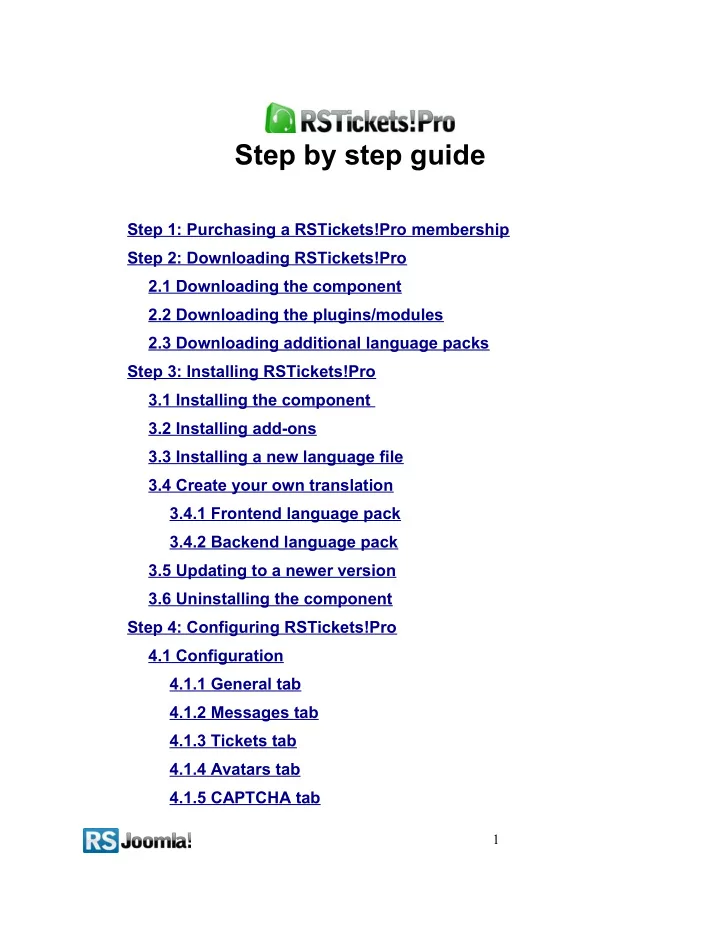
Step by step guide Step 1: Purchasing a RSTickets!Pro membership Step 2: Downloading RSTickets!Pro 2.1 Downloading the component 2.2 Downloading the plugins/modules 2.3 Downloading additional language packs Step 3: Installing RSTickets!Pro
When you purchase a membership for the first time, a RSJoomla! account is automatically created for unregistered users, after the purchase has been approved, based on the filled in
After purchasing a license, users have 2 means of accessing the www.rsjoomla.com account and download RSTickets!Pro: 1. Log in with the user and password automatically created and sent through email during the transaction process, using the Customer Login form. 2. Log in with the order number received on the user email.
In order to download RSTickets!Pro you will need to:
○ log in on www.rsjoomla.com with the user details or the order number received by email; ○ in the right side, you will find a section dedicated to RSJoomla! customers: Customer Login, click on View my downloads; ○ all the user’s memberships are listed in the Customer downloads section, click
RSTickets!Pro for Joomla 1.5
There are three plugins available for RSTickets!Pro: ○ Cron Plugin : you can use this plugin in order to create and reply to tickets through emails sent to a pre-configured email address; ○ Reports Plugin : this plugin allows you to create different reports from your tickets database; ○ Import Plugin : you can import your tickets and settings from RSTickets! into RSTickets!Pro with this plugin. The Import plugin is included in the RSTickets!Pro license cost, you do not need to pay anything extra in order to use it. The remaining plugins need to be purchased separately in
by clicking the Purchase this link from the Membership extra field. After the purchase is completed you will be able to download them by going to View my downloads >> Downloads >> RSTickets!Pro Cron or RSTickets!Pro Reports.
If you own a multi-language site, you can download the available RSTickets!Pro translations (language packs) from View my downloads >> Downloads >> RSTickets!Pro Files >> Languages You can also create your own translation of RSTickets!Pro by following the instructions from the step 3.4 Create your own translation
RSTickets!Pro is installed like any other component, from the default Joomla! installer. In the back-end panel, just go to Extensions >> Install/Uninstall, browse to the component install file on your PC and click Upload File&Install.
All the RSTickets!Pro add-ons are installed through the default Joomla! installer as well, just go to Extensions > Install/Uninstall, browse to the plugin install file on your PC and click Upload File&Install.
You can install additional language files for RSTickets!Pro exactly the same way that you installed the component, trough the default Joomla! installer (see the above screenshot). Please note that, in order to be able to use these language files you have to previously install the according Joomla! language pack for frontend and backend. 1. Install the Joomla language pack (if you don’t have them already installed):
http://community.joomla.org/translations.html and choose the desired language pack;
installer): in the backend panel head to Extensions >> Install/Uninstall >> Browse the Joomla! language files >> Upload e.g. If you want to use the RSTickets!Pro Dutch translation, first of all install the Dutch Joomla! language packs for frontend and backend: nl- NL_joomla_lang_site.1.5.20.zip nl- NL_joomla_lang_admin.1.5.20.zip 2. Install the RSTickets!Pro languages pack: (through the Joomla! installer)
Customer Downloads (see Step 2.3 Downloading additional language packs)
the RSTickets!Pro language files >> Upload
To create a new site (front-end) language pack, follow these steps: 1. Download the English administration (front-end) example language pack listed in your download files. 2. Unzip the file. 3. Edit the install.xml file and apply the changes accordingly. 4. Edit and translate the en-EN.com_rsticketspro.ini file. Note that will also have to rename the file according to the adjustment made in the XML file.
To create a new administrator (back-end) language pack, follow these steps: 1. Download the English administration (back-end) example language pack listed in your download files. 2. Unzip the file. 3. Edit the install.xml file and apply the changes accordingly. 4. Edit and translate the en-EN.com_rsticketspro.ini file. Note that will also have to rename the file according to the adjustment made in the XML file. Notice:
you choose not to use HTML codes for your UTF-8 characters, please make sure that you save the file with UTF-8 no BOM encoding.
Keeping your component up to date is essential to it’s overall functionality. You can check the component version that you are using by going to Components >> RSTickets!Pro, you will be able to see the revision number on the right side of the screen, above the component logo. You can check if a new update is available for your component by going to Components >> RSTickets!Pro >> Updates. You will need a valid license code to be able to search for any available updates. In order to retrieve the license code for your component you will have to register your domain on www.rsjoomla.com. To do this, you simply need to log in with your purchase user, go to View my downloads >> Licenses >> Please specify a domain first, enter your domain and click Save. The license code will be available when you return to the Licenses page, just copy this code in your Joomla! administrative panel Components >> RSTickets!Pro >> Please enter your license code to receive updates.
If an update is found, you will need to follow the Click here to download the update link, download the update file, return to your Joomla! administrative panel Extensions >> Install/Uninstall, browse to your downloaded file and click Upload File&Install.
In order to uninstall RSTickets!Pro you will need to go to Extensions >> Install/Uninstall >> Components, select the component from the list and click Uninstall. If you encounter any problems when uninstalling RSTickets!Pro from the default Joomla! installer you can also perform a manual uninstall by following these instructions: 1. Locate your Joomla! /administrator/components/ folder. Delete the folder named com_rsticketspro. 2. Connect to your MySQL database and remove all of the _rsticketspro tables. For example, if your Joomla! database prefix is "jos", remove all tables that start with jos_rsticketspro. For instance, you can use this SQL script: DROP TABLE `jos_rsticketspro_configuration`, `jos_rsticketspro_custom_fields`, `jos_rsticketspro_custom_fields_values`, `jos_rsticketspro_departments`, `jos_rsticketspro_emails`, `jos_rsticketspro_groups`, `jos_rsticketspro_kb_categories`, `jos_rsticketspro_kb_content`, `jos_rsticketspro_priorities`, `jos_rsticketspro_searches`, `jos_rsticketspro_staff`, `jos_rsticketspro_staff_to_department`, `jos_rsticketspro_statuses`, `jos_rsticketspro_tickets`, `jos_rsticketspro_ticket_files`, `jos_rsticketspro_ticket_history`, `jos_rsticketspro_ticket_messages`, `jos_rsticketspro_ticket_notes` 3. Browse the _components table. Delete all records that have the value com_rsticketspro in the option column. For instance, use this SQL script: DELETE FROM `jos_components` WHERE `option`='com_rsticketspro'
The general behavior of the RSTickets!Pro component can be configured from here. To facilitate component management, the configuration area is divided into eight tabs: General, Messages, Tickets, Avatars, Captcha, Email, Autoclose and Plugins.
a valid license key in the Please enter your license code to receive updates field;
display the time. It uses the standard PHP date masks ;
time portion. Setting this field can enable a separate mask for displaying the time;
will be displayed below the main pages of RSTickets!Pro; Use the Joomla! editor for writing messages: if enabled, all RSTickets!Pro message boxes will display a WYSIWYG editor.
Global Message : RSTickets!Pro allows you to set a message that will be displayed on all RSTickets!Pro pages. This can be used to announce support time schedule, or other useful information. Submit Message : this message will be displayed on the submit ticket page. This can be used to advice the user to first use search through your FAQ area for example.
between a tabbed (the ticket information will be displayed on a separate tab) or plain (the ticket information will be displayed on the same page as the ticket message) version;
customers information;
want to display on the ticket message page, you can choose between the user’s name, username or email;
you have selected in the previous field;
rate it on a scale from 1 to 5, this is a good way of receiving feedback on your customer support service;
closed tickets instead of submitting a new ticket; Ticket Viewing History: if you enable this feature each time a person opens the content of the ticket, this action will be recorded in a history log.
asscending or descending;
be recorded in a history log;
priority, the whole ticket will have its background and foreground colored;
subjects instead of having your customers input their subject in a textbox;
he spent on a ticket;
the avatars from a different component in RSTickets!Pro, you can choose between: Gravatar, Community Builder, JomSocial, Kurena, Fireboard.
your submit ticket form and also select if you want to use a built-in CAPTCHA field or use reCAPTCHA;
Unregistered, Customers or Staff. This is done from the Display CAPTCHA for field;
specific algorithms. This settings helps prevent this from happening by decreasing the spam bots chance of identifying the correct pattern;
into consideration or not when validating the input;
submit ticket form, you will need to enter the public key you have retrieved from the reCAPTCHA site in this field for the validation to function properly;
ensures the functionality of the reCAPTCHA field, this key is also retrieved from the reCAPTCHA site;
your template.
settings for RSTickets!Pro from the Use Joomla! Global Configuration field;
address in the From Email Address field;
message.
when your customer clicks on email links.
can use it to keep the same page style (along with assigned modules) when your staff clicks on email links.
become eligible for autoclosing. It will not be automatically closed until a notification message is sent;
how often should RSTickets!Pro check for tickets that are eligible for autoclosing;.
into autoclosing status if it has no activity;
that will pass until the ticket is closed after the notification message is sent.
The Notices is particularly useful when you wish to be notified when tickets meet certain
without getting an answer.
the notification can be triggered for a ticket that hasn't been assigned to a staff member.
notification can be triggered for a ticket that has been assigned to a staff member.
triggered.
Hits for "Hot" Articles: This is the amount of hits an article must achieve in order to be listed as a "most viewed" article. By default set to 200. Comments Integration: You can allow users to comment on knowledgebase articles. If enabled you can allow them to comment with the following tools: Facebook comments, RSComments!, JComments and Jom Comment.
The Departments tab allows an administrator to add new departments to the RSTickets!Pro
By default, RSTickets!Pro comes with three predefined departments: 1. Billing, 2. Licensing, 3. Tech Support, 4. Pre Sales. These can be deleted or renamed. It is to be noted that erasing a department will also delete all tickets that belong to that department.
You can add a new department by going to Components >> RSTickets!Pro >> Departments and clicking New.
the component when generating the ticket id;
the Published field.
members of your new department: Static or Automatic. Static assignment type implies that once a ticket has been added, this will not be assigned to anyone - it will be flagged
as Unassigned. A staff member can assign it to others (if it has sufficient group permissions - see step 4.3 Staff groups ) or it is automatically assigned to the staff member once he/she replies to it. The Automatic assignment type option will assign the ticket to one of the staff members that are listed for that particular department. This assignment type is load balanced, meaning that the ticket will be assigned to the staff member that has the fewest opened tickets;
RSTickets!Pro Configuration area, here, you can specify what the subjects are (each on a new line).
unique number sequence. In the Ticket Code Generation Rule you can control the second component. You can have a random order for the unique sequence or incremental; in the Priority dropdown you will be able to select the department’s default priority for incoming tickets; these priorities are defined in the Ticket priorities tab - see step 4.5 Ticket Priorities
Here you can configure some emails that are specific for every department.
email notification to the customer when a staff member replies to his submitted ticket
notification to the staff member the ticket is assigned to when the customer replies to his ticket;
to configure any number of email addresses (each on a new line) that will receive an email each time a new ticket is submitted to your department;
from the Notify staff members when a ticket has been manually assigned the them
field
uploading files for field; you can allow any user to upload, restrict the upload functionality only to registered users or deny attachments altogether for your department;
upload in their tickets.
mb = 1024 kb). To disable this, just set it to 0.
attachment button. If you want to limit this, set a value greater than 0. Note that the upload size and maximum uploaded files can also be restricted by your hosting provider.
With RSTickets!Pro you can define any number of custom fields for each department. The custom field manager can be accessed by going to Components >> RSTickets!Pro >> Departments and clicking on the button located on the left side of your department name. Each custom field has the following properties:
group, Calendar, Calendar and Time;
items, each on a new line;
displayed;
The Staff Groups tab allows you to set some restrictions to your staff members. Different groups can have different permissions, thus offering a better control of your staff member's actions and what they can view as far as support tickets goes. Clicking on the Components >> RSTickets!Pro >> Staff Groups will display a list of all your configured RSTickets!Pro groups. You can add a new staff group simply by clicking the New button.
group can submit tickets;
members to submit tickets on behalf of a customer; Can submit a ticket on behalf of another staff member, similar to your second option this allows staff members to submit tickets on behalf of other staff members.
ticket replies;
ticket replies;
ticket replies;
ticket replies;
members ticket replies.
this group can see tickets that have not been assigned yet;
members to see tickets that have been assigned to other staff members.
information recorded in the ticket’s custom fields;
tickets to other staff members;
to change the ticket status;
move tickets between departments;
internal notes to tickets;
internal notes;
notes created by other staff members;
internal notes;
internal notes of other staff members.
After you have created your staff group you will need to select your staff members. Staff members are assigned Joomla! users that respond to support tickets. They need to be assigned to one or more departments and must belong to one group. This can be done by going to Components >> RSTickets!Pro >> Staff Members and clicking New staff member.
select will be set as staff member in RSTickets! Pro.
staff member will be able to perform the actions defined in the group.
members will be responsible for, you can choose one or multiple departments in this drop-down list by holding the CTRL key;
available in order to customize the text. The signature will be added to ticket replies that the staff member will post.
With RSTickets!Pro you have full control over your tickets priorities. By default the following priorities are available for your tickets: "low", "normal", "high". These default priorities cannot be deleted, you can only choose to rename them. You can translate your priorities by adding the priority's name in uppercase and the translation in your language file (/languages/en-GB/en-GB.com_rsticketspro.ini). For example: LOW=low translation. Depending on your customers needs, you may want to create additional priorities. In order to add a new priority for your tickets you just need to click the "New" button:
end or not.
In the Ticket Statuses screen you can create/delete statuses for your tickets, and also publish
Also these statuses will always be published and cannot be deleted but can be renamed. In RSTickets! Pro you can also translate the statuses by adding the status name in uppercase and it's translation in your language file (language/fr-FR/fr-FR.com_rsticketspro.ini). Example:
The status of ticket will determine if this is eligible for auto-closing (if enabled from: Components >> RSTickets!Pro >> Configuration >> Autoclose).
Similar to the ticket priorities, you can easily add a new status for your tickets by clicking the New button:
the second field, Published, will determine if the priority will be displayed in the front-end or not.
The Email Messages tab allows a central place for all the emails that will be generated with RSTickets!Pro. You can configure the available emails for each language installed for your Joomla! website. All you need to do is select the language from the Select language dropdown then edit the messages. Placeholders: By default, eight email types are generated, each with their own list of placeholders that can be used in order to send ticket information:
a. {live_site} - your website's URL; b. {ticket} - link to your ticket (returns HTML tag + URL); c. {customer_name} - the customer's name; d. {customer_username} - the customer's username; e. {customer_email} - the customer's email; f. {code} - the ticket code; g. {subject} - the ticket subject; h. {message} - the ticket message; i. {custom_fields} - the custom fields defined for the selected department; j. {department_id} - the department unique id; k. {department_name} - the department name.
a. {live_site} b. {ticket} c. {customer_name} d. {customer_username} e. {customer_email} f. {code} g. {subject} h. {message} i. {custom_fields} j. {staff_name} - the staff's name; k. {staff_username} - the staff's username; l. {staff_email} - the staff's email;
n. {department_name}.
a. {live_site} b. {ticket} c. {customer_name} d. {customer_username} e. {customer_email} f. {code} g. {subject} h. {message} i. {staff_name} j. {staff_username} k. {staff_email} l. {department_id}
a. {live_site} b. {ticket} c. {customer_name} d. {customer_username} e. {customer_email} f. {code} g. {subject} h. {message}
i. {staff_name} j. {staff_username} k. {staff_email} l. {department_id}
to him a. {code} b. {customer_email} c. {message} d. {custom_fields} e. {department_id} f. {department_name}
a. {live_site} b. {username} - the username for the new account; c. {password} - the password for the new account; d. {email} - the email address for the new account;
a. {subject} b. {inactive_interval} - the period of time the ticket was inactive for before entering the autoclose status; c. {close_interval} - the period of time the ticket will be closed in after the notification has been sent; d. {live_site}; e. {ticket}; f. {customer_name}; g. {customer_username}; h. {staff_name}; i. {staff_name}; j. {staff_username}; k. {staff_email}; l. {code}.
a. {subject} b. {customer_name} c. {department_id} d. {department_name}
Email sent when the number of replies with no staff response exceeds the setting in the Notice Configuration (and the ticket is assigned) Available placeholders:
Email sent when a ticket contains any of the keywords in the Notice Configuration Available placeholders:
Email sent when the number of replies with no staff response exceeds the setting in the Notice Configuration (and the ticket is assigned)
Clicking on a email, will open up a simple screen with a WYSIWYG editor for easy HTML message creation.
RSTickets!Pro offers a flexible platform that can be easily extend in terms of functionality. The Reports plugin offers an statistical overview of your tickets. Proper staff management is crucial in providing a quality support system. With the Reports plugin you can now view the staff member's ticket activity for example. Overall, the Reports plugin incorporates a lot of parameters that can be easily configured in order to provide you an overall view of your support system. To install this plugin please refer to the Install add-ons part of the guide. After the successful installation, the Reports plugin can be accessed from within the Components >> RSTickets! Pro >> Reports area. After the plugin installation, the Reports area can be accessed by clicking on Components >> RSTickets!Pro >> Overview and then on Reports. A generated report example can be seen below.
Next, we will present all the configuration filters and report types that the Reports plugin has: Report types:
ticket reply and closing date per ticket. This report type has two additional filters - time unit (minutes,hours, days) and data category (by department or staff member);
closed state. This too has an additional data group filter: By department and By staff;
the end of each ticket - By department or By staff members;
ticket was submitted until it got the first reply. This report type has two additional filters: time unit (minutes,hours, days) and data category (by department or staff member);
Filters:
all your tickets. You can set two calendar fields - Start date and End date;
generated graph;
Color coding has been added so you can tell apart the different lines. You can set color codes to each department and staff member. On the right side of the chart you will see a legend with the current color codes so that you can easily identify the data in the graph.
The RSTickets!Pro Cron plugin extends the standard RSTickets!Pro functionality by adding the possibility to transform an email into a ticket. Basically the administrator can configure an email account, and any emails received on that address can be transformed. To install this plugin please refer to the Install add-ons section of the guide. After the successful installation, the Cron plugin can be accessed from within the Components >> RSTickets!Pro >> Cron Email Parser Configuration area The basic Cron Email Parser Configuration tab displays a list of all the current configured crons (see image below) that are available on your installation. Yes, this is correct, RSTickets! Pro support multiple crons. A fundamental change has been implemented from its predecessor (RSTickets!). Due to use of a system plugin, now the Cron plugin will run on any page that is being accessed, no longer being chained to accessing the former RSTickts!'s Tickets or My tickets tabs. Upon clicking New or editing an existing cron, the core cron configuration area will be displayed (see image below). This screen is divided into: General and Advanced. The main difference from the regular RSTickets! version is the missing cron type option and the Advanced tab.
General Main configuration area:
port number that should be used for the connection;
should the cron check the email account for new emails;
as tickets. This verification is based on the incoming email address;
tickets that arrive from the cron, can be introduced directly into your selected department;
the configured priority;
Advanced Advanced configuration area:
Validate Server Certificate: validate or not the SSL/TSL server. If your server connection uses TLS or SSL you should enable this.
The RSTickets!Pro Import plugin allows you to migrate the data from RSTickets! to RSTickets!Pro as accurately as possible. The Import plugin is rather easy to use, having only one parameter to configure: Number of queries per second. Depending on your server performance, this setting can be used to speed up or slow down the import process. When Importing from RSTickets!, this will replace your current RSTickets!Pro data. Restored data: tickets, departments, staff members, groups and custom fields.
There are many customer issues that can have the same answer. This is where a Knowledgebase comes into place. A staff member can simply build an article regarding a common issue and publish it, thus whenever a user submits a ticket regarding this issue, the staff member can simply search through the knowledgebase (integrated AJAX search) upon adding a reply. The Knowledgebase can also be displayed using a menu item, so users can read through, before submitting a support ticket, thus reducing the staff members workload. A good knowledgebase will save you valuable time. Basically, the knowledgebase is composed out of articles. Similar, to the standard articles, RSTickets!Pro has also incorporated a category-subcategory structure for articles, thus you can easily differentiate between articles from different departments. Accessing the Components >> RSTiclets!Pro >> Knowledgebose will open up the Knowledgebase control center. Here you can create new categories and knowledgebase articles.
Upon editing or adding a new category, you will be presented with the following options:
Upon editing or adding a new article, you will be presented with the following options:
The access to the front-end functionality of RSTickets!Pro is done via the following menu items:
Creating a Knowledgebase Article menu item will allow you to display a certain article from your
box has been added to easily point out the article to be displayed.
This menu item type will create a listing of all your configured RSTickets!Pro knowledgebase categories and articles. The following parameters are available:
Adding a Tickets Layout will display a list of tickets: Advanced:
○ Show all tickets available to the user - this will display all your tickets; ○ Show only unassigned tickets - this will display only tickets that are unassigned; ○ Show tickets submitted by the logged in user - this will display only tickets that were submitted by the logged in user; ○ Show tickets assigned to current logged in user - applying this filter will only display the tickets assigned to the currently logged in staff member; ○ Show both (assigned and submitted) - this filter will display both the tickets submitted by the staff member and the tickets that were assigned to him.
subject / status / priority / replies);
Basic:
The Search Layout will allow you to search through already submitted tickets. It is to be noted that if you are logged in as a customer it will search on tickets that belong to the logged in user. If the user is a staff member it will search through tickets that are accessible (is assigned as staff for a department). In both instances, the search will be performed on the ticket subject and message fields. Furthermore, you can perform the search only on flagged tickets. RSTickets!Pro offers a advance search option. Here you can filter out the result based on the following criterias: customer (username or email address), staff member (username or email address), department, priority and status. The search results can be filtered by: last reply, subject, status, priority and replies, ascending or descending.
As the name implies, one can use save a often use search - like open tickets for example. Using this menu item will allow you to manage these searches: edit/delete and make a search item
members.
This menu item also address RSTickets!Pro staff members. Here one can add/edit the
reply.
The Submit Layout will allow one to post new tickets. It is basically the ticket submission form. As a parameter, this menu item has a Department option. Setting this will open up the ticket submission form with the configured department selected by default.
The Dashboard Layout introduces a single frontend point for RSTickets!Pro actions. Accessing the dashboard view, user will be able to search the knowledgede base, submit new tickets, view existing tickets, search for tickets, browse through the knowledgebase or directly view the current tickets of the logged in user. This greatly reduces the number of required function specific RSTickets!Pro menu items, by having a single focal point.
This guide is designed to assist you, step by step, in setting up a Joomla! help desk ticketing system using the RSTickets!Pro Component. We've also created a RSTickets!Pro Quick Guide, that includes all important steps that you must follow to quickly setup a support department. Additionally, we've launched the RSJoomla! TV Channel to support our components with a series of video tutorials and presentations. The RSTickets!Pro Documentation can be found here. For any other questions, please submit a ticket to the RSJoomla! support department.