Managing the Historic City: Dublin Paraic Fallon, Senior Planner: - - PowerPoint PPT Presentation

managing the historic city dublin
SMART_READER_LITE
LIVE PREVIEW

Managing the Historic City: Dublin Paraic Fallon, Senior Planner: - - PowerPoint PPT Presentation

Managing the Historic City: Dublin Paraic Fallon, Senior Planner: Conservation, Archaeology & Heritage Dublin 2015 City area: 11,761 hectares City population: 525,000 Greater Dublin Area: 1.80 million Population of

slide-1
SLIDE 1

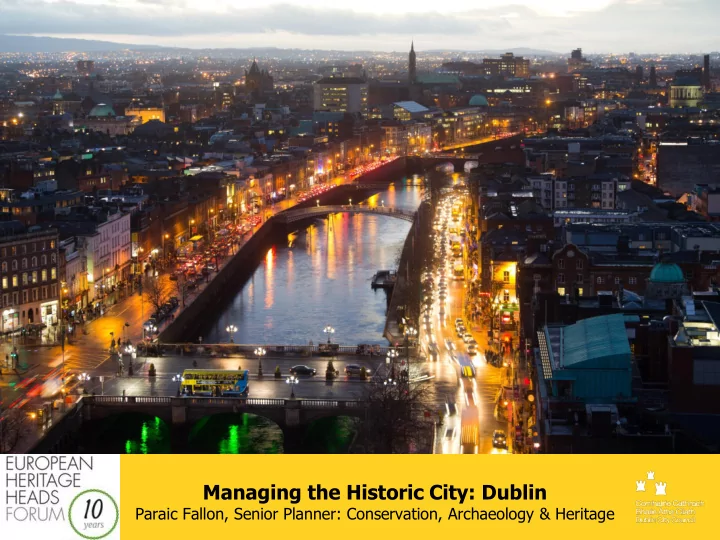
Managing the Historic City: Dublin

Paraic Fallon, Senior Planner: Conservation, Archaeology & Heritage

slide-2
SLIDE 2

Dublin 2015

  • City area:

11,761 hectares

  • City population:

525,000

  • Greater Dublin Area:

1.80 million

  • Population of

Country:

4.6 million

  • 39% national

population lives in Greater Dublin Area

slide-3
SLIDE 3

Dublin City Development Plan – Core Strategy

slide-4
SLIDE 4
slide-5
SLIDE 5

Key Policy Instruments: Historic City

Planning & Development Acts 2000-2013 National Monuments Acts 1930-1994 Dublin City Development Plan 2011-2017

Record of Protected Structures (RPS): 8,600 Architectural Conservation Areas (ACAs): 18 w. 7 in HUC Special Planning Control Scheme (SPSC) re: uses + inherited legacy (older plans): Conservation Areas Z8 ‘Conservation & Urban Design Set-Piece’ Zoning Z2 ‘Residential Conservation Areas’

+

Record of Monuments & Places (RMP) Historic (Medieval) Core = Zone of Archaeological Interest

slide-6
SLIDE 6

Lost in Translation?

Dublin City Development Plan 2011-2017

Land Use Zoning & Specific Objectives (incl. Conservation & Zones Archaeological Interest)

slide-7
SLIDE 7

Confused? + Public Expectation

  • ver-lapping policies and objectives

competing priorities for city investment competing projects & initiatives restricted public funding / borrowing limited human resources conservation policies and objectives: prevention / prohibition (static) v innovation & intervention (dynamic)

slide-8
SLIDE 8
slide-9
SLIDE 9
slide-10
SLIDE 10
slide-11
SLIDE 11
slide-12
SLIDE 12
slide-13
SLIDE 13
slide-14
SLIDE 14
slide-15
SLIDE 15
slide-16
SLIDE 16
slide-17
SLIDE 17
slide-18
SLIDE 18

Prioritise Targeted Interventions

Restoration Vacant and Underused Historic Structures Infill Critical Reconstruction Stephen’s Street Plot Size, Height, Depth Design Briefs & Uses Public Realm High Profile / Quick Wins Shopfronts and Parking on Private Landings Long-term, Phased Programme

slide-19
SLIDE 19
slide-20
SLIDE 20

Model Projects / Case Studies

Restoration Case Studies – already: 19 & 20 Aungier Street (LOTTS Architecture) 6/6A Aungier Street (Mesh Architects) The Swan Bar DCC Building Project? – lead by example Infill Design Competition Identify Location & prepare Brief Public Realm Already Fade Street Model Valentine Quarter

slide-21
SLIDE 21

19 & 20 Aungier Street

LOTTS Architecture DCC funded exemplar

slide-22
SLIDE 22
slide-23
SLIDE 23

Risk - Risk Management

 Protected & Historic Structures  Standards & Regulations  Flexibility / Dispensation  Guidance = Clarity  Exemplar / Template  Opportunity

  • DCC Apartment Sizes (all dev)
  • DoE Apartment Sizes (new dev)
  • Mimimum Floor Areas
  • Fire Safety & min Distances
  • Universal Access
  • Amenity & Open Space
  • Storage
  • Bike Parking / Car Parking
  • Bin Storage
  • Energy Efficiency / Rating
  • Separated Services
  • ‘Flying Freehold’

OR

slide-24
SLIDE 24
slide-25
SLIDE 25
slide-26
SLIDE 26

Carrot & Stick

sporadic public support financing reactive

v

carrot & stick

=

consistent, continuous, multi-annual funding

  • f even relatively small amounts

+

clear advice & guidance: dynamic ACA proactive multi-disciplinary team

+

swift and consistent enforcement action key role of Conservation Enforcement Officer

slide-27
SLIDE 27
slide-28
SLIDE 28

Thank You!

“When the urban designer talks of learning from the past, this is not a call for some pastiche replication, it is a plea for designers to understand how people, places and buildings react to one another and learn from historical successes or mistakes.”

(Paul Vanner: Urban Design: Myth or Reality?)