DOWNTOWN LINCOLN Historic Survey DOWNTOWN LINCOLN Historic Survey - - PowerPoint PPT Presentation

downtown lincoln historic survey downtown lincoln
SMART_READER_LITE
LIVE PREVIEW

DOWNTOWN LINCOLN Historic Survey DOWNTOWN LINCOLN Historic Survey - - PowerPoint PPT Presentation

KANSAS HISTORIC RESOURCES INVENTORY SURVEY REPORT Downtown Lincoln Historic Survey 2019 Town and County the preeminent Main Street DOWNTOWN LINCOLN Historic Survey DOWNTOWN LINCOLN Historic Survey LINCOLN DOWNTOWN Historic Survey DO


slide-1
SLIDE 1

DOWNTOWN LINCOLN Historic Survey

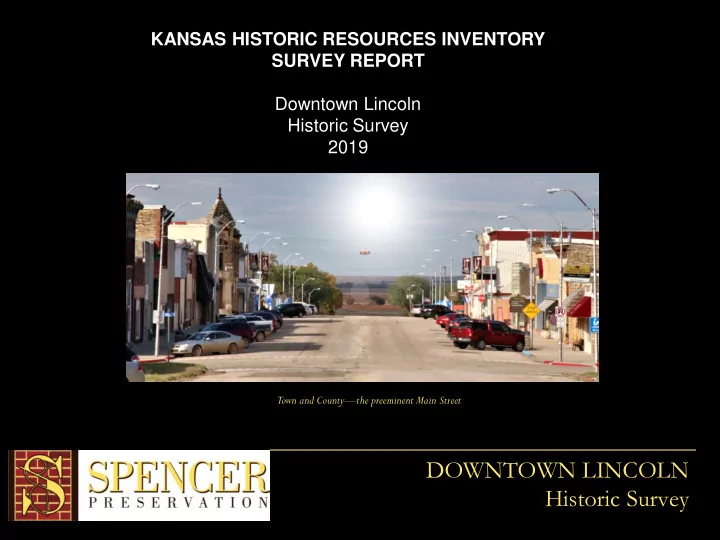
KANSAS HISTORIC RESOURCES INVENTORY SURVEY REPORT Downtown Lincoln Historic Survey 2019

Town and County—the preeminent Main Street
slide-2
SLIDE 2

DOWNTOWN LINCOLN Historic Survey

slide-3
SLIDE 3

LINCOLN DOWNTOWN Historic Survey

slide-4
SLIDE 4

LINCOLN DOWNTOWN Historic Survey

DO NOT USE BACK ARROW Click on column to sort Click on building to select that record

slide-5
SLIDE 5

LINCOLN DOWNTOWN Historic Survey

slide-6
SLIDE 6

LINCOLN DOWNTOWN Historic Survey

slide-7
SLIDE 7

LINCOLN DOWNTOWN Historic Survey

  • Dates of Construction: 1870 – 2000s (1877 & 2001)

The oldest resource surveyed was the Kynne House Museum located at 214 W. Lincoln Avenue. The newest resource is a County Office Building at 114 Court Street in 2001.

  • 20% of the buildings surveyed were built in the 1870s and 1880s
  • 20% were built from 1890-1910.

Reflecting the largest twentieth-century building boom,

  • 26% of the resources surveyed were constructed in the 1910s and 1920s
  • 18% were built in the 1930s and 1940s
  • 10% were built in the 1950s-1960s
  • Only seven of the surveyed resources were constructed after 1970 and are

less than fifty-years old, the basic threshold for historic consideration.

slide-8
SLIDE 8

LINCOLN DOWNTOWN Historic Survey

  • Architectural Styles
  • 11% Prominent Late Victorian (1870s-1900s)
slide-9
SLIDE 9

LINCOLN DOWNTOWN Historic Survey

Progressive Era Commercial Style Buildings (30%)

slide-10
SLIDE 10

LINCOLN DOWNTOWN Historic Survey

Early to mid-20th Century Minimal Commercial (6%)

slide-11
SLIDE 11

LINCOLN DOWNTOWN Historic Survey

Modern Movement: Art Deco through Post-WWII/Mid-Century Modern - 10%

slide-12
SLIDE 12

LINCOLN DOWNTOWN Historic Survey

Vernacular Designs

slide-13
SLIDE 13

LINCOLN DOWNTOWN Historic Survey

CONTRIBUTING/NON-CONTRIBUTING TO HISTORIC DISTRICT does NOT mean good and bad

  • 50-year age threshold, 1969-1970
  • In order to be considered historically-significant ,a property must generally

retain the physical features and original materials that define both why a property is significant and when it gained significance.

  • Replacement of storefronts, windows, and even entire facades were common

alterations of historic commercial buildings particularly during local boom years when merchants had money and were reinvesting in their buildings to attract new customers.

  • It is the degree to which the past modifications were in keeping with the

building’s historic character that determines the level of historic integrity a property retains, or whether the past modifications reflected a major design change that has gained significance in its own right.

slide-14
SLIDE 14

LINCOLN DOWNTOWN Historic Survey

There are a variety of reasons that a building could be identified as a non- contributor to a historic district or not eligible for listing including:

  • built less than fifty years ago;
  • removal or infill of glass storefront on traditional historic commercial building

thereby changing the relationship of the building to the street front and passersby;

  • infill or downsizing of upper windows on the front facade altering the

proportions of the historic facade;

  • r installation of siding covering street facades (obscuring historic fabric).
slide-15
SLIDE 15

LINCOLN DOWNTOWN Historic Survey

slide-16
SLIDE 16

LINCOLN DOWNTOWN Historic Survey

slide-17
SLIDE 17

DOWNTOWN LINCOLN Historic Survey

slide-18
SLIDE 18

LINCOLN DOWNTOWN Historic Survey BENEFITS OF HISTORIC SURVEY

  • First Step in considering designation of Historic

District

  • Based on number of “contributing” properties,

determine proposed boundaries

Recommendation is to establish Lincoln Downtown Historic District

In the recommended boundary for the proposed historic district :

  • 63 buildings
  • 2 properties listed in the National Register,
  • 38 deemed to be eligible for individual listing in

the National Register or contributors to a potential district, and

  • 23 non-contributing buildings. Resulting in a

total of 63% contributing buildings, a clear majority of the district resources.

slide-19
SLIDE 19

LINCOLN DOWNTOWN Historic Survey

slide-20
SLIDE 20

LINCOLN COUNTY Historic Survey WHY HISTORIC DISTRICT

  • Financial Incentives for rehabilitation projects, building improvements

and general maintenance

  • Marketing and Heritage Tourism

COMMON MISCONCEPTIONS

  • “They” are going to make me to something to my building
  • “They” are going to keep me from doing something I want to my building
  • Requires public access
  • All incorrect….Review and Comment is extent of state involvement in

what you do to your buildings even in a historic district, all power lies with local municipality who issues building permits

slide-21
SLIDE 21

LINCOLN DOWNTOWN Historic Survey Preservation Education and Marketing

  • Take advantage of available incentives
  • 25% KS HTC and/or 20% Federal HTC
  • If you follow rules, you will get the credit
  • Heritage Trust Fund Grants
  • 80/20; 60/40 matching grants $90,000 max
  • competitive annual round (1 in 3 average)
  • Consider local incentives to piggyback on

state/federal – Neighborhood Revitalization

  • Combine physical improvements with economic

development – Downtown revitalization is EcoDevo

  • Training to do it right (improvements)
  • Marketing – promote historic resources as part of

your identity – Heritage Tourism

slide-22
SLIDE 22

LINCOLN COUNTY Historic Survey Tax Credit Basics Tax credits provide a key tool for the rehabilitation of historic properties—

The federal program provides an income-tax credit equal to 20 percent of qualified rehabilitation expenditures on income- producing properties (4% per year for 5 years). The state program provides a tax credit equal to 25 percent of qualified expenditures on income-producing or non income- producing properties. Projects must meet the Secretary of the Interior's Standards for Rehabilitation

slide-23
SLIDE 23

LINCOLN COUNTY Historic Survey

Tax Credit Basics – Quick and Dirty

Buy Building $40,000 Land valued at $5,000 less depreciation Adjusted Basis $35,000 Rehabilitation Project QRE Non- Qualified Roof 22,500 New HVAC 15,000 New flooring 7,500 Displays/equi pment 2,400 Sign 600 45,000 3,000 federal KS Rehab Cost (QRE) 45,000 45,000 exceeds Adj Basis x.25 Qualify for Federal 0.04 11250 per year 1800 0.9 5 years 9000 10,125 sell state credit at .90 cents Net cost of project $28,875

Debt Service Building 35000 QRE 45000 Non-qualified 3000 Total Cost 83000 Down payment

  • 10,000

KS HTC

  • 10,000

Finance 63,000 20 years, 4.5% $450 monthly debt service annual balloon payment first 5 years 1,800 Drop debt service $75-$100/month after $350 reinvesting Fed HTC 5 years Over next 15 years 18,000 less in debt service reducing net cost of project

slide-24
SLIDE 24

LINCOLN COUNTY Historic Survey

Scope of rehabilitation using HTC can be maintenance, repair , interior, or extensive

slide-25
SLIDE 25

LINCOLN COUNTY HISTORIC SURVEY PROJECT

Historic Preservation Grant Kansas State Historical Society & National Park Service Lincoln County Economic Development Foundation

THANK YOU

QUESTIONS?

Kelly Larson, LCEDF Brenda Spencer: Brenda@SpencerPreservation.com 785-456-9857