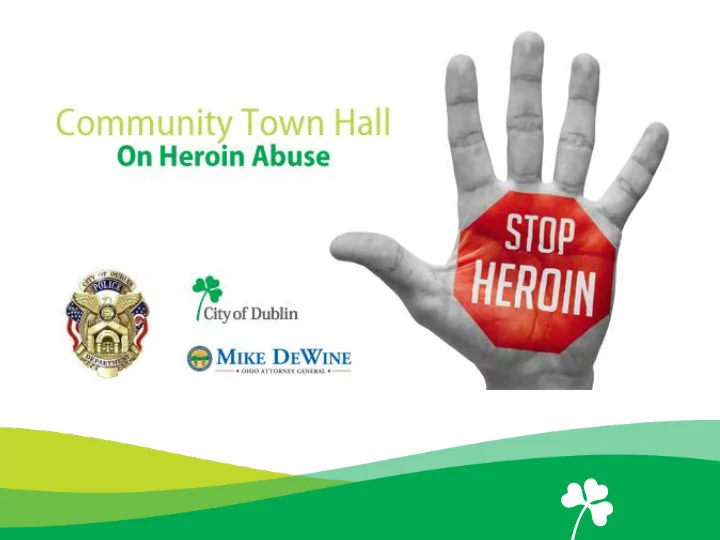
SLIDE 1
SLIDE 2
Chief Heinz von Eckartsberg Dublin Police
Welcome
SLIDE 3 Dublin & Washington Township Elected Officials and Leadership
Washington Township Trustees Gene Bostic Denise Franz King Charles Kranstuber Fiscal Officer Joyce E. Robinson Administrator Sara Ott City of Dublin City Council Mayor Michael Keenan Vice Mayor Richard Gerber Marilee Chinnici-Zuercher Greg Peterson Amy Salay John Reiner Tim Lecklider City Manager Dana McDaniel Dublin City Schools Board of Education
- Dr. Todd Hoadley, Superintendent
Stephen Osborne, Treasurer Lynn May, Board President Stu Harris, Board Vice President Scott Melody Chris Valentine Rick Weininger
SLIDE 4 Distinguished Guests
U.S. Senator Rob Portman’s Office Ohio Attorney General Mike DeWine’s Office Franklin County Prosecuting Attorney Franklin County Municipal Judge Scott VanDerKarr Franklin County Coroner Franklin County Sheriff’s Office Union County Sheriff’s Office Delaware County Sheriff’s Office
SLIDE 5 Other Partners
Dublin A.C.T. Coalition PERC (Parents Encouraging Responsible Choices) Syntero, Inc. The Woods at Parkside Precision Labs Dublin City Schools Washington Township Fire Department Franklin County Public Health Drug Free Action Alliance Start Talking!
SLIDE 6
SLIDE 7
Ohio’s Opioid Epidemic
Jennifer Biddinger, Director Drug Abuse Outreach Initiatives
SLIDE 8
Historically 1804: Morphine is distilled from Opium. 1853: The hypodermic syringe is invented. Inventor’s wife is first to die of injected drug use. 1898: Bayer chemist invents diacetylmorphine, names it heroin. 1980: World Health Organization develops ladder of pain management. 1996: Purdue Pharma releases OxyContin.
Ohio’s Opioid Epidemic
SLIDE 9
Historically 1996: President of American Pain Society urges doctors to treat pain as a vital sign. 1998: Xalisco black tar heroin arrives in Columbus. 1998: Portsmouth, Ohio. Dr. Procter, who opened what is thought to be the first pain clinic, has an auto accident that leaves him unable to practice medicine but still capable of running a pain clinic.
Ohio’s Opioid Epidemic
SLIDE 10
Historically 1998-99: VA and JCAHOP (Joint Commission on Allied Health Personnel in Ophthalmology) adopt idea of pain as fifth vital sign. 2002: Dr. Procter pleads guilt to drug trafficking and conspiracy and serves eleven years in federal prison. 2004: Washington State publishes findings on deaths of injured workers due to overdose on opiate painkillers.
Ohio’s Opioid Epidemic
SLIDE 11
Historically Mid-2000s: Xalisco black tar heroin cells are now in at least 17 states. Portsmouth has more pill mills per capita than any US town. 2007: Purdue and three executives plead guilty to misdemeanor charges of false branding of OxyContin - fined $634 million. 2008: Drug overdoses, mostly from opiates, surpass auto fatalities as the leading cause of accidental death in the US. 2011: Ohio passes House Bill 93, regulating pain clinics.
Ohio’s Opioid Epidemic
SLIDE 12
- Unintentional Drug overdose continued to be the
leading cause of injury-related death in Ohio in 2014 with 2,482 deaths. This is the highest number of deaths on record from drug
- verdose and reflects a 17.6 % increase
compared to 2013.
- Fentanyl-related unintentional drug overdose
deaths in Ohio increased from 84 in 2013 to 502 in 2014.
Ohio’s Opioid Epidemic
SLIDE 13
- Heroin-related deaths accounted for 1,177 (47.4%)
percent of unintentional drug overdose deaths in 2014, compared to 983 (46.6%) in 2013.
- Prescription Opioid-related deaths accounted for
1,155 (46.5 %) of unintentional Drug Overdose deaths in 2014 compared to 726 (34.4%) in 2013. Fentanyl-related drug overdose deaths are categorized as prescription opiate deaths, a contributing factor to the increase.
Ohio’s Opioid Epidemic
SLIDE 14
- Multiple drug use was the single-largest
contributor to unintentional drug
- verdoses. In 2014, 59% of overdose
deaths involved more than one drug.
- Ohioans aged 45-54 are at the highest risk
for prescription opioid overdose; males aged 25- 34 are at the highest risk for fatal heroin overdose.
Ohio’s Opioid Epidemic
SLIDE 15
- Most people use drugs for the first time when
they are teenagers. There were just over 2.8 million new users of illicit drugs in 2013, or about 7,800 new users per day. Over half (54.1 percent) were under 18 years of age.
- The US is about 4% of world population and
will use about 80% of the world’s hydrocodone in 2014.
Ohio’s Opioid Epidemic
SLIDE 16 Ohio’s Opioid Epidemic
The Transition to Heroin
- Average age in Ohio for first use of prescription
drugs is 14.
- 70 % of abused Rx drugs are received from a friend
- r loved one.
- Affects all ages, all races, all income levels; a
suburban epidemic.
SLIDE 17 Trends - Positive
- Increased use of MAT/Medicaid
- Increased use of Naloxone - rebate
- Greater Awareness
- Drug Courts
- Community Engagement
- Recovery Housing
- Law Enforcement’s Response
- Legislation
SLIDE 18 Trends - Positive
- Increased use of MAT/Medicaid
- Increased use of Naloxone - rebate
- Greater Awareness
- Drug Courts
- Community Engagement
- Recovery Housing
- Law Enforcement’s Response
- Legislation
SLIDE 19 Jenni nifer r Bidd dding nger er Director, Drug Abuse Outreach Initiatives Jennifer.Biddinger@OhioAttorneyGeneral.gov
SLIDE 20
Heroin in Franklin County
Ron O’Brien, Prosecuting Attorney Chief Deputy Rick Minerd, FCSO
SLIDE 21
SLIDE 22 2012 – 68 heroin
related
2013 – 93 heroin
related
2014 – 117 heroin
related
An individual in
Franklin County is 33% more likely to die
than to die in a car accident.
SLIDE 23
SLIDE 24 Developed in 2002 Educating adults with a
nexus to children
Latest trends on street
level drugs, terminology, paraphernalia, and effects
Over 135,000 people,
including prosecutors, judges, teachers, councilors, doctors, nurses, etc.
SLIDE 25 Effort to bring a community-wide action plan
to Central Ohio to find a solution
Prevention, Education, Healthcare, Treatment
and Law Enforcement together with a common goal
200-500 attendees
SLIDE 26
Sergeant Nick Tabernik Officer Chuck Collier
Heroin in Dublin
SLIDE 27
Quick Question
SLIDE 28 Drug Deal
- Back alley
- Night time
- Outside location
SLIDE 29 Reality
- Homes (inside, driveways, curbside)
- Parking lots
- Gas stations
- Parks
SLIDE 30
SLIDE 31
SLIDE 32
SLIDE 33
SLIDE 34
SLIDE 35
SLIDE 36 How does this relate to crime?
- Thefts from vehicles
- Burglaries
- Robberies
SLIDE 37 How can you help?
- Community partnership
- See something, say something
- WE CAN’T DO THIS ALONE!
SLIDE 38 Dublin Police contacts
- 911 (emergency)
- 614.889.1112 (non-emergency)
- Online Anonymous Tip System
- dublinohiousa.gov/police
SLIDE 39
School Research & Resources
GeorgiAnn Diniaco, Dublin City Schools
SLIDE 40
Parent Programs & Local Treatment Options
Jaime Burke, Dublin A.C.T. Coalition
SLIDE 41
SLIDE 42
A Parent’s Story
Paul Schoonover
SLIDE 43
SLIDE 44
SLIDE 45
SLIDE 46
SLIDE 47
SLIDE 48
SLIDE 49
SLIDE 50
SLIDE 51
SLIDE 52
SLIDE 53
Beating Addiction
Randy
SLIDE 54
Panel Discussion/ Q & A
SLIDE 55