pg. 96 # 1: Some of Aristotles followers like all of Aquinas - - PowerPoint PPT Presentation

pg 96 1 some of aristotle s followers like all of aquinas
SMART_READER_LITE
LIVE PREVIEW

pg. 96 # 1: Some of Aristotles followers like all of Aquinas - - PowerPoint PPT Presentation

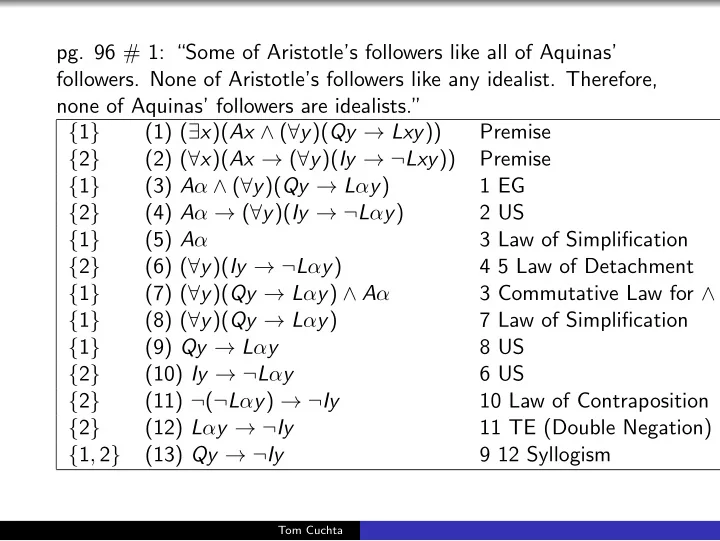
pg. 96 # 1: Some of Aristotles followers like all of Aquinas followers. None of Aristotles followers like any idealist. Therefore, none of Aquinas followers are idealists. { 1 } (1) ( x )( Ax ( y )( Qy Lxy ))


slide-1
SLIDE 1
  • pg. 96 # 1: “Some of Aristotle’s followers like all of Aquinas’
  • followers. None of Aristotle’s followers like any idealist. Therefore,

none of Aquinas’ followers are idealists.” {1} (1) (∃x)(Ax ∧ (∀y)(Qy → Lxy)) Premise {2} (2) (∀x)(Ax → (∀y)(Iy → ¬Lxy)) Premise {1} (3) Aα ∧ (∀y)(Qy → Lαy) 1 EG {2} (4) Aα → (∀y)(Iy → ¬Lαy) 2 US {1} (5) Aα 3 Law of Simplification {2} (6) (∀y)(Iy → ¬Lαy) 4 5 Law of Detachment {1} (7) (∀y)(Qy → Lαy) ∧ Aα 3 Commutative Law for ∧ {1} (8) (∀y)(Qy → Lαy) 7 Law of Simplification {1} (9) Qy → Lαy 8 US {2} (10) Iy → ¬Lαy 6 US {2} (11) ¬(¬Lαy) → ¬Iy 10 Law of Contraposition {2} (12) Lαy → ¬Iy 11 TE (Double Negation) {1, 2} (13) Qy → ¬Iy 9 12 Syllogism

Tom Cuchta

slide-2
SLIDE 2
  • pg. 96 # 3: “None of the paintings is valuable, except the battle
  • pieces. All the battle pieces are painted in oils. Some of the

paintings are not painted in oil. Some paintings are not framed. Therefore, none of the paintings not painted in oils is valuable.” {1} (1) (∀x)(Px → (¬Vx ∨ Bx)) Premise {2} (2) (∀x)(Bx → Ox) Premise {3} (3) (∃x)(Px ∧ ¬Ox) Premise {4} (4) (∃x)(Px ∧ ¬Fx) Premise Conclusion: (∀x)((Px ∧ ¬Ox) → ¬Vx) This argument is not valid... try to find an interpretation.

Tom Cuchta

slide-3
SLIDE 3
  • pg. 96 # 8: “Every philosophical empiricist admires Hume. Some

philosophical idealists like no one who admires Hume. Therefore, some philosophical idealists like no philosophical empiricist.” {1} (1) (∀x)(Ex → Hx) Premise {2} (2) (∃x)(Ix ∧ (∀y)(Hy → ¬Lxy)) Premise {2} (3) Iα ∧ (∀y)(Hy → ¬Lαy) 2 ES {2} (4) (∀y)(Hy → ¬Lαy) ∧ Iα 3 Commutative Law for ∧ {2} (5) (∀y)(Hy → ¬Lαy) 4 Law of Simplification {2} (6) Hy → ¬Lαy 5 US {1} (7) Ey → Hy 1 US {1, 2} (8) Ey → ¬Lαy 6 7 Syllogism {1, 2} (9) (∀y)(Ey → ¬Lαy) 8 UG {1, 2} (10) Iα 3 Law of Simplification {1, 2} (11) Iα ∧ (∀y)(Ey → ¬Lαy) 9 10 Law of Adjunction {1, 2} (12) (∃x)(Ix ∧ (∀y)(Ey → ¬Lxy)) 11 EG

Tom Cuchta

slide-4
SLIDE 4
  • pg. 96 # 4: “Some psychologists admire Freud. Some

psychologists like no one who admires Freud. Therefore, some psychologists are not liked by all psychologists.” {1} (1) (∃x)(Px ∧ Fx) Premise {2} (2) (∃x)(Px ∧ (∀y)(Fy → ¬Lxy)) Premise Conclusion: (∃x)(Px ∧ (∀y)(Py ∧ ¬Lxy)) Find an interpretation! x y Px Py Fx Fy Lxy Px ∧ Fx Fy → ¬Lxy Py ∧ ¬Lxy T F T T F T T F

Tom Cuchta