How to measure the size of sets: Aristotle-Euclid or Cantor-Zermelo? - - PowerPoint PPT Presentation

how to measure the size of sets aristotle euclid or
SMART_READER_LITE
LIVE PREVIEW

How to measure the size of sets: Aristotle-Euclid or Cantor-Zermelo? - - PowerPoint PPT Presentation

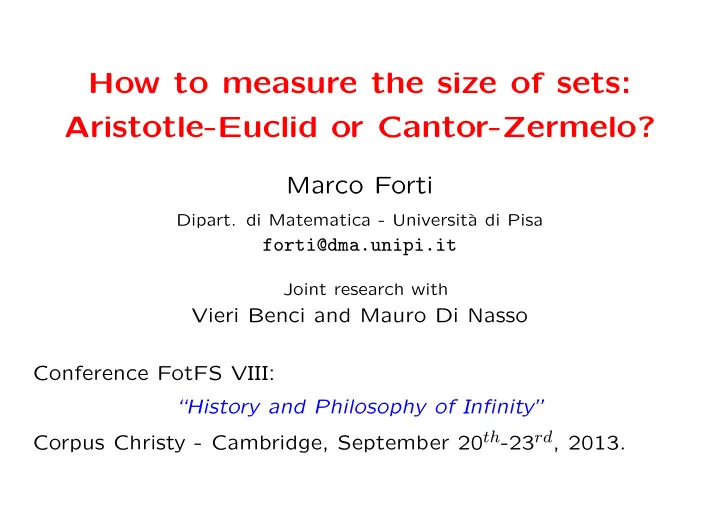
How to measure the size of sets: Aristotle-Euclid or Cantor-Zermelo? Marco Forti Dipart. di Matematica - Universit` a di Pisa forti@dma.unipi.it Joint research with Vieri Benci and Mauro Di Nasso Conference FotFS VIII: History and


slide-1
SLIDE 1

How to measure the size of sets: Aristotle-Euclid or Cantor-Zermelo?

Marco Forti

  • Dipart. di Matematica - Universit`

a di Pisa

forti@dma.unipi.it

Joint research with

Vieri Benci and Mauro Di Nasso Conference FotFS VIII: “History and Philosophy of Infinity” Corpus Christy - Cambridge, September 20th-23rd, 2013.

slide-2
SLIDE 2

1

A measure of size for arbitrary sets should be submit- ted to the famous five common notions of Euclids Elements, which traditionally embody the properties

  • f magnitudes,
  • 1. Things equal to the same thing are also equal to one another.
  • 2. And if equals be added to equals, the wholes are equal.
  • 3. And if equals be subtracted from equals, the remainders are

equal.

  • 4. Things applying [exactly] onto one another are equal to one

another.

  • 5. The whole is greater than the part.
slide-3
SLIDE 3

2

The presence of the fourth and fifth principles among the Common Notions in the original Euclid’s treatise is controversial, notwithstanding the fact that they are explicitly accepted in the fundamental commentary by Proclus to Euclid’s Book I, where all the remaining statements included as axioms by Pappus and others are rejected as spurious additions. We consider the five principles on a par, since all of them can be viewed as basic assumptions for any reasonable theory of magnitudes. NB We translate ǫφαρµoζoντα by “applying [exactly] onto”, instead of the usual “coinciding with”. This translation seems to give a more appropriate rendering of the Euclidean usage of the verb ǫφαρµoζǫιν, which refers to superposition of congruent figures. This remark is important, because in measuring infinite collections it has to be taken much weaker than the full Cantorian counting principle that equipotent sets have equal sizes.

slide-4
SLIDE 4

3

The notion of numerosity

A notion of “number of elements” (numerosity) that maintains the Euclidean principle that the whole is larger than the part for infinite collections was first introduced in [1] for so called “labelled sets”, a special class of countable sets whose elements come with natural numbers as labels.

This notion of numerosity was then variously generalized in several papers:

  • to arbitrary sets of ordinal numbers in [3],
  • to whole “universes of mathematical objects” in [4], and, returning to

the original Cantorian study,

  • to finite dimensional real point sets in [5], while
  • special numerosities of point sets over a countable line are considered in

[6,7].

slide-5
SLIDE 5

References

  • 1. V. Benci, M. Di Nasso - Numerosities of labelled sets: a new way of

counting, Adv. Math. 173 (2003), 50–67.

  • 2. V. Benci, M. Di Nasso, M. Forti - The eightfold path to Nonstan-

dard Analysis, in Nonstandard Methods and Applications in Mathematics (N.J. Cutland, M. Di Nasso, D.A. Ross, eds.), L.N. in Logic 25, A.S.L. 2006, 3–44.

  • 3. V. Benci, M. Di Nasso, M. Forti - An Aristotelian notion of size, Ann.

Pure Appl. Logic 143 (2006), 43–53.

  • 4. V. Benci, M. Di Nasso, M. Forti - An Euclidean notion of size for math-

ematical universes, Logique et Analyse 50 (2007), 42–55.

  • 5. M. Di Nasso, M. Forti - Numerosities of point sets over the real line,
  • Trans. Amer. Math. Soc. 362 (2010), 5355–5371.
  • 6. A. Blass, M. Di Nasso, M. Forti - Quasi-selective ultrafilters and asymp-

totic numerosities, Adv. Math. 231 (2012), 1462–1486.

  • 7. M. Forti, G. Morana Roccasalvo - Natural numerosities of sets of tuples,
  • Trans. Amer. Math. Soc. (2013, in print)
slide-6
SLIDE 6

5

Cantor’s theory of cardinalities

The Cantorian theory of cardinalities originates from the idea of extending the notion of counting from finite sets to arbitrary Punktmengen, i.e. arbitrary subsets of the Euclidean space Ed(R) of dimension d. Cantor assumed the natural counting principle

(CP): two point sets have the same cardi- nality if and only if they can be put in one- to-one correspondance.

slide-7
SLIDE 7

6

Incompatibility of Cantor with Euclid

Historically the Cantorian principle (CP) revealed in- compatible with the fifth Euclidean common notion, for infinite collections, long before the celebrated Galileo’s remark that there should be simultaneously “equally many” and “much less” perfect squares than natural numbers. The impact of this inconsistency cannot be overes- timated: it led Leibniz (an inventor of infinitesimal [nonstandard] analysis!) to assert the impossibility of infinite numbers.

slide-8
SLIDE 8

7

Cantor extended sum, product, and ordering of in- tegers to infinite cardinals by assuming the following natural principles:

(SP): |A| + |B| = |A ∪ B| provided A ∩ B = ∅. (PP): |A||B| = |A × B| for all A, B. (OP): |A| ≤ |B| if and only if there exists C ⊆ B such that |A| = |C|.

slide-9
SLIDE 9

8

The algebra of cardinalities

In the Cantorian theory of cardinalities these proper- ties give rise to a very weird arithmetic, where

a + b = max (a, b)

whenever the latter is infinite. No cancellation law (a fortiori no subtraction), hence not only the 5th, but also the 3rd Euclidean principle

  • fails. (i.e. Aristotle’s preferred example of an axiom.)

Actually, every infinite set is equipotent to a proper subset (Dedekind’s negative definition of finiteness)

slide-10
SLIDE 10

9

Moreover, not allowing division, Cantor’s theory pro- vides a satisfying treatment of infinitely large num- bers, but it cannot produce “infinitely small” num- bers, thus preventing a natural introduction of “in- finitesimal analysis”. (History repeats itself: Cantor asserted the existence

  • f actually infinite numbers, but strongly negated

that of actually infinitesimal numbers!)

slide-11
SLIDE 11

10

The 1st Euclidean principle for collections

  • Things equal to the same thing are also equal to
  • ne another

essentially states that “having equal sizes” is an equiv-

  • alence. We write A ≈ B when A and B are equinu-

merous (have equal sizes). The first Euclidean prin- ciple becomes E1 (Equinumerosity Principle) A ≈ C, B ≈ C = ⇒ A ≈ B.

slide-12
SLIDE 12

11

2nd and 3rd Euclidean principles for collections

  • And if equals be added to equals, the wholes are equal
  • And if equals be subtracted from equals, the remainders are

equal addition and subtraction are “compatible” with equinumeros-

  • ity. For collections, sum and difference naturally correspond to

disjoint union and relative complement, ` a la Cantor:

E2 (Sum Principle) A ≈ A′, B ≈ B′, A ∩ B = A′ ∩ B′ = ∅ = ⇒ A ∪ B ≈ A′ ∪ B′ E3 (Difference Principle) A ≈ A′, B ≈ B′, B ⊆ A, B′ ⊆ A′ = ⇒ A\B ≈ A′\B′

slide-13
SLIDE 13

12

The 5th Euclidean principle for collections

  • The whole is greater than the part

Say that A is smaller than B, written A ≺ B, when A is equinumerous to a proper subset of B A ≺ B ⇐ ⇒ A ≈ A′ ⊂ B Comparison of sizes must be consistent with equinu-

  • merosity. So the fifth principle becomes

E5 (Ordering Principle) A ⊂ B ≈ B′ = ⇒ A ≈ B & A ≺ B′

slide-14
SLIDE 14

13

The problem of comparability

Homogeneous magnitudes are usually arranged in a linear ordering. So the followig strengthening of the Ordering Principle would be most wanted E5b (Total Ordering Principle) Exactly one of the following relations always holds: A ≺ B, A ≈ B, B ≺ A [A weaker alternative could be requiring E5b only for a transitive extension of the relation ≺]

  • Cardinalities of infinite sets are always comparable,

but only thanks to Zermelo’s Axiom of Choice.

slide-15
SLIDE 15

14

The algebra of numerosities

Measuring size amounts to associating suitable “numbers” (nu- merosities) to the equivalence classes of equinumerous collec-

  • tions. Sum and ordering of numerosities can be naturally de-

fined ` a la Cantor

(sum)

n(X)+n(Y ) = n(X ∪Y ) whenever X ∩Y = ∅;

(ord)

n(X) ≤ n(Y ) if and only if X Y .

thanks to the principles E2, E3, and E5a. A “satisfactory” algebra of numerosities should also compre- hend a product, so as to obtain (the non-negative part of) a (discretely) ordered ring.

slide-16
SLIDE 16

15

The product of numerosities

One could view the notion of measure as originating from the length of lines, and later extended to higher dimensions by means of products. In classical geometry, a product of lines is usually intended as the corresponding rectangle. So one could use Cartesian products in defining the product of numerosities. The natural “arithmetical” idea that multiplication is an iterated addition of equals is consistent with the “geometrical” idea of rectangles, because the Cartesian product A×B can be naturally viewed as the union of “B-many disjoint copies” of A A × B =

  • b∈B

Ab, where Ab = {(a, b) | a ∈ A }.

slide-17
SLIDE 17

16

The Product Principle

But is Ab a “faithful copy” of A?

  • Let A = {b, (b, b), ((b, b), b), . . . , (((. . . , b), b), b), . . .}

Ab = A×{b} is a proper subset of A, so (the numerosity of) the singleton {b} is not an identity w.r.t. (the numerosity of) A. A severe constraint, stronger than disjointness condition of the Sum Principle, has to be put in the following

PP (Product Principle) A ≈ A′, B ≈ B′ = ⇒ A × B ≈ A′ × B′

e.g. considering only finite dimensional point sets, i.e. subsets

  • f the n-dimensional spaces En(L) over arbitrary “lines” L.
slide-18
SLIDE 18

17

The 4th Euclidean principle for collections

  • Things applying [exactly] onto one another are

equal to one another

. . . the [fourth] Common Notion . . . is intended to as- sert that superposition is a legitimate way of proving the equality of two figures . . . or . . . to serve as an axiom of

  • congruence. (T.L. Heath).

i.e.“appropriately faithful” transformations (congru- ences) preserve sizes: it is a criterion for being equinu- merous.

slide-19
SLIDE 19

18

Isometries vs. congruences

The 3rd (and 5th) common notion can be saved by restricting the meaning of “applying [exactly] onto” to comprehend only “natural transformations”, such as permutations and regroup- ings of n-tuples, and similars. Any transformation T with an infinite orbit Γ = {x, Tx, T 2x, . . . } maps Γ onto a proper subset

  • f Γ, so T is not a “congruence”for Γ itself.

Also the isometries of Euclidean geometry work only for special classes of bounded geometrical figures. Even on the line there are no translation invariant numerosities [MF 2010]:

  • There exist bounded subsets of the algebraic line ¯

Q

that are proper subsets of some of their translates

slide-20
SLIDE 20

19

Natural congruences

A notion of congruence appropriate for the 4th Euclidean princi- ple might include all “natural transformations” that map tuples to tuples having the same sets of components

  • A natural congruence is an injective function map-

ping tuples to tuples with the same components. E4a (Natural Congruence Principle) X ≈ T[X] for all natural congruences T.

A wider class of “natural congruences”, like rising dimension, is admissible only after “appropriately restricting” their domains

  • f application to finite dimensional point sets.
slide-21
SLIDE 21

20

Restricted isometries

An interesting point of view considers equinumerosity as wit- nessed by an appropriate family of “restricted isometries”:

IP[T ] (Isometry Principle) There exists a group of transformations T such that A ≈ B ⇐ ⇒ ∃T ∈ T A ⊆ dom T & B = T[A].

Remark: IP[T ] implies the Half Cantor Principle HCP of [3] A ≈ B = ⇒ |A| = |B|, and also the ordering principle E5 A ⊂ B ≈ B′ ⇐ ⇒ A ≺ B′

slide-22
SLIDE 22

21

The algebra of numerosities

A surjective map n : W → N is a numerosity function corre- sponding to the equinumerosity relation ≈ if

n(X) = n(Y ) ⇐

⇒ X ≈ Y. Define +, · and < on N by (sum) n(X) + n(Y ) = n(X ∪ Y ) whenever X ∩ Y = ∅; (prod) n(X) · n(Y ) = n(X × Y ) for all X, Y ; (ord) n(X) < n(Y ) if and only if X ≺ Y .

  • The numerosity n is Zermelian iff ≈ satisfies the total order-

ing principle E5b.

  • The numerosity n is Cantorian iff ≈ satisfies the Half Cantor

principle HCP.

slide-23
SLIDE 23

22

Obviously, finite sets receive their “number of elements” as numerosities, namely

  • Proposition. Let A, B be finite. Then

A ≈ B ⇐ ⇒ |A| = |B| Moreover, if X is infinite, then A ≺ X.

  • Theorem. The structure N, +, ·, < is a positive subsemiring of

a partially ordered discrete ring, and N can be taken as an initial segment of N. N is the positive part of a discretely ordered ring if and only if ≈ is Zermelian. So the algebra of numerosities is the most natural, and in fact, in all cases known up to now, the set N can be taken to be a nonstandard extension of the natural numbers.

slide-24
SLIDE 24

23

Set theoretic commitments

  • The existence of Cantorian numerosity functions defined for

all sets is provable in ZFC.

  • Assuming the Continuum Hypothesis there are Zermelian nu-

merosities defined on all countable finite dimensional pointsets

  • ver the real line.
  • A sufficient condition for the existence of Zermelian numerosi-

ties defined on all countable subsets of some cardinal λ is that both κℵ0 = κ+ and ✷κ hold for all singular cardinals κ < λ of countable cofinality. In particular V = L yields a Zermelian numerosity to all countable sets.

slide-25
SLIDE 25

24

Normal approximations

Let X be uncountable. A normal approximation of X is a sequence Xα | α < |X| s.t.

  • 1. α < β =

⇒ Xα ⊆ Xβ;

  • 2. Xλ =
  • α<λ Xα for limit λ < |X|;
  • 3. |Xα| < |X| for all α < |X|;
  • 4. X =
  • α<|X| Xα.
slide-26
SLIDE 26

25

Normal numerosities

The numerosity function n is normal if, given normal approxi- mations Xα | α < |X| of X and Yα | α < |Y | of Y , one has ∀α < |X| (n(Xα) ≤ n(Yα) ) = ⇒ n(X) ≤ n(Y ) Let W0 be the family of all countable point sets over L, and let

W be the family of all point sets over L. Then

Theorem 1. There exist normal numerosity functions on W whenever |L| < ℵω. Moreover, if n is a Zermelian numerosity function on W0, then n can be extended to numerosity functions

nn and nC on W that are respectively normal and Cantorian.

slide-27
SLIDE 27

26

Open questions

  • Is it consistent with ZFC the existence of Zer-

melian numerosities defined on all point sets of an uncountable line?

  • Is it possible to have numerosity functions defined
  • n all pointsets that are simultaneously Cantorian

and normal?

  • Can one prove the existence of normal numerosi-

ties defined on all point sets over an arbitrarily large line?

slide-28
SLIDE 28

27

Can Euclid be reconciled with Cantor? The answer could be YES! if we recall that the cardinal compara- bility of all sets was obtained much later by Zermelo, but NOT YET! if we take into account that both Euclid and Cantor viewed general com- parability as a fundamental principle.