Theory! objectivity and neutrality Rise of pseudo-science: - - PDF document

theory
SMART_READER_LITE
LIVE PREVIEW

Theory! objectivity and neutrality Rise of pseudo-science: - - PDF document

Induction vs. Deduction: Synthesis vs. Analysis 23 May, 2015 Past V1 2015 Schield CTC 1 V1 2015 Schield CTC 2 We thought critically! Induction vs. Deduction Synthesis vs. Analysis January, 1776 In proportion to the population of Milo


slide-1
SLIDE 1

Induction vs. Deduction: Synthesis vs. Analysis 23 May, 2015 2015-Schield-CTC2-slides.pdf 1

2015 Schield CTC

V1

1

Milo Schield Augsburg College May 23, 2015 West Minneapolis Critical Thinking Club

www.StatLit.org/pdf/2015-Schield-CTC2-Slides.pdf

Induction vs. Deduction Synthesis vs. Analysis

2015 Schield CTC

V1

2

In proportion to the population of the colonies (2.5 million), it had the largest sale and circulation of any book published in American history. [500,000 copies 1st year] As of 2006, it remains the all-time best-selling American title Wikipedia: Common Sense

We thought critically! January, 1776

Past

2015 Schield CTC

V1

3

Critical Thinking in America 1858

1st speaker had 60 minutes; 2nd had 90; 1st replied for 30 Speakers averaged around 100 words per minute. Families stood, listened, analyzed and evaluated!

Past

2015 Schield CTC

V1

4

.

Change in Values US Freshman

Present

2015 Schield CTC

V1

5

Advocacy journalism rejects

  • bjectivity and neutrality

Rise of pseudo-science:

  • young-earth creation
  • denial of evolution

Confirmation bias in media

  • MS-NBC & Fox News

Critical Thinking: The Fall in Culture

Present

2015 Schield CTC

V1

6

.

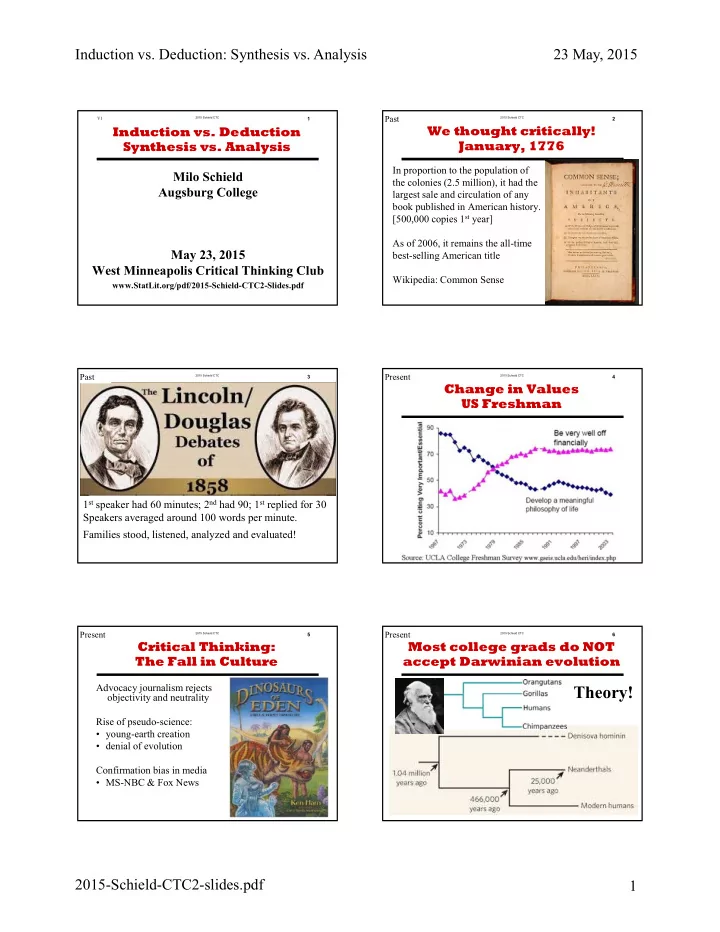
Most college grads do NOT accept Darwinian evolution

Present

Theory!

slide-2
SLIDE 2

Induction vs. Deduction: Synthesis vs. Analysis 23 May, 2015 2015-Schield-CTC2-slides.pdf 2

2015 Schield CTC

V1

7

.

Assumptions are Arbitrary

Present

2015 Schield CTC

V1

8

.

Assumptions are Arbitrary

Present

2015 Schield CTC

V1

9

Secular humanism Religious humanism

Assumptions are Arbitrary

Present

2015 Schield CTC

V1

10

Humanism is a philosophical and ethical

stance that emphasizes the value and agency

  • f human beings, individually and collectively,

and generally prefers critical thinking and evidence (rationalism, empiricism) over established doctrine or faith (fideism). … humanism refers to a perspective that

affirms some notion of “human nature”… Stance & Perspective: Optional / Elective

Present

2015 Schield CTC

V1

11

Recent causes; but not the Root Cause Schools drop diagramming sentences (1960s) Colleges drop logic as GenEd requirement. No evidence that logic improves writing Schools cut back on formal debate Critical thinking: waxes, peaks (1996) and wanes Reading for pleasure declines for school children Decline in academic rigor (Academically Adrift) College is not much harder than high school

2015 Schield CTC

V1

Aristotle noted two kinds of reasoning:

  • Deduction: from general to specific
  • Induction: from specific to general.

Aristotle was extremely clear on deduction. Aristotle was ambiguous (incomprehensible?)

  • n induction.

12

The Root Cause Aristotle!

slide-3
SLIDE 3

Induction vs. Deduction: Synthesis vs. Analysis 23 May, 2015 2015-Schield-CTC2-slides.pdf 3

2015 Schield CTC

V1

13

Aristotle: the Father of Logic Aristotle was clear on deduction: valid arguments gave true conclusions given true premises. All men are mortal. Socrates is a man, Therefore, Socrates is mortal. Every deductive argument required a universal premise: Either “All X are Y” or “No X are Y”. Where did these universals come from?

2015 Schield CTC

V1

14

Aristotle: the Father of Logic Inductions generate universals based on

  • particulars. From “Some” to “All”.

Aristotle seemed incomprehensible on induction.

Induction: Socrates is mortal; Plato is mortal; Therefore all men are mortal. Aristotle said induction was justified if we knew what was true for all subjects. This made him sound like an

  • idiot. It required omniscience!

All swans are white, so all swans are white…

2015 Schield CTC

V1

15

Examples of Induction All inductions involve universals: All men are mortal; All acorns come from oak trees; All water runs downhill; All shocks come from electricity. Benjamin Franklin investigated various sources of “shocks”: eels, cloths, etc. His famous kite- lightning experiment demonstrated “the sameness

  • f electrical matter with that of lightening…”

All universals about the causes and natures of things are inductions.

2015 Schield CTC

V1

1748 Hume: Human Understanding: The problem of causation; The problem of induction “We cannot rationally justify the claim that nature will continue to be uniform.” “The supposition that the future resembles the past is not based on arguments of any kind, but is derived entirely from habit.”

16

The Fall in Philosophy Hume in 1748

2015 Schield CTC

V1

1748 Hume: Human Understanding: The problem of causation; The problem of induction

Cannot generalize with certainty "induction is the glory of science and the scandal of philosophy" Broad Hume has posed “a most fundamental challenge to all human knowledge claims.” Kant & Popper

17

The Fall in Philosophy No Certainty

2015 Schield CTC

V1

18

Critical Thinking: The Fall in Philosophy

1748 Hume: Human Understanding: Problem of induction; Problem of causation. 1879 Frege: Formal Language for Pure Thought Father of Analytic philosophy Creator of mathematical/symbolic/predicate logic 1903 Moore: Principia Ethica, the naturalistic fallacy Cannot derive an “ought” from an “is” 1921 Wittgenstein: the Tractatus: Language limits what can be said meaningfully. This excludes “religion, ethics, aesthetics, the mystical”...

slide-4
SLIDE 4

Induction vs. Deduction: Synthesis vs. Analysis 23 May, 2015 2015-Schield-CTC2-slides.pdf 4

2015 Schield CTC

V1

19

.

.

2015 Schield CTC

V1

20

.

Change in Values US Freshman

Present

2015 Schield CTC

V1

21

Critical Thinking: The Fall in Philosophy

No way to validate an ethical statement: Impossible to obtain an “ought” from an “is” No way to validate a scientific statement. All statements are conditionally or temporarily true: true until they have been refuted. Induction as invalid/unjustified leads to:

  • Skepticism
  • Cynicism
  • Relativism
  • Subjectivism

2015 Schield CTC

V1

22

Relativism: The Religious Response

Relativism: No good or bad; no right or wrong; no virtue or vice; no merit or sin; no earned or unearned Involves “cognitive promiscuity”

2015 Schield CTC

V1

23

.

Bloom’s Taxonomy #2: Top 2 are opinions; Ignored

2015 Schield CTC

V1

24

Analysis: Synthesis: “To break up” “to put together” decomposition, composition, disintegration, integration, reductionism creation

Focus on Analysis Treat Synthesis as Opinion

slide-5
SLIDE 5

Induction vs. Deduction: Synthesis vs. Analysis 23 May, 2015 2015-Schield-CTC2-slides.pdf 5

2015 Schield CTC

V1

25

What is called critical thinking in the classroom tends to be

  • reductionist (explaining complex phenomena in

terms of more elemental events),

  • positivistic (limiting the “real” to what is

physically observable or which can be proved),

  • quantitative (understanding qualities in terms of

quantities).

Source: John Bardi: www.personal.psu.edu/jfb9/essay2ThinkingCritically.html

Critical Thinking: Problems Teaching

2015 Schield CTC

V1

26

Three Key Problems: Schield (2004)

Resolving Three Key Problems in the Humanities. Abstract: The disarray in the humanities reflects their sensitivity to the problems of objectivity, unobservables and induction. Resolving these problems could set a new direction. Copy: www.statlit.org/pdf/2004SchieldNDIH.pdf

2015 Schield CTC

V1

27

Resolving these problems could

  • “Provide a reality-based middle ground that avoids

the excess of relativistic subjectivism and dogmatic intrinsicism.

  • Reverse the tide of anti-intellectualism, skepticism

and pseudo-science.

  • Lay the foundation for a second renaissance that

would outshine the first in its benefits to society.” Schield 2004

2015 Schield CTC

V1

28

.

Ethics reclaimed from value-clarification

2015 Schield CTC

V1

29

More on Essentials; Less “cognitive promiscuity”

The officer reported he was being assaulted [by the suspects] with a

  • skateboard. May 21, 2015 Yahoo News.

2015 Schield CTC

V1

30

Cultural Relativism

slide-6
SLIDE 6

Induction vs. Deduction: Synthesis vs. Analysis 23 May, 2015 2015-Schield-CTC2-slides.pdf 6

2015 Schield CTC

V1

31

3) Solution or Resolution Solving or resolving the problem of induction

2015 Schield CTC

V1

32

The most-accessible book on the Problem of Induction

The Logical Leap: Induction in Physics. Harriman (2010). “Refuting the skepticism that is endemic in contemporary philosophy of science, Harriman offers demonstrable evidence

  • f the power of reason.”

“He argues that philosophy itself is an inductive science.” [Most accessible]

2015 Schield CTC

V1

33

Untangling Aristotle’s views on the Problem of Induction

An Aristotelian Account of Induction: Creating Something from Nothing by Groarke (2009). “Groarke explains how Aristotle

  • ffers a viable solution to the

so-called problem of induction…” Professor of philosophy at St. Francis Xavier University, Canada.

2015 Schield CTC

V1

34

Aristotle misunderstood

In presenting induction, Aristotle spoke of knowing what was true for all members of the group. This made Aristotle sound like the village idiot. It required omniscience of past, present and future! If all swans are white, then all swans are white… Groarke says that Aristotle was trying to talk about what was essential to something. If it were essential, it would be true for all members of that group.

2015 Schield CTC

V1

35

Socrates: Misunderstood

  • 1. Always questioning. Sharing opinions.
  • 2. Searching for what is essential about something.

2015 Schield CTC

V1

36

A philosopher’s discussion

  • f the Problem of Induction

Shifting the Paradigm: Alternate Perspectives on Induction Editors Biondi and Groarke (2014). “essays by experts who argue against the prevailing Humean view of inductive reasoning as an unreliable, enumerative argument.” Paolo C. Biondi, Professor Philosophy.

  • U. Sudbury, Canada

[Most academic]

slide-7
SLIDE 7

Induction vs. Deduction: Synthesis vs. Analysis 23 May, 2015 2015-Schield-CTC2-slides.pdf 7

2015 Schield CTC

V1

37

Two Kinds of Induction

Induction is “proceeding from particulars to a universal” Aristotle’s statement is ambiguous – two interpretations: Scholastic induction (propositions) [Hume, Analytics] > From particular propositions to universal propositions All swans I’ve seen are white, so all swans are white. Socratic induction (Definitions) [Aristotle, Bacon] > From particular things to universal ideas or concepts. Is color essential for being a swan? What is a swan? What is man? What is truth? What is good?

2015 Schield CTC

V1

38

Critical Thinking The Future will be Better

Truth, goodness and beauty will be explored and recast. Philosophy will once again be the queen of the sciences. The humanities will be ascendant.

  • Truth: Concept formation, the nature of knowledge

and the field of education will be transformed.

  • Goodness: Ethics will be secularized. The social

sciences will merge back under the Humanities.

  • Beauty: Art and literature will be redefined.

Organized religion will no longer have a “monopoly”

  • n goodness, values and virtues.

Future

2015 Schield CTC

V1

Induction is the motor of the mind.

39

Critical Thinking The Future will be Much Better

Future

2015 Schield CTC

V1

40

Will a different Philosophy make that much difference?

Scientists manage to ignore the problem of induction. Problem solvers don’t worry about this problem. People in the professions don’t worry about it. Most individuals ignore the problem of induction. They believe there is a right and wrong, a good and bad.

  • Q. Is there any evidence that resolving the problem of

induction will make much difference?

  • A. Yes, Ocassionalism in Islamic civilization today!

Future

2015 Schield CTC

V1

41

Socrates Averroes  Aquinas Aristotle Al-Ghazali  Ayatolla Yes No

2015 Schield CTC

V1

1058-1110 Al-Ghazali The Incoherence of the Philosophers: Most influential Muslim after Muhammad. Asharite doctrine: Occasionalism: As God wills it

42

The Fall in Islam Rejection of Aristotle and Plato

slide-8
SLIDE 8

Induction vs. Deduction: Synthesis vs. Analysis 23 May, 2015 2015-Schield-CTC2-slides.pdf 8

2015 Schield CTC

V1

.

43

Averroes: 1126-1198

2015 Schield CTC

V1

44

Socrates Bacon ???????? Aristotle Hume GE Moore Yes No

2015 Schield CTC

V1

45

I look forward to a brighter future for all of mankind

.

2015 Schield CTC

V1

46

Critical Thinking Generalizations

Scientific generalizations:

  • Water runs downhill
  • What a thing is (nature) determines what it does (causation)
  • All swans are white (No)

Human/Ethical Generalizations:

  • Humans are mortal
  • Reason is man’s basic means of survival
  • The right to life is the source of all rights

2015 Schield CTC

V1

47

Critical Thinking: The Fall in Philosophy

Analytic Philosophy (1879 to today): “emphasis on clarity and argument (often achieved via modern formal logic and analysis of language)…” In a narrower sense:

  • The logical-positivist principle that there are no

specifically philosophical truths and that the object of philosophy is the logical clarification of thoughts

  • the logical clarification of thoughts can only be

achieved by analysis of their logical form

  • The rejection of sweeping philosophical systems in

favour of attention to detail, or ordinary language