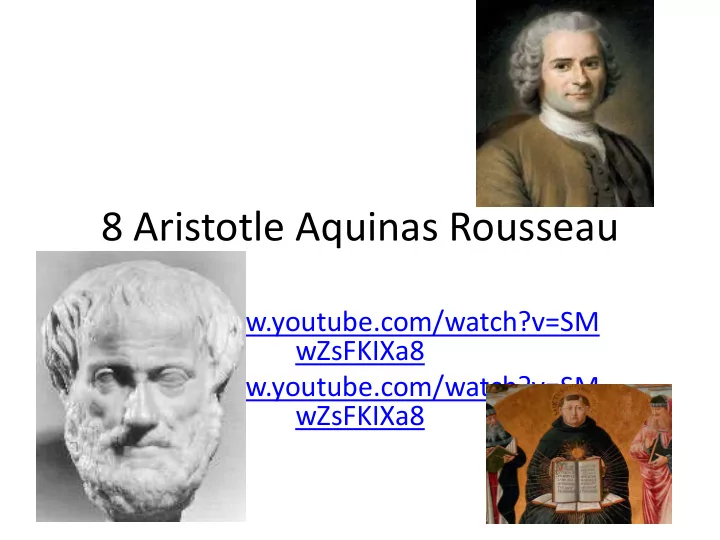
8 Aristotle Aquinas Rousseau http://www.youtube.com/watch?v=SM - - PowerPoint PPT Presentation

8 aristotle aquinas rousseau
SMART_READER_LITE
LIVE PREVIEW

8 Aristotle Aquinas Rousseau http://www.youtube.com/watch?v=SM - - PowerPoint PPT Presentation

8 Aristotle Aquinas Rousseau http://www.youtube.com/watch?v=SM wZsFKIXa8 http://www.youtube.com/watch?v=SM wZsFKIXa8 Review: What is the Political Community? Is it the same as the Polis? Whos in and Whos out? Who thinks the following?


slide-1
SLIDE 1

8 Aristotle Aquinas Rousseau

http://www.youtube.com/watch?v=SM wZsFKIXa8 http://www.youtube.com/watch?v=SM wZsFKIXa8

slide-2
SLIDE 2

Review: What is the Political Community? Is it the same as the Polis? Who’s in and Who’s out? Who thinks the following?

  • “The Polis come into being by consent to leave the state
  • f nature”
  • “Polis exists in the state of nature
  • “The Community needs to be governed by a state.”
  • A community is created and maintained by a powerful

prince.”

  • Do you have to give up freedom to be a member of the

Polis or political community?” Who says?

  • Who’s in and who’s out? Does it include the econ.

Community? Who says? Does size matter?

slide-3
SLIDE 3

Review: Political Economy in the political community

  • Who thinks that the polis should repress

human nature and who thinks it should flow from human nature?

  • what How does “who gets what” get decided

in the state of nature? According to whom?

  • How do they differ in their understanding of

that principle?

  • What other principles might a state use to

decide who gets what?

slide-4
SLIDE 4

Aristotle: Polis and economic community

  • Is the polis essentially identical to the

(enlarged) economic community?

– No: the end of the polis is different from the end

  • f the economic community. The difference is

qualitative. – Morally, material wealth is not interesting in the Polis…Real value is in the good life and not in the economy – Ends are good; means (even to good ends) are not so lofty. (Contrast with Machiavelli)

slide-5
SLIDE 5

Slavery: Human beings as tools

  • What is the difference between the “wage-

slave” and the actual slave?

  • For Aristotle, there is very little difference: in

both cases a person is made into or (makes himself into) the tool of another (and to that extent he or she is unfree)

slide-6
SLIDE 6

Wealth and trade: other implications of Aristotle’s argument

vs.

slide-7
SLIDE 7

Sum: Aristotle and Economic Justice: Paving the way for Aquinas

  • Economics is a lower form of activity than politics

– Economics is a means to an end; politics is an end in itself – those who contribute to the economy do not have citizenship! – The Polis is must not tainted with economic activity – The privilege of political leadership must not be based on wealth---it must be based on merit and honor

  • The good life has nothing to do

with wealth and wealth has nothing to do with value

  • Making money from money is evil!
slide-8
SLIDE 8

Fast Forward History…. Fast Forward History….

BEFORE AFTER GREECE ROMAN EMPIRE Constantine DARK AGES ROME FALLS Antisemitism

slide-9
SLIDE 9

The Economy corrupted the soul

Homo mercator vix aut numquam Deo placere potest

slide-10
SLIDE 10

Just Price

  • What is a “just price?”
  • Just Price represented norms holding the community

together

  • Why are market prices (supply and demand) wrong?

Two reasons

– Undermined community because it led to search for individual profits (temptation to buy cheap and sell dear) – Market Prices undermine inherent value “can’t buy me love!”

  • Church set the price so that souls would not be

corrupted (through greed, averice, deceit, lies)

slide-11
SLIDE 11

Thomas Aquinas modifies “Just Price” as the market takes over social life

  • Justice: equivalence in

exchange

  • Natural law is Will of God and

natural order

  • But…..transaction costs!
  • Moral worth of trade depends
  • n motives of the trader to

help the community

  • The state should enforce laws

that protect community and still allow the market to

  • perate
  • Just price is market price

without fraud or coercion!

“Sorrow can be alleviated by good sleep, a bath and a glass

  • f wine.” Thomas Aquinas
slide-12
SLIDE 12

"Good" is finite; there is a limited amout of material good, love, friendship "good" is infinate; there are infinate amounts of both material and non- material goods community is a closed system ruled by personal relationships and ascriptive heirarchies community is an open system guided by impersonal laws and freedom. if my situation is improved, yours is worsened and vice-versa: therefore, don't try to improve your position or you will be punished and

  • thers won't like you

If my situation improves, it doesn't hurt you, if fact, it may help you and vice-versa; we can both be rewarded by improvement Value cannot be created by man; it is given by

  • God. Therefore luck is rewarded, but hard

work is not rewarded; no relationship between hard work and the acquisition of wealth Value can be created through work; hard work should be rewarded Wealth is inherent in nature; there are limitations on land and technology; additional hard work will not improve anything Wealth comes from work; work and thrift create wealth progress is impossible; it will only come at the expense of others progress is both possible and necessary Individual achievement is punished; contentment with what you have is valued individual achievement is valued; contentment with what you have is punished. ancient Greek and medieval “COMMUNITY”values Modern values based on “FREEDOM”

slide-13
SLIDE 13

Carrying out the General Will

Rousseau and the purpose of the state

slide-14
SLIDE 14

How did Rousseau think like Plato and Aristotle?

  • "Do I dare set forth here the most important,

the most useful rule of all education? it is not to save time, but to squander it." Rousseau

  • "It is too difficult to think nobly when one

thinks only of earning a living." -Rousseau

slide-15
SLIDE 15

Rousseau’s “Social Contract”

  • We suffer in the state of nature under conditions
  • f scarcity:
  • We want to live sustainably, to avoid the conflict

in our souls

  • But we develop technology that allows us to have

more than we really need

  • And we begin to fight over the surplus
  • In order to avoid those fights, we enter into the

social contract —we consent to give up our natural freedom for civil liberty which is……

slide-16
SLIDE 16

Positive Freedom and Human Nature under the Social Contract

  • Negative vs. positive freedom
  • Positive freedom is living according to the laws of

rationality.

  • “The mere impulse of appetite is slavery, while
  • bedience to a law we prescribe to ourselves is liberty”

(Social Contract, bk. IV, ch. 8, p. 196).

  • Dissenters to the general will must be forced to be free.
  • How can that be?
  • Human nature changes! Or….we become truly human
  • nly in community
slide-17
SLIDE 17

Rousseau’s Noble Lie!

  • The “legislator” can’t use force and not everyone-
  • -even using the power of reason—will agree.

– People’s station in life gets in the way of reason

  • So he must have recourse to “divine

intervention—crediting the gods for our own wisdom so that people will submit to laws and

  • “might obey freely, and bear with docility the

yoke of the public happiness.”

  • It’s noble because it’s wise……. and politics needs

religion! (at least in the very beginning— countries need founding myths)

slide-18
SLIDE 18

The General Will

  • Human nature can change: collective

rationality replaces individual rationality*

  • “Each of us puts his person and all his power in

common under the supreme direction of the general will, and, in our corporate capacity, we receive each member as an indivisible part

  • f the whole.”
  • Like sticks in a bundle:

Stronger together!

slide-19
SLIDE 19

How does the General Will work?

  • When you give yourself to

the community, you give your all…..

  • Which means….. You are

not under the power of particular persons, but under the right of the law.

  • The “will” comes from the

whole to the individual, not from individual to the whole

  • It is indivisible!
slide-20
SLIDE 20

The General will is infallible

slide-21
SLIDE 21

Rousseau’s Political Economy

In the state of Nature

In the community of the General Will

  • Individual possession becomes

the property of all.

  • All possessions in the hands of

the sovereign!

  • The sovereign has the right of

eminent domain. *

  • Justice is the “Buffett Rule”
  • VS. ….
slide-22
SLIDE 22

In Sum

  • Rousseau does not believe in liberal individualism!
  • He doesn’t believe in private property if it’s useful to

the community—ok if the community doesn’t need it.

  • He is a civic republican---probably a social conservative
  • The General Will strengthens us
  • The General will is Machiavellian
  • The Sovereign is like the Philosopher-Kings
  • Justice is equality
  • Justice is when the individual submits to the conditions

he imposes on others.

slide-23
SLIDE 23

solitary individuals Community by consent hierarchies in power relations, masters and slaves, Kings and subjects, etc. equality of all citizens; equal rights for all citizens hierarchies should be functional—reason and rationality lead to this Natural Liberty as license; liberty as the independence of individuals; " an unlimited right to all that tempts us;" "a mode of living unsettled and insecure." civil liberty created by agreement; moral Liberty created by social limitations creates a secure mode of living. Impulse governs conduct. justice and law govern conduct Rights defined by power Rights defined by general will it is slavery to be under the impulse

  • f mere appetite

it is freedom to obey a law which we prescribe for ourselves Because there is no sovereign, rights are not protected authority, liberty, and the protection

  • f rights are mutually reinforcing; a

strong state protects rights constructed by the social contract

STATE OF NATURE SOCIAL CONTRACT

slide-24
SLIDE 24

Two Threads: Reason and Freedom