
SLIDE 1
patrick.rousseau@unicaen.fr EMIE-UP summer school “Multiscale Dynamics in Molecular Systems” 1
Experimental studies
- f decays at long timescales
Patrick Rousseau
patrick.rousseau@unicaen.fr
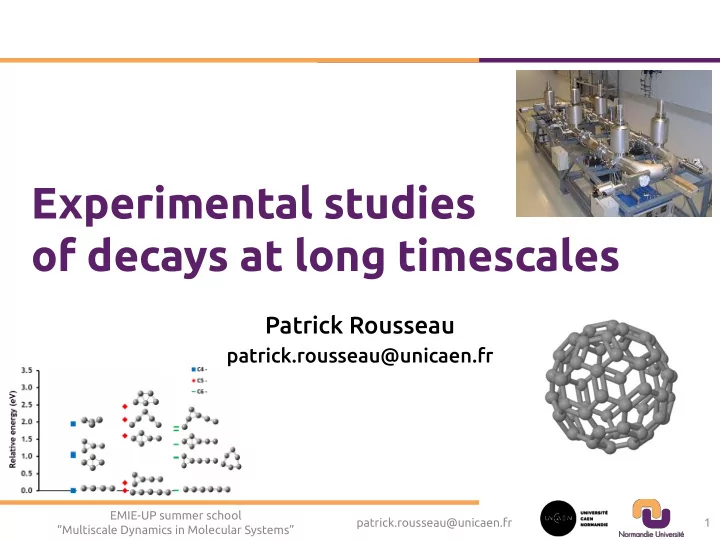
Experimental studies of decays at long timescales Patrick Rousseau - - PowerPoint PPT Presentation
Experimental studies of decays at long timescales Patrick Rousseau patrick.rousseau@unicaen.fr EMIE-UP summer school patrick.rousseau@unicaen.fr 1 Multiscale Dynamics in Molecular Systems Introduction Instru strume ment ntatio ion
patrick.rousseau@unicaen.fr EMIE-UP summer school “Multiscale Dynamics in Molecular Systems” 1
patrick.rousseau@unicaen.fr
patrick.rousseau@unicaen.fr EMIE-UP summer school “Multiscale Dynamics in Molecular Systems” 2
patrick.rousseau@unicaen.fr EMIE-UP summer school “Multiscale Dynamics in Molecular Systems” 3
They posses a large number of degrees of freedom: →! numerous relaxation channels are expected
patrick.rousseau@unicaen.fr EMIE-UP summer school “Multiscale Dynamics in Molecular Systems” 4
patrick.rousseau@unicaen.fr EMIE-UP summer school “Multiscale Dynamics in Molecular Systems” 5
They posses a large number of degree of freedom: →! numerous relaxation channels are expected
Today we will focus on really long timescales (higher than ns).
10-15 s 10-12 s 10-9 s 10-6 s 10-3 s 1 s 103 s
patrick.rousseau@unicaen.fr EMIE-UP summer school “Multiscale Dynamics in Molecular Systems” 6
At such long timescale, the system can be described by statistical physics. From the experimental point of view, we need to keep the control on the system BUT in 1 µs, a thermal water molecule runs through about 1 mm. One need to store the molecular system in order to study longer timescales.
10-15 s 10-12 s 10-9 s 10-6 s 10-3 s 1 s 103 s
patrick.rousseau@unicaen.fr EMIE-UP summer school “Multiscale Dynamics in Molecular Systems” 7
patrick.rousseau@unicaen.fr EMIE-UP summer school “Multiscale Dynamics in Molecular Systems” 8
Indeed for relatively “short” timescales (µs range), one may study the so- called delayed fragmentation using time-of-fmight mass spectrometer. With refmectron confjguration, one can observe decays occuring in the fjrst fjeld-free region.
ToF
patrick.rousseau@unicaen.fr EMIE-UP summer school “Multiscale Dynamics in Molecular Systems” 9
For longer timescales, the fjeld-free region length required is too high. →! one needs to consider alternative confjgurations (multiple refmections, ring…) Storage rings based on magnetic fjeld existed since several decades. However, as the molecular system can be heavy, it is important to consider instead electrostatic device with no mass limitation. In 1997, two families of electrostatic storages devices emerge:
patrick.rousseau@unicaen.fr EMIE-UP summer school “Multiscale Dynamics in Molecular Systems” 10
The idea is to use two electrostatic mirrors in order to obtain multiple refmection of the beam.
patrick.rousseau@unicaen.fr EMIE-UP summer school “Multiscale Dynamics in Molecular Systems” 11
t t Pick-up signal Neutral detector
patrick.rousseau@unicaen.fr EMIE-UP summer school “Multiscale Dynamics in Molecular Systems” 12
The use of electrostatic steering elements removes the mass limitation.
patrick.rousseau@unicaen.fr EMIE-UP summer school “Multiscale Dynamics in Molecular Systems” 13
t
patrick.rousseau@unicaen.fr EMIE-UP summer school “Multiscale Dynamics in Molecular Systems” 14
patrick.rousseau@unicaen.fr EMIE-UP summer school “Multiscale Dynamics in Molecular Systems” 15
Multiply charged fullerene can accomodate the charge excess. →! they are metastable on the µs timescale. This is due to the presence of a fjssion barrier associated with a transition state during the dissociation. Theoretical predictions stated that is stable while the dissociation energy is favourable from .
[S. Díaz-Tendero et al., Phys. Rev. Lett. 95 (2005) 013401]
patrick.rousseau@unicaen.fr EMIE-UP summer school “Multiscale Dynamics in Molecular Systems” 16
Using a long extraction region (several cm), it is possible to observe decays
ToF
patrick.rousseau@unicaen.fr EMIE-UP summer school “Multiscale Dynamics in Molecular Systems” 17
Based on the Weisskopf theory, a fragmentation model is obtained. The dissociation rate depends on the dissociation energy and fjssion barrier energy. Competition between dissociation by emission of neutral/charged C2. For higher charged states (q ≥ 4), one can expect a delayed fjssion.
patrick.rousseau@unicaen.fr EMIE-UP summer school “Multiscale Dynamics in Molecular Systems” 18
It is possible to deduce the lifetime of the metastable states studying their delayed fragmentation.
patrick.rousseau@unicaen.fr EMIE-UP summer school “Multiscale Dynamics in Molecular Systems” 19
Complex molecules with a broad energy distribution →! population of many initial excited states →! many difgerent exponential decays The emission rate is given by Considering that the energy distribution decays exponentially from an initial one broad enough to be considered as constant If is strongly peaked at its maximum It may be necessary to include a second term to the exponent
patrick.rousseau@unicaen.fr EMIE-UP summer school “Multiscale Dynamics in Molecular Systems” 20
Delaying the extraction of the ion into the ToF, one can study longer timescale. Evaporation model fails to fjt data →! competitive process
patrick.rousseau@unicaen.fr EMIE-UP summer school “Multiscale Dynamics in Molecular Systems” 21
Coupling between electronic and vibrational degrees of freedom by internal conversion. →! hot species are produced Decay through:
Evaporative model may be applied power law decay if broad initial energy distributions However some discrepancies may appear →! competitive process
patrick.rousseau@unicaen.fr EMIE-UP summer school “Multiscale Dynamics in Molecular Systems” 22
patrick.rousseau@unicaen.fr EMIE-UP summer school “Multiscale Dynamics in Molecular Systems” 23
Beside the dissociation, the internal energy can be lowered via electronic, vibrational and/or rotational transitions →! emission of one photon →! radiative cooling
patrick.rousseau@unicaen.fr EMIE-UP summer school “Multiscale Dynamics in Molecular Systems” 24
The radiative cooling quenches the thermoionic electron emission.
Neutral counts Time [s]
patrick.rousseau@unicaen.fr EMIE-UP summer school “Multiscale Dynamics in Molecular Systems” 25
The radiative cooling via vibrational transitions is associated with IR photons and long timescale (ms). It was proposed that inverse internal conversion (IIC) can lead to a fast radiative cooling by recurrent fmuorescence.
patrick.rousseau@unicaen.fr EMIE-UP summer school “Multiscale Dynamics in Molecular Systems” 26
Using a compact storage ring, the MINI-RING in Lyon, short revolution times (few µs) are accessible.
A fast quenching of the dissociation of anthracene cation is observed.
patrick.rousseau@unicaen.fr EMIE-UP summer school “Multiscale Dynamics in Molecular Systems” 27
Fast radiative cooling: IR cooling rate: →! Poincaré fmuorescence
Decay as a function of the cooling time shows that the anthracene population cools down on the ms timescale. →! internal energy distribution
patrick.rousseau@unicaen.fr EMIE-UP summer school “Multiscale Dynamics in Molecular Systems” 28
: decay in ms time range : decay below 0.1 ms. Poincaré fmuorescence requires excited states for inverse internal conversion.
patrick.rousseau@unicaen.fr EMIE-UP summer school “Multiscale Dynamics in Molecular Systems” 29
Detection of 607 nm photon correlated with revolution
patrick.rousseau@unicaen.fr EMIE-UP summer school “Multiscale Dynamics in Molecular Systems” 30
The emission of one photon allows to dissipate some excess energy. →! radiative cooling This may occur through both electronic and vibrational transitions. Vibrational transition:
Electronic transition:
patrick.rousseau@unicaen.fr EMIE-UP summer school “Multiscale Dynamics in Molecular Systems” 31
patrick.rousseau@unicaen.fr EMIE-UP summer school “Multiscale Dynamics in Molecular Systems” 32
The excess energy due to electron attachment can induce vibrational excitation: Further decays include:
patrick.rousseau@unicaen.fr EMIE-UP summer school “Multiscale Dynamics in Molecular Systems” 33
One may take into account the rotation of excited molecules. In order to observe the VAD, long storage time (several 100 ms) are required. →! cryogenic storage device
PhD of S. Merk Heidelberg University (2013)
patrick.rousseau@unicaen.fr EMIE-UP summer school “Multiscale Dynamics in Molecular Systems” 34
Cryogenic environments allow to increase the lifetime of the stored beam.
Storage of at CSR MPIK webpage
CSR Heidelberg DESIREE Stockholm
patrick.rousseau@unicaen.fr EMIE-UP summer school “Multiscale Dynamics in Molecular Systems” 35
Using a cryogenic EIBT it is possible to observe the VAD otherwise hidden by the depletion due to the background pressure. Model fjts well the data for difgerent source parameters.
patrick.rousseau@unicaen.fr EMIE-UP summer school “Multiscale Dynamics in Molecular Systems” 36
Similarly to , metal dimer such as can decays through dissociation or VAD.
Using room temperature storage device, the decay rate is well described (below 100 ms) by a power law assuming the fragmentation from high rotational levels. Decay at further time range is associated with the depletion of the beam due to collision with the residual gas.
1/signal (arb. units)
patrick.rousseau@unicaen.fr EMIE-UP summer school “Multiscale Dynamics in Molecular Systems” 37
Longer storage time are obtained with the DESIREE cryogenic ring. Deviation from the power law decay is not anymore due to depletion of the beam. →! contribution from the VAD
PhD of E. K. Anderson Stockholm University (2019)
patrick.rousseau@unicaen.fr EMIE-UP summer school “Multiscale Dynamics in Molecular Systems” 38
Coincidences between detectors disentangle the two contributions.
PhD of E. K. Anderson Stockholm University (2019)
For : high J level →! fragmentation high vibrational levels →! VAD no J - v exchange
patrick.rousseau@unicaen.fr EMIE-UP summer school “Multiscale Dynamics in Molecular Systems” 39
Vibrational auto-detachment (VAD) →! transfer from the vibrational energy to the electronic excitation →! electron emission Timescale can be very long (ms range) →! VAD “hidden” by beam depletion →! need of cryogenic device As the radiative cooling, VAD may be used to determine the internal energy distribution.
patrick.rousseau@unicaen.fr EMIE-UP summer school “Multiscale Dynamics in Molecular Systems” 40
patrick.rousseau@unicaen.fr EMIE-UP summer school “Multiscale Dynamics in Molecular Systems” 41
Passage from linear isomer to cyclic isomer →! isomerisation barrier: 2.68 eV
Nature Comm. 9 (2018) 912
patrick.rousseau@unicaen.fr EMIE-UP summer school “Multiscale Dynamics in Molecular Systems” 42
Trapping:
Laser excitation:
→! below and above →! no VAD from linear
Nature Comm. 9 (2018) 912
patrick.rousseau@unicaen.fr EMIE-UP summer school “Multiscale Dynamics in Molecular Systems” 43
VAD: IR radiative cooling: Recurrent fmuorescence from linear isomer: Isomerisation
Nature Comm. 9 (2018) 912
patrick.rousseau@unicaen.fr EMIE-UP summer school “Multiscale Dynamics in Molecular Systems” 44
Neutralisation by VAD from linear isomer after 1 and 2-photon excitation Neutralisation of cyclic isomer after isomerisation For one-photon excitation: For two-photon excitation: Total neutralisation rate:
Nature Comm. 9 (2018) 912
patrick.rousseau@unicaen.fr EMIE-UP summer school “Multiscale Dynamics in Molecular Systems” 45
Model fjts well the experimental data. Two-photon excited molecules promptly decay. One-photon excitation:
Nature Comm. 9 (2018) 912
Slow isomerisation
patrick.rousseau@unicaen.fr EMIE-UP summer school “Multiscale Dynamics in Molecular Systems” 46
Isomerisation is slow due to the barrier to pass BUT promptly after isomerisation, the cyclic isomer decays via VAD
Nature Comm. 9 (2018) 912
patrick.rousseau@unicaen.fr EMIE-UP summer school “Multiscale Dynamics in Molecular Systems” 47
Excited molecular system de-excites via various processes →! statistical physics Both electronic and vibrational dynamics observed in the range µs – s →! coupling between electronic and vibrational degrees of freedom (dissociation, isomerisation, radiative cooling, VAD) (Cryogenic) storage devices allow to prepare a well-defjned system
Action spectroscopy
Faraday Discuss. 217 (2019) 126
patrick.rousseau@unicaen.fr EMIE-UP summer school “Multiscale Dynamics in Molecular Systems” 48
patrick.rousseau@unicaen.fr EMIE-UP summer school “Multiscale Dynamics in Molecular Systems” 49
Photo-enhanced electron emission allows to determine the internal energy distribution.
patrick.rousseau@unicaen.fr EMIE-UP summer school “Multiscale Dynamics in Molecular Systems” 50
Vertical auto-detachment can also give the internal energy distribution.