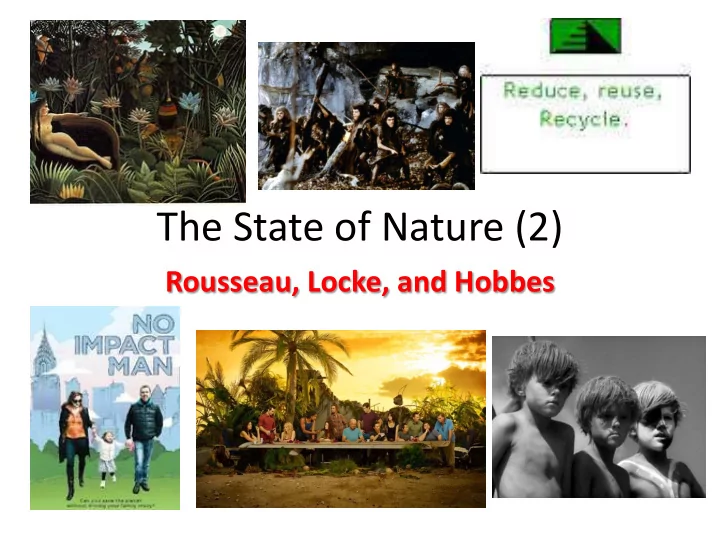
The State of Nature (2) Rousseau, Locke, and Hobbes Review .. - - PowerPoint PPT Presentation

the state of nature 2
SMART_READER_LITE
LIVE PREVIEW

The State of Nature (2) Rousseau, Locke, and Hobbes Review .. - - PowerPoint PPT Presentation

The State of Nature (2) Rousseau, Locke, and Hobbes Review .. Aristotle : State of Nature and Human Nature "Nature has a meaningful order What is human nature within that meaningful order? Two things: 1. Human beings are


slide-1
SLIDE 1

The State of Nature (2)

Rousseau, Locke, and Hobbes

slide-2
SLIDE 2

Review..Aristotle : State of Nature and Human Nature

  • "Nature has a meaningful order”
  • What is human nature within that

meaningful order? Two things:

  • 1. Human beings are naturally good
  • 2. Human beings are naturally political (social

and living in community

  • Aristotle’s Political Economy: Humans

Deserve what they are fit for and what they merit

slide-3
SLIDE 3

We deserve what we merit and what fits with our TRUE nature

Philosopher slaves

slide-4
SLIDE 4
slide-5
SLIDE 5

Rousseau, Locke, and Hobbes

slide-6
SLIDE 6

Rousseau

slide-7
SLIDE 7

Rousseau

  • Nature itself holds the key to a good life.

– God made all things good; man meddles with them and they become evil’

  • “Man” is good by nature; “he” has a divine

capacity to live by enlightened and noble ideals.

– Compassion and self preservation motivate him

  • it’s society that corrupts

– Rousseau took a dim view of human progress.

slide-8
SLIDE 8

Compassion is the key

  • “It is this compassion that hurries us without

reflection to the relief of those who are in distress: it is this which in a state of nature supplies the place of laws, morals, and virtues, with the advantage that none are tempted to disobey its gentle voice: it is this which will always prevent a sturdy savage from robbing a weak child or a feeble old man of the sustenance they may have with pain and difficulty acquired, if he sees a possibility of providing fur himself by

  • ther means.” (Discourse on the Origin of

Inequality, 76)

slide-9
SLIDE 9

Is natural compassion enough to prevent conflict?

  • Don’t compassion and self-preservation come

into conflict?

  • in a condition of scarcity we would suffer

doubly.

  • So we would want to avoid this situation.
  • How would we avoid it?
slide-10
SLIDE 10

Sustainability is the way to do it

  • Man wants to walk lightly on the earth
  • Savage man’s “desires never extend beyond

his physical wants; he knows no goods but food, a female, and rest”

Not for Profit!

For your own health

slide-11
SLIDE 11

Rousseau’s political Economy

  • Instead of fighting, we develop tools to survive. (we

don’t fight for scarce goods, we want to live sustainably)

  • Why does natural man innovate and not fight?
  • Natural man is naturally cooperative
  • And has leisure time and He becomes dependent on

consumer goods

  • And this is his downfall! EVIL!
  • It’s all downhill from here
  • And the real culprit is private property
  • And it all leads to war……
slide-12
SLIDE 12

Modern Anti-Consumerism

slide-13
SLIDE 13

Rousseau’s solution: “The Social Contract”

  • To bring peace
  • But most social contracts destroy our freedom
  • Rousseau argues for a form of association in

which 'while uniting himself with all (each associate) may still obey himself alone, and remain as free as before' (Social Contract, bk. 1, ch. 6, ).

slide-14
SLIDE 14

John Locke

slide-15
SLIDE 15

Locke’s imagined “state of nature”

  • Humans are born a “blank slate”
  • A state of perfect equality
  • Bound by the law of nature
  • 'Everyone... is bound to preserve himself, . . . so

by the like reason when his own Preservation comes not in competition, ought he, as much as he can, to preserve the rest of Mankind (Second Treatise, s. 6).

  • The state of nature is a state of perfect freedom
  • Or is it?
slide-16
SLIDE 16

Vigilante Justice

  • We are probably not naturally compassionate
  • It’s the law of nature!
  • “if any one in the state of nature may punish

another for any evil he has done, (then) every

  • ne may do so: for in that state of perfect

equality, where naturally there is no superiority or jurisdiction of one over another, what any may do in prosecution of that law, every one must needs have a right to do."

slide-17
SLIDE 17

Locke’s political economy in the state

  • f nature: The right to property
  • Reasoning:

– God put us on earth, – he did not put us here to starve. – But we will starve unless we can rightfully consume apples and acorns in peace – individuals can peacefully consume if they can securely possess plots of land and rightfully exclude others.

slide-18
SLIDE 18

What went wrong with this lovely picture?

  • Abundance will turn to scarcity
  • Why? The invention of money!
  • Once we have money we want more land than

we can use….

  • Land becomes scarce and we will fight over

the meaning of justice

  • The state is now unbearable
  • We will want a government!
slide-19
SLIDE 19

Hobbes

slide-20
SLIDE 20

Hobbes’ State of Nature

  • In the state of nature……
  • There is no authority above humans sooooo
  • There is no morality**
  • All are equal (no “natural” hierarchy/roles)*
  • All are AFRAID of violent death
  • All are solitary, isolated individuals
  • Each is free to preserve his own life
  • Nature is characterized by scarcity
slide-21
SLIDE 21

Liberty is necessity—freedom to obey the “Laws” of Nature

  • Because of the state of nature being a

state of war, we have to have a new understanding of liberty. "Liberty and necessity are consistent; as in the water, that hath not only liberty, but a necessity

  • f descending by the channel; so likewise

in the actions which men voluntarily do: which, because they proceed from their will, proceed from liberty." (p. 161) "In the act of our submission consisteth both

  • ur obligation and our liberty." (p. 164)
slide-22
SLIDE 22

Hobbes’ Dim view of Human Nature

  • People are always searching, never at rest,

always seeking objects of desire in a world of scarcity

  • We cannot trust each other*
  • We are not naturally cruel or selfish but we

are afraid**

  • We are rational***
  • To get what we desire, we must become

powerful

slide-23
SLIDE 23

Why Human Nature leads to war in the state of nature

  • Humans must be powerful to get what they desire (felicity)

– Sources of power are riches, reputations, friends**

  • They will never be satisfied, they always want more power
  • The search for power among equals leads to competition

for power and “desires” in a world of scarcity*

  • Because they both can’t have the same thing, they become

enemies

  • Three reasons for desiring, distrusting humans to attack in

the state of nature: for gain, for safety (to pre-empt invaders), and for glory or reputation.

  • Rational human action will make the state of nature a

battleground.***

slide-24
SLIDE 24

Hobbes’ Political Economy

  • No place for Industry
  • No navigation
  • No Trade
  • NO ECONOMY!
slide-25
SLIDE 25

The Hobbesean Fallacy

  • The premise of primordial individualism
  • In fact, however, community came first and

individualism later.*

slide-26
SLIDE 26

Science and human nature

  • biology and anthropology: there was never a

period in human evolution when human beings existed as isolated individuals

  • Indeed, the most basic forms of cooperation

predate the emergence of human beings by millions of years

slide-27
SLIDE 27

Science, state of nature, and human nature

  • When there was violence it was perpetrated

not by individuals but by tightly bonded social groups.

  • Human beings do not enter into society and

political life as a result of conscious, rational decision.

  • two natural sources of cooperative behavior:

kin selection and reciprocal altruism.

slide-28
SLIDE 28

Reciprocal altruism and Polanyi’s political economy

  • The economy is submerged in social

relationships

  • Material goods are only valuable insofar as

they serve those relationships

  • The economic system is run on non-economic

motives

– No profit – Giving freely is a virtue