SLIDE 1
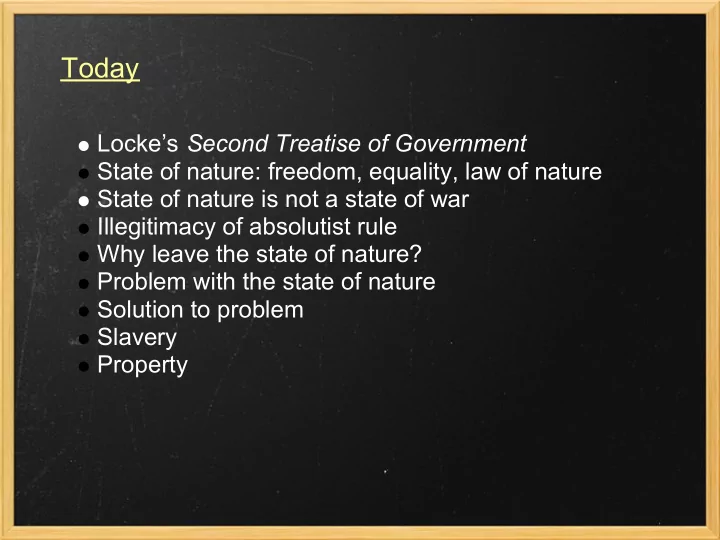
Today
Locke’s Second Treatise of Government State of nature: freedom, equality, law of nature State of nature is not a state of war Illegitimacy of absolutist rule Why leave the state of nature? Problem with the state of nature Solution to problem Slavery Property
SLIDE 2
Goal of Locke’s Second Treatise To determine the origin of political power To determine when political power is legitimate and when it is not To determine when we are obligated to obey the political powers and when we may legitimately resist To refute political absolutism
SLIDE 3
Locke’s State of Nature Locke’s state of nature: Perfect freedom Perfect equality Law of nature
SLIDE 4
Locke’s State of Nature Perfect equality “A state also of equality, wherein all the power and justification is reciprocal, no one having more than another… without subordination or subjection.” Equality is “the foundation of that obligation to mutual love amongst men, on which [is built] the duties they owe one another, and from whence [is derived] the great maxims of justice and charity.”
SLIDE 5
Locke’s State of Nature Perfect freedom “A state of perfect freedom to order their actions, and dispose of their possessions and persons, as they think fit, within the bounds of the law of nature, without asking leave, or depending upon the will of any other man.” The state of liberty is not a state of license to do whatever you want.
SLIDE 6
Locke’s State of Nature Perfect freedom “A state of perfect freedom to order their actions, and dispose of their possessions and persons, as they think fit, within the bounds of the law of nature, without asking leave, or depending upon the will of any other man.” The state of liberty is not a state of license to do whatever you want.
SLIDE 7 Locke’s State of Nature
Law of nature There is a law of nature, discoverable by reason, that
- bligates one “to preserve himself” and “to preserve
the rest of mankind.” The law of nature obligates us “not to harm others in their life, health, liberty, or possessions; and not to take away or impair the life of what tends to the preservation of the life, liberty, health, limb, or goods of another.” The law of nature follows from the fact that we are all the workmanship of God. Everyone is God’s property.
SLIDE 8
Locke’s State of Nature
Law of nature
We have a duty not to destroy ourselves because we are God’s property. We have a duty not to destroy others (unless our preservation absolutely depends on it) because they are God’s property. We have a duty not to harm another in life, liberty, healthy, or possessions. We have a duty to preserve not only ourselves but all of humankind.
SLIDE 9 State of nature is not a state of war
- State of Nature: peace, good will, mutual
assistance and preservation; people living together, according to reason, without a common superior on earth, each with the authority to judge and execute the law of nature. Not a prisoners’ dilemma.
SLIDE 10
State of nature is not a state of war
State of War: Enmity, malice, violence and mutual destruction; when someone has a declared design of force upon another; force without right.
SLIDE 11
State of nature is not a state of war State of War: When one person has a “sedate settled design upon another man’s life,” the first has declared war on the second.
SLIDE 12 State of nature is not a state of war State of War When someone has declared war on you (has expressed a design on your life), you have the right to kill him, just as you have the right to kill a wolf
SLIDE 13
State of nature is not a state of war State of War But, contra Hobbes, not everyone has such designs on you; and if a person does not threaten you, you have no right to harm them.
SLIDE 14
Illegitimacy of Absolutist Rule
He who attempts to gain absolute power over me declares himself to be in state of war with me. For if someone gains absolute power over me, he will be able to take away my liberty. And once he has taken away my liberty, he may then take away everything else. Indeed, he can kill me whenever he pleases.
SLIDE 15
Illegitimacy of Absolutist Rule
I have the right to kill someone who declares himself to be in a state of war with me. Therefore, I have the right to kill someone who tries to gain absolute power over me. This includes the right of preemptive attack.
SLIDE 16 Illegitimacy of Absolutist Rule
Freedom from absolute, arbitrary power is inalienable: you can never part with it because it is necessary for self- preservation, and self-preservation is demanded by the law of nature. To give someone absolute, arbitrary power
- ver you is to enslave yourself, which
violates the law of nature.
SLIDE 17 Illegitimacy of Absolutist Rule
To give someone absolute, arbitrary power
- ver you is to give someone the ability to
kill you whenever he pleases, which violates the law of nature. You do not have the right to take your own life, and so you cannot give anyone else that right.
SLIDE 18
Illegitimacy of Absolutist Rule
In the Hobbesian commonwealth, someone else has absolute, arbitrary power over you. You cannot give morally meaningful consent to someone else’s having absolute, arbitrary power over you.
SLIDE 19
Illegitimacy of Absolutist Rule
You cannot give morally meaningful consent to the Hobbesian social contract. The Hobbesian social contract cannot be legitimate; it cannot have any morally binding force.
SLIDE 20
What are the political implications of Locke’s attack on absolutist rule?
SLIDE 21
Locke maintains a distinction between force and right.
SLIDE 22
So why do we ever leave the state of nature?
SLIDE 23
Who enforces the law of nature when we are in the state of nature? Everyone has the right to enforce the law of nature. Everyone has the right to punish transgressions for the sake of reparation and restraint “so far as calm reason and conscience dictate.” One’s right to enforce the law of nature follows from one’s obligation to preserve mankind.
SLIDE 24 Are individuals perfect enforcers of the Law
Why? Or why not?
SLIDE 25
Problem with the state of nature
Locke thinks that while people may have reasonably good intentions, they will almost inevitably screw up the enforcement to some extent. Self-love will make people partial to themselves and their friends when they are judging the natural law in their own case.
SLIDE 26
Problem with the state of nature
Locke thinks that while people may have reasonably good intentions, they will almost inevitably screw up the enforcement to some extent. Ill nature, passion, and revenge will carry people too far in punishing others.
SLIDE 27 Solution to problem of the state of nature
The solution is to have civil government, which will prevent people from having to judge their own case (neutral third part referees). The purpose of civil government: to prevent the ills of a person’s judging his
SLIDE 28 Reason to leave the state of nature and enter into political unit: To create a situation in which there are neutral third party judges to enforce the law
Essential element of legitimate political unit: Neutral third party judges to enforce the law of nature.
SLIDE 29 A state of war between people who can appeal to an impartial third-party judge will
- ften be resolved and ended.
But a state of war between people who cannot appeal to an impartial third-party judge will likely continue to escalate.
SLIDE 30 Avoiding escalating states of war is a great reason for leaving the state of nature and entering society, as there are no impartial third-party judges in the state of nature. But it will be reasonable to enter a society
- nly if it contains impartial, third-party
judges for every conflict. A Hobbesian commonwealth does not contain impartial, third-party judges for every conflict. Therefore, a Hobbesian commonwealth is not reasonable to enter.
SLIDE 31
Hobbesian absolute monarchs judge in their own case. Hobbesian states fail to be proper civil governments: they lack the essential element of a legitimate political unit. We’re better off in the state of nature than in a Hobbesian state: the reason we have to leave the state of nature and enter a political unit does not support entering a state with an absolute ruler.
SLIDE 32
“Absolute monarchs are but men; and if government is to be the remedy of those evils, which necessarily follow from men’s being judges in their own cases, and the state of nature is therefore not to be endured, I desire to know what kind of government that is, and how much better it is than the state of nature…
SLIDE 33
“…where one man, commanding a multitude, has the liberty to be judge in his own case, and may do to all his subjects whatever he pleases, without the least liberty to any one to question or control those who execute his pleasure? and in whatsoever he doth, whether led by reason, mistake or passion, must be submitted to? …
SLIDE 34
“…Much better it is in the state of nature, wherein men are not bound to submit to the unjust will of another: and if he that judges, judges amiss in his own way, or any other case, he is answerable for it to the rest of mankind.” p. 112
SLIDE 35
Inalienability of freedom from absolute rule
Freedom from absolute rule is inalienable. No one can take it from you, and you can never give it away.
SLIDE 36
Why is it inalienable?
You cannot give away something you don’t have. You don’t have the right to destroy yourself. You cannot give anyone else the right to destroy yourself. Someone with absolute power over you can destroy you at will.
SLIDE 37
What is (legitimate) civil government?
Having a standing rule to live by which is common to everyone in society. Being able to follow my own will in all things about which that rule is silent. Not being subject to the inconstant, uncertain, unknown, arbitrary will of another man.
SLIDE 38 Slavery
Slavery is the absolute power of one person
Slavery is always unjust. All absolutist relationships are instances of slavery.
SLIDE 39
Property
What did Hobbes say about property in the state of nature? What do you think Locke says about this?