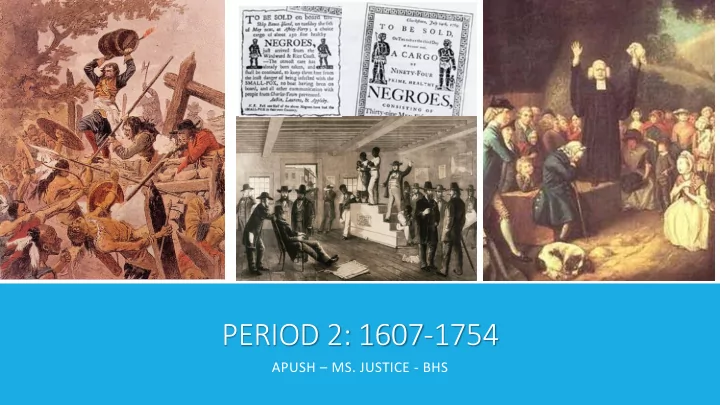
SLIDE 1 PERIOD 2: 1607-1754
APUSH – MS. JUSTICE - BHS
SLIDE 2
COMPETING MODELS OF COLONIZATION
SLIDE 3
COMPETING MODELS OF COLONIZATION
SLIDE 4
FAILURE & SUCCESS IN VIRGINIA
SLIDE 5 ENGLAND’S ATTEMPTS TO OUTMANEUVER SPAIN IN N. AM.
Roanoke
- John White
- 1587
- 1590 -no trace of
the colonists.
SLIDE 6 ENGLAND’S ATTEMPTS TO OUTMANEUVER SPAIN IN N. AM.
Jamestown
settlement
does not work, shall not eat.”
- John Rolfe & Pocahontas
- Tobacco
SLIDE 7 RELIGIOUS MOTIVATIONS FOR COLONIZATION
Plymouth colony
- 1620
- present-day Massachusetts
- Pilgrims
- Mayflower Compact: a “civil body politic”
- 1621 – the “first Thanksgiving”
SLIDE 8
CHESAPEAKE SOCIETY
SLIDE 9
SLIDE 10
ROYAL COLONY vs. PROPRIETARY COLONY
Virginia was a royal colony. Maryland was a proprietary colony.
Catholic “haven” in the New World.
SLIDE 11 LABOR SHORTAGES & INDENTURED SERVANTS
- High death rates
- Indenture contract
- Headright system
- Exploitation of labor
SLIDE 12 BACON’S REBELLION
- 1676
- English/Native American
conflicts on the frontier
- Low tobacco prices
- High taxes
- Massacred Indians
- Burned Jamestown
- Looted plantations
- Outcome: highlighted 2
disputes in colonial Virginia
SLIDE 13
- DOC. 2.10 – NATHANIEL BACON’S “DECLARATION
AGAINST GOVERNOR WILLIAM BERKELEY”
▪ Read Document 2.10 ▪ Highlight/underline important ideas ▪ Look up any words you do not know or understand ▪ On a separate sheet of notebook paper, respond to the “Practicing Historical Thinking” questions at the bottom of the page ▪ Read Document 2.13 (on the back) for Monday
SLIDE 14 FROM SERVITUDE TO SLAVERY
1640-1660
- Changing ideas about race
SLIDE 15
PURITANISM
SLIDE 16 A CITY UPON A HILL
- 1630
- Massachusetts Bay Company / Boston
- Puritan-dominated, self-governing
SLIDE 17 NEW ENGLAND WAYS
public conversion experience education mandatory church attendance
SLIDE 18
PURITAN INTOLERANCE
Roger Williams Anne Hutchinson
SLIDE 19
SLIDE 20
ECONOMIC & RELIGIOUS TENSIONS IN NEW ENGLAND
SLIDE 21 ECONOMIC TENSIONS
- Diversified economy
- Desire for prosperity
- “Outlivers”
SLIDE 22 RELIGIOUS TENSIONS
- Halfway covenant
- Pure saints vs. Puritan power
SLIDE 23
EXPANSION & NATIVE AMERICANS
SLIDE 24
PEQUOT WAR
SLIDE 25
PEQUOT WAR
We often look at the settlers of New England as religious, pious, and peaceful peoples. We mythologize the first Thanksgiving and the relationship between the Pilgrims and the Native Americans, yet the Pequot War tells a very different story. Why do you believe we are so quick to forget this important part of the history of Puritan settlers and embrace the mythology that we learned in grade school of the peaceful and freedom-seeking pilgrims?
SLIDE 26
KING PHILIP’S WAR
SLIDE 27
PRAYING TOWNS
SLIDE 28
THE SPREAD OF SLAVERY
SLIDE 29
THE WEST INDIES
SLIDE 30
CAROLINA
SLIDE 31
SLIDE 32
THE MIDDLE COLONIES
SLIDE 33
NEW NETHERLAND & NEW SWEDEN
SLIDE 34
THE BEAVER WARS
SLIDE 35 NEW YORK & NEW JERSEY
James, Duke of York / King James II
SLIDE 36
QUAKER PENNSYLVANIA
SLIDE 37
RIVALS FOR NORTH AMERICA: FRANCE & SPAIN
SLIDE 38 FRANCE CLAIMS A CONTINENT
- Jesuit missionaries
- Good Indian relations
- Fur trade/voyaguers
- 1702 - Mobile
SLIDE 39 NEW MEXICO
- 1680
- Pueblo Revolt
- 1692 – Spanish “reconquered” Santa Fe
- 1700 – Pueblo resistance conquered
- Encomienda abolished
SLIDE 40
REBELLION & WAR
SLIDE 41 THE DOMINION OF NEW ENGLAND
King Charles II King James II
SLIDE 42 THE GLORIOUS REVOLUTION
William & Mary
SLIDE 43
LEISLER’S REBELLION
SLIDE 44 A GENERATION OF WAR
Queen Anne’s War, 1702-1713
SLIDE 45
COLONIAL ECONOMIES & SOCIETIES
SLIDE 46
MERCANTILISM
SLIDE 47
SLIDE 48
POPULATION GROWTH
1700 1750 English: 250,000 1,170,000 (20% were slaves) French: 15,000 60,000 Spanish: 4,500 19,000
SLIDE 49
SLAVERY
SLIDE 50
SLAVERY & THE MIDDLE PASSAGE
SLIDE 51
SLAVERY
SLIDE 52
STONO REBELLION
SLIDE 53
RURAL VS. URBAN LIFE
SLIDE 54
RURAL VS. URBAN LIFE
SLIDE 55
COMPETING FOR A CONTINENT
SLIDE 56
FRANCE & THE AMERICAN HEARTLAND
SLIDE 57
BRITISH EXPANSION: GEORGIA
SLIDE 58
SPAIN’S BORDERLANDS
SLIDE 59
PUBLIC LIFE IN BRITISH AMERICA
SLIDE 60 COLONIAL POLICIES
- Self-government
- Religious tolerance
- No hereditary aristocracy
- Social mobility
SLIDE 61
THE ENLIGHTENMENT & GREAT AWAKENING
SLIDE 62
THE ENLIGHTENMENT
SLIDE 63 THE GREAT AWAKENING
Jonathan Edwards George Whitefield
SLIDE 64