Disclosure REBOA for Non-Compressible Torso REBOA for - - PDF document

disclosure
SMART_READER_LITE
LIVE PREVIEW

Disclosure REBOA for Non-Compressible Torso REBOA for - - PDF document

3/7/2018 Disclosure REBOA for Non-Compressible Torso REBOA for Non-Compressible Torso Hemorrhage: Hemorrhage: I have served as a consultant for Prytime Medical Inc History and the Way Forward History and the Way Forward J.R. Taylor III


slide-1
SLIDE 1

3/7/2018 1

REBOA for Non-Compressible Torso Hemorrhage: History and the Way Forward REBOA for Non-Compressible Torso Hemorrhage: History and the Way Forward

J.R. Taylor III MD Assistant Professor of Surgery, University of Arkansas for Medical Sciences @11A2TraumaMD

Disclosure

  • I have served as a consultant for Prytime

Medical Inc

Objectives

  • Describe the history of REBOA
  • Discuss the progression of the technology

and its evolution in clinical care

  • Discuss the way forward implementing

REBOA for trauma and acute care surgery

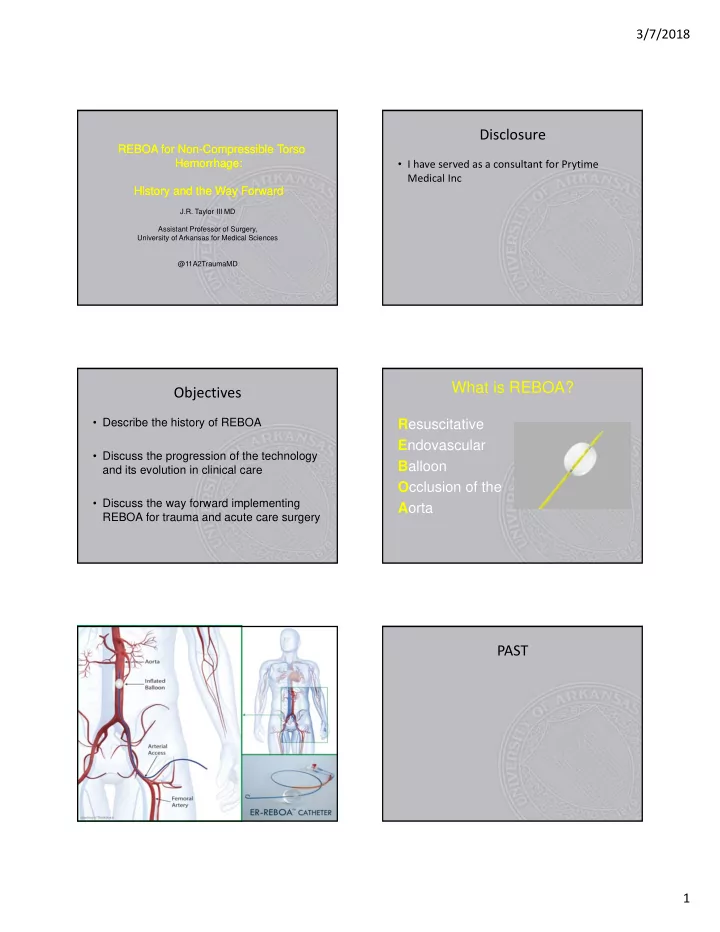
What is REBOA?

Resuscitative Endovascular Balloon Occlusion of the Aorta

PAST

slide-2
SLIDE 2

3/7/2018 2

Korean War Medical Advances

  • MASH Unit
  • Helicopter as flying ambulance
  • Blood collection and distribution using

plastic containers

  • Body armor
  • First attempted during the Korean War
  • Two patients with intra-abdominal hemorrhage
  • Placed AFTER patients received >10 units blood
  • Catheter placed through femoral artery
  • Balloon inflated at level of diaphragm
slide-3
SLIDE 3

3/7/2018 3

PRESENT

OIF / OEF / GWOT Medical Advances

  • Tourniquets
  • Improved body armor
  • Golden hour
  • Damage control resuscitation

Five Steps: 1.Obtain femoral arterial access 2.Balloon selection and positioning 3.Balloon inflation 4.Balloon deflation 5.Sheath removal

– Closure of arteriotomy – Confirm distal pulses

slide-4
SLIDE 4

3/7/2018 4

Aortic Occlusion Zones

  • Select zone of occlusion

based upon injury pattern

  • Zones I and III preferred
  • Avoid occlusion in Zone II
  • Confirm zone of occlusion
  • n plain x ray or

fluoroscopy

Conclusions from this series

  • REBOA is a feasible and effective means of

proactive aortic control for patients in end- stage shock from blunt and penetrating mechanisms

  • Can be safely placed by Acute Care

Surgeons with some, but no formal, vascular training

  • More studies necessary to define population

where REBOA is truly beneficial

Overall (N = 96) Resuscitative Thoracotomy (n=72) REBOA (n=24) p value Age Median (P25,P75)

30.5(23.5, 48) 41 (24,62) 0.33

Male %(n)

87.5% (63) 79.2%(19) 0.33

Blunt %(n)

44.4% (32) 66.7% (16) 0.10

ISS Median (P25,P75)

34 (22,59) 29 (19,41) 0.17

AIS Head Median (P25,P75)

3 (0,5) 4 (3,5) 0.29

AIS Chest Median (P25,P75)

3 (3,4) 3.5 (3,4) 0.91

AIS Abdomen Median (P25,P75)

2 (0,4) 3 (2,4) 0.26

AIS Extremity Median (P25,P75)

1.5 (0,3) 4 (3,4) <0.001

Survival Rate % (n)

9.7% (7) 37.5% (9) 0.003

slide-5
SLIDE 5

3/7/2018 5

Among Deaths (N=80)

Resuscitative Thoracotomy Deaths (n=65) REBOA Deaths (n=15) p value All Deaths %(n) 90.3% (65) 62.5% (15) 0.003 Died in ED %(n) 69.2% (45) 26.7% (4) <0.001 Died in OR %(n) 9.2% (6) 20% (3) 0.69 Died in ICU %(n) 21.6% (14) 53.3% (8) 0.17 Age Median (P25,P75) 31 (24,46) 40.5 (24,66) 0.41 Male %(n) 87.7% (57) 73.3% (11) 0.22 Blunt %(n) 44.6% (29) 73.3% (11) 0.08 ISS Median (P25,P75) 35.5 (22,67) 34 (20,45.5) 0.39

Comparison of Cause of ICU Death

RT ICU Deaths (n=14) REBOA ICU Deaths (n=8) Early death from hemorrhage %(n) 71.4% (10) 0% (0) Multiple organ failure %(n) 14.3% (2) 12.5% (1) Head injury %(n) 14.3% (2) 87.5% (7)

Comparison of Survivors

Among Survivors (N=16) Resuscitative Thoracotomy Alive (n=7) REBOA Alive (n=9) p value Survivors % (n) 9.7% (7) 37.5% (9) 0.003 Age Median (P25,P75) 29 (21,51) 43 (25,59) 0.71 Male % (n) 85.7% (6) 88.9% (8) 1.00 Blunt % (n) 42.9% (3) 55.6% (5) 1.00 ISS Median (P25,P75) 29 (16,34) 26 (17,29) 0.56

Conclusions from this series

  • Use of REBOA in patient with noncompressible

hemorrhage from abdomen and pelvis is feasible and effectively controls hemorrhage

  • Patients undergoing REBOA have at least equivalent
  • verall survival and fewer early deaths
  • Any patient with a suspected or confirmed major

intrathoracic injury and cardiovascular collapse should still undergo resuscitative thoracotomy

slide-6
SLIDE 6

3/7/2018 6

Case Example 1

  • 42 y/o male crushed between two cranes

while at work

  • Presented to the OSH with a GCS 15,

hypotension  intubated at OSH, hypotensive, placed in pelvic binder transferred to MHH

  • VS @ presentation, SBP 60, HR 120,

normal cxr, pelvis xray

Case Example 1

  • Cordis placed, right femoral arterial line

place, pelvic binder moved inferiorly

  • Persistent hypotension  right femoral

REBOA placed  SBP improved to 130

  • Taken to the CT scanner and

subsequently to the interventional radiology suite for angiography +/- embolization

slide-7
SLIDE 7

3/7/2018 7

  • Angiography without evidence of actively bleeding

arterial source  REBOA removed, sheath maintained in right groin

  • RUG showed prostatic urethral injury, so percutaneous

SP tube placed

  • Taken to the operating room found to have mesenteric

injury with devitalized small bowel segment x 2  small bowel resection with HS anastomosis x 2, no other injury, NJ feeding tube placed, fascia closed

  • Sheath removed after hemodynamics normalized,

coagulopathy corrected

Case Example 1

  • POD 1 went for placement of uniplanar

external fixator anterior pelvis, closed reduction percutaneous screw fixation of right SI joint disruption, closed reduction percutaneous screw fixation left sacral fracture

Case Example 1 Case Example 2

  • 41 y/o male s/p auto-pedestrian with

traumatic right lower extremity amputation below the knee

  • OSH intubated patient, placed right lower

extremity proximal tourniquet and transferred to MH

  • At evaluation, BP 60/40  52/30  massive

transfusion protocol started, right femoral arterial line placed, left subclavian cordis

slide-8
SLIDE 8

3/7/2018 8

Case Example 2

  • FAST initially negative then positive with

massive transfusion

  • 7FR sheath exchanged for right femoral

arterial line  REBOA deployed to Zone I

Case Example 2

  • Taken to the OR for exploratory laparotomy
  • At laparotomy found to have multiple Grade

III liver lacerations that underwent hepatorraphy and packing  wound vac placed

  • Right lower extremity mangled and non-

salvageable  gigli amputation undertaken

  • After liver packing and hepatorraphy balloon

deflated, hemodynamics maintained, and balloon removed

Case Example 2

  • Taken to STICU overnight for resuscitation
  • 7FR sheath pulled at bedside once TEG

normalized  72 hour post removal duplex showed no evidence of pseudoaneurysm

  • Taken next day to OR for pack removal

without evidence of further bleeding and formalization of AKA

  • Discharged to rehab after 41 day hospital

stay

Case Example 3

  • 34 y/o male with GSW to left thigh
  • Taken to OSH where improvised

tourniquet was placed

slide-9
SLIDE 9

3/7/2018 9

Case Example 3

  • Given hasty tourniquet right femoral artery

access was obtained, 7FR sheath placed and REBOA deployed but not inflated

  • Tourniquet removed, vascular control
  • btained, and balloon removed without

inflation

Case Example 3

  • Destructive injury to SFA, shunt placed 2

hours after time of injury

  • Artery repaired with reverse saphenous

vein graft

  • Discharged from hospital on POD 3

Future Prehospital REBOA

slide-10
SLIDE 10

3/7/2018 10 Emergency Room Use Non‐Trauma

slide-11
SLIDE 11

3/7/2018 11

Acute Care Surgery

Endovascular Training for Acute Care Surgeons

  • BEST  Basic Endovascular Skills for

Trauma Course  coordinated by the American College of Surgeons Committee

  • n Trauma
  • Endovascular procedures on vascular

surgery rotations aren’t just for fellows / chiefs  it is a skill that translates to other parts of surgery

slide-12
SLIDE 12

3/7/2018 12

Questions?