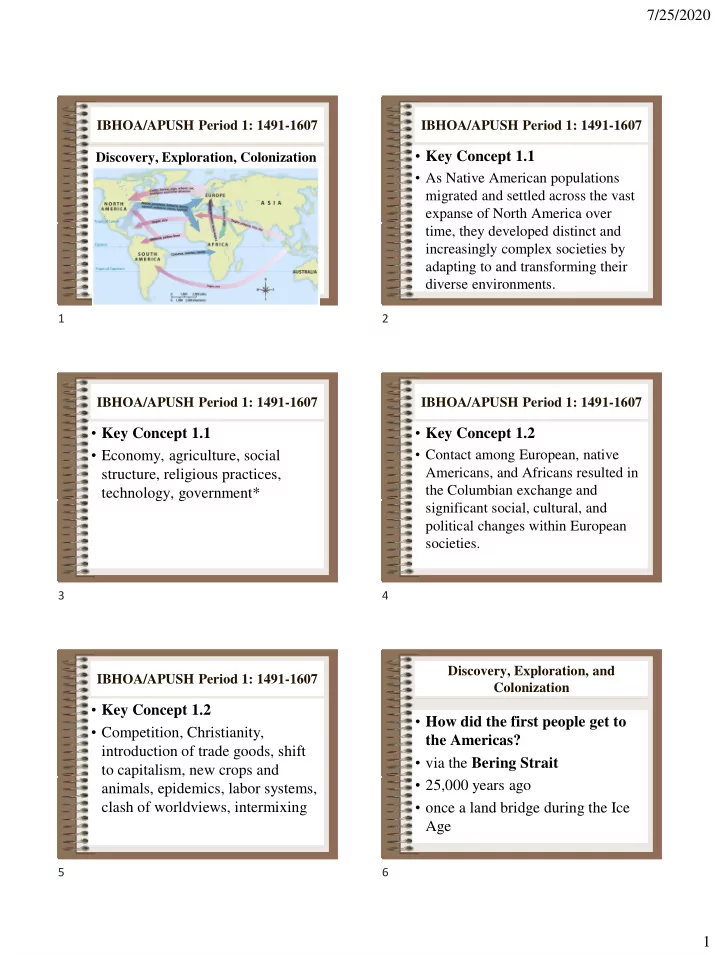
7/25/2020 IBHOA/APUSH Period 1: 1491-1607 IBHOA/APUSH Period 1: - - PDF document

7 25 2020
SMART_READER_LITE
LIVE PREVIEW

7/25/2020 IBHOA/APUSH Period 1: 1491-1607 IBHOA/APUSH Period 1: - - PDF document

7/25/2020 IBHOA/APUSH Period 1: 1491-1607 IBHOA/APUSH Period 1: 1491-1607 Key Concept 1.1 Discovery, Exploration, Colonization As Native American populations migrated and settled across the vast expanse of North America over time, they


slide-1
SLIDE 1

7/25/2020 1

Discovery, Exploration, Colonization IBHOA/APUSH Period 1: 1491-1607

  • Key Concept 1.1
  • As Native American populations

migrated and settled across the vast expanse of North America over time, they developed distinct and increasingly complex societies by adapting to and transforming their diverse environments.

IBHOA/APUSH Period 1: 1491-1607

  • Key Concept 1.1
  • Economy, agriculture, social

structure, religious practices, technology, government*

IBHOA/APUSH Period 1: 1491-1607

  • Key Concept 1.2
  • Contact among European, native

Americans, and Africans resulted in the Columbian exchange and significant social, cultural, and political changes within European societies.

IBHOA/APUSH Period 1: 1491-1607

  • Key Concept 1.2
  • Competition, Christianity,

introduction of trade goods, shift to capitalism, new crops and animals, epidemics, labor systems, clash of worldviews, intermixing

IBHOA/APUSH Period 1: 1491-1607

  • How did the first people get to

the Americas?

  • via the Bering Strait
  • 25,000 years ago
  • once a land bridge during the Ice

Age

Discovery, Exploration, and Colonization

1 2 3 4 5 6

slide-2
SLIDE 2

7/25/2020 2

Discovery, Exploration, and Colonization

  • Mesolithic – hunters/gatherers
  • crude tools, used fire
  • migration ended 10,000 years ago
  • temperatures increased, oceans

rose, land bridge covered

Discovery, Exploration, and Colonization

  • What did they find?
  • abundant land
  • only 1-7 million people
  • warmer temps

Discovery, Exploration, and Colonization

  • What did they do?
  • many tribes split up and settled
  • others were nomadic for survival
  • quarrels and curiosity also divided

them

Results

  • variety of cultures and languages

developed – est. 500 by the year 1500

  • ranged from simple tribal existences

to a few large civilizations (Aztec, Maya, Inca)

  • adaptation to a variety of climates

The Key

  • the single most important factor of all

– ?????????????????????????????????? ?????????????????????????????????? ????????????

7 8 9 10 11 12

slide-3
SLIDE 3

7/25/2020 3

Discovery, Exploration, and Colonization

  • GEOGRAPHY
  • Results in economic development and

social diversification among Native American societies Examples

  • Southeast – forests, slash and burn

agriculture (Cherokee)

  • Northeast and Atlantic Seaboard –

(Iroquois, Algonquin)

  • Plains and Great Basin – nomadic,

dependent on bison herds and the horse (Sioux, Cheyenne, Dakota)

Examples

  • Southwest – adobe construction

(Navajo, Apache, Hopi, Pueblo)

  • Pacific Northwest – fishing,

potlatch, totem poles (Chinook)

Case Study – Native American Diversity

  • Choose any TWO Native American

cultures – they MUST be from different regions – you may include Canada and Central America

  • Briefly compare and contrast your two

cultures using the list of characteristics under Key Concept 1.1

  • Add population around the year 1500 to

the list of characteristics

Case Study – Native American Diversity

  • Gather the information
  • Analyze your findings
  • Compare and Contrast
  • What similarities do you observe based on

the characteristics assigned?

  • What differences do you observe based on

the characteristics assigned?

  • Due Friday

13 14 15 16 17 18

slide-4
SLIDE 4

7/25/2020 4

World Events Leading to Exploration

  • 1. The Crusades – began in 1095
  • Results of the Crusades
  • *Europeans exposed to different

foods, clothes, jewels of the East

  • *eventually made trading partners
  • f their former enemies

World Events Leading to Exploration

  • *great demand created
  • *the goal – to maximize trade

by finding the swiftest route east from Europe

World Events Leading to Exploration

  • 2. The Black Death – plague
  • wiped out 1/3 of the entire

population of Europe – Dark Ages late 1200s-1300s

World Events Leading to Exploration

  • 3. Travels of Marco Polo (1300)
  • copies slowly reached Europe

throughout 1300s – why 100 years?

  • curiosity about the east is

reawakened in Europe

World Events Leading to Exploration

  • 4. The Renaissance – French

word for “rebirth” – 14th and 15th centuries

  • health had improved
  • curiosity revived

19 20 21 22 23 24

slide-5
SLIDE 5

7/25/2020 5

Seeds of Exploration

  • led by Portugal – purpose to ALL

exploration – search for new, quicker water routes to the East

  • Prince Henry the Navigator 1418

– founded a school for sailors, developed the caravel, astrolabe

Seeds of Exploration

  • Portugal begins trading

relationships with West African nations – end of 15th century

  • Products?
  • guns and horses for gold and

slaves

25 26 27 28 29 30

slide-6
SLIDE 6

7/25/2020 6

Seeds of Exploration

  • continued search for path to the

Indies – around southern tip of Africa

  • 1488 – Bartolome Dias sails to

Cape of Good Hope, S. tip of Africa

Seeds of Exploration

  • 1498 – Vasco da Gama around

Africa to India

  • profitable trade established, his

ship returned 60x the cost of its exploration.

Spanish Influence in the New World

  • Spain claims America with the

voyages of Columbus

  • Columbus’ theory: sail west as a

quicker path east

  • Rejected by Portugal and Italy
  • Found sponsors in Spain

Voyages of Columbus Spanish Influence in the New World

  • “discovered” America while

searching for Asia 1492

  • died thinking he had

accomplished his goal

  • named the natives “Indians”

(Indies)

31 32 33 34 35 36

slide-7
SLIDE 7

7/25/2020 7

Spanish Influence in the New World

  • 1494 – Conflict between Spain

and Portugal

  • Treaty of Tordesillas set up a

line of demarcation under the authority of Pope Alexander IV

Spanish Influence in the New World

  • Treaty divides the Americas
  • west of line to Spain – incl all
  • f North Am.
  • east of line to Portugal

Spanish Influence in the New World

  • Spain established as dominant

world power by 1500 Spanish Learn the Truth

  • *1513 – Ponce de Leon search for

Asia found Florida – 1st in U.S.

  • *1513 – Balboa crossed isthmus of

Panama – 1st European to see Pacific

Spanish Learn the Truth

  • *1519 – Magellan lost his life

proving that traveling west to reach Asia was impractical

  • *Who was right all along?
  • *PORTUGAL

37 38 39 40 41 42

slide-8
SLIDE 8

7/25/2020 8

Spanish Learn the Truth

  • Sp. focus in North Am. will

shift from discovery to conquest The Spanish Empire

  • The Conquistadors
  • ruthless seekers of gold and

fame for selves and country

  • God, Gold, Glory

The Spanish Empire

  • 1. Hernan Cortes 1520-21
  • lived among Aztecs in Mexico
  • burned own ships – why?
  • conquered and destroyed Aztec

empire The Spanish Empire

  • Why so easy?
  • 1. Impact of diseases – smallpox
  • 2. Thought the Spanish were

gods

  • 3. Superior weapons
  • 4. Death of Montezuma – Aztec

leader

The Spanish Empire

  • 5. Starvation due to
  • verpopulation
  • 6. Use of the horse
  • 7. Alliances with Aztec

enemies – added thousands to his 500+ The Spanish Empire

  • 2. Francisco Pizarro 1532
  • conquered and destroyed the Inca

empire

  • Andes Mountains
  • death of Atahualpa
  • 3. Juan de Onate – North Am.

conquest of Pueblos 1598

  • Rio Grande Valley – Battle of Acoma

1599

43 44 45 46 47 48

slide-9
SLIDE 9

7/25/2020 9

The Spanish Empire

  • Shift from conquest to

colonization 1525-1625

  • Why?
  • Riches not abundant
  • conquistadors to encomenderos
  • became farmers, ranchers

The Spanish Empire

  • Encomienda system leads to

enslavement of NAs, intermixing, development of an economy

  • Diseases continued to harm NAs – 9

million dead by 1600

  • Mestizos – Racial diffusion between

Spanish and NAs

  • Zambo – ?

The Spanish Empire

  • Economic Base (encomienda system)
  • sugar, silver mining, agriculture
  • SP – horses, cows; NAs – maize

(corn), potatoes

  • Documents – OPCVL, context, point
  • f view, intended audience

Analyzing Historical Resources The Spanish Empire

  • Role of RCC in Sp. Colonies
  • Bartolome de Las Casas
  • Promoted laws to protect NAs who

converted to the RCC, end their enslavement

  • Promotes transportation of African

slaves to Sp. colonies

  • Animism – clash of religious world

views (Euro, NA, African)

49 50 51 52 53 54

slide-10
SLIDE 10

7/25/2020 10

The Spanish Empire The Spanish Empire

  • Junipero Sierra
  • priest who established missions

along west coast – “mission system”

  • converted NA’s gained access to

missions in travels

  • Juan de Sepulveda – diff POV

The Spanish Empire The Spanish Empire

  • Communication Problems
  • magnified NA abuses
  • distance
  • power struggles, new sets of laws

applied

The Spanish Empire

  • Pope’s Rebellion 1680 aka Pueblo

Revolt

  • Pueblo leader punished for religious

practices

  • led 17,000 SW warriors vs. the

Spanish

  • freed SW region from Spanish control

for 14 years

Contest For Empire Begins

  • Late 1500s to mid 1700s
  • European Colonization of North

America

  • A clash of worldviews, cultures
  • Spanish, French, Dutch, English,

African, Native American, other?

55 56 57 58 59 60

slide-11
SLIDE 11

7/25/2020 11

Contest For Empire Begins

  • 1. Early English Disasters
  • A. Humphrey Gilbert settles

Newfoundland 1583

  • winter too harsh
  • sails back to England, ship

sinks, dead Contest For Empire Begins

  • B. Walter Raleigh
  • settles Roanoke Island 1585
  • John White in charge – 118p.
  • Virginia Dare
  • “the lost colony” – 1590
  • CROATOAN

Contest For Empire Begins

  • Challenges to Spain
  • England 1580s
  • Elizabeth I vs. Philip II
  • Role of Francis Drake
  • Defeat of Spanish armada 1588
  • Significance??

Contest For Empire Begins

  • Leads to colonization of

America’s by England, France, the Netherlands Contest For Empire Begins

  • 2. Early French Colonies
  • Jacques Cartier 1534 –

explored St. Lawrence River

  • Samuel de Champlain – estab.

Quebec 1608

61 62 63 64 65 66

slide-12
SLIDE 12

7/25/2020 12

Contest For Empire Begins

  • explore Great Lakes and Miss.

River

  • claim entire area for France

1682 – called Louisiana

  • only 80,000 by 1760

Contest For Empire Begins

  • French more interested in

economic profit – fur trade

  • coureurs du bois
  • formed strong econ alliances

with NA tribes – Huron, Ottawa

  • military alliances will develop

Contest For Empire Begins

  • 3. The Dutch in America
  • Henry Hudson – employed by

the Dutch

  • “theft” of Manhattan Island
  • New Amsterdam est. 1621
  • fur trade with Iroquois

New Amsterda dam

67 68 69 70