Patient Population Characteristics N = 965 Mean age - - PowerPoint PPT Presentation

patient population characteristics
SMART_READER_LITE
LIVE PREVIEW

Patient Population Characteristics N = 965 Mean age - - PowerPoint PPT Presentation

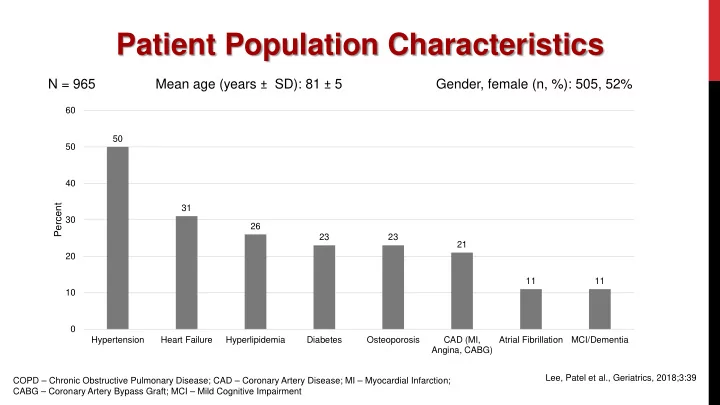
Patient Population Characteristics N = 965 Mean age (years SD): 81 5 Gender, female (n, %): 505, 52% 60 50 50 40 Percent 31 30 26 23 23 21 20 11 11 10 0 Hypertension Heart Failure


slide-1
SLIDE 1

50 31 26 23 23 21 11 11 10 20 30 40 50 60 Hypertension Heart Failure Hyperlipidemia Diabetes Osteoporosis CAD (MI, Angina, CABG) Atrial Fibrillation MCI/Dementia

Percent

Patient Population Characteristics

N = 965 Mean age (years ± SD): 81 ± 5 Gender, female (n, %): 505, 52%

COPD – Chronic Obstructive Pulmonary Disease; CAD – Coronary Artery Disease; MI – Myocardial Infarction; CABG – Coronary Artery Bypass Graft; MCI – Mild Cognitive Impairment Lee, Patel et al., Geriatrics, 2018;3:39

slide-2
SLIDE 2

48 36 16 10 20 30 40 50 60 Physically active: 30+ min moderate intensity 5+ days/week Physically active:

  • ccasionally or

during some seasons Not physically active beyond activities of daily activities

Percent

Exercise (N = 945)

14 7 2 4 6 8 10 12 14 16 Gait Speed Gait Speed _ Hand Grip

Percent

Frailty (N = 965)

Level 1 Screening Results

4 5 1 2 3 4 5 6 2+ in past 6 months Falls in past 6 months requiring medical attention

Percent

Falls (N = 750)

Lee, Patel et al., Geriatrics, 2018;3:39

slide-3
SLIDE 3

Screening Component n (%) Fracture Risk (N = 119) Prescribed medications for osteoporosis 23 (19%) Not prescribed medication for osteoporosis /T-L spine x-rays were ordered 27 (23%) Not prescribed medication for osteoporosis/ BMD testing ordered. 51 (43%) Mental Health Screening PHQ-9 – positive screen for depression (N = 50) 11 (7%) GAD-7 – positive screen for anxiety disorder (N = 94) 4 (3%) LSNS-6 – positive screen for social isolation (N = 117) 29 (20%) Zarit Caregiver Burden – positive screen for high burden (N = 103) 15 (15%) Cognition Screening (N = 119) Mini-Cog – positive screen 26 (22%) Urinary Incontinence Screening (N = 147) Patients reporting symptoms of urinary incontinence 47 (39%) Assessment Urgency Algorithm (N = 68) Level 1 Level 2 Level 3 Level 4 Level 5 Level 6 21 (31%) 8 (12%) 22 (32%) 5 (7%) 1 (1%) 10 (15%)

Lee, Patel et al., Geriatrics, 2018;3:39

Screening Component

Level 2 Screening Results

slide-4
SLIDE 4

Initial medication review (n = 41) Total medications/patient (mean/range) 11 (5 – 23) Prescribed medications/patients (mean/range) 8 (3 – 15) Over the Counter Medication per patient (mean/range) 4 (0 – 9) PRN per patient (mean/range) 1.44 (0 – 8) High Risk Drug (HRD) per patient (mean/range) 3.27 (0 – 7) % patients on 1+ HRD 95% % patients on 5+ prescribed medications 90% % patients on 5+ total medications 100%

Medication Use in Frailty

(April 2013 (April 2013 (April 2013 – August 2015; Pharmacist Review)

Patel T, Bauer J, Lee L et al. CPJ 2016; 149: S27

slide-5
SLIDE 5

Top 10 prescription medications (n = 142)

77% 56% 43% 42% 42% 32% 30% 30% 27% 27% 0% 10% 20% 30% 40% 50% 60% 70% 80% 90% 100% % of patients using ≥1 7% 90% 32% 17% 15% 63% 10% 0% 10% 20% 30% 40% 50% 60% 70% 80% 90% 100% Insulin CV meds NSAIDs O/N BD2 AP/AC Other % of patients using ≥1 Initial medication review

Top 10 prescription medications (n = 142)

Review of Medications in C5 Review of Medications in C5- Review of Medications in C5 75

High risk drugs used by patients with an initial medication review (n = 41)

Patel T, Bauer J, Lee L et al. CPJ 2016; 149: S27 Hu C. Can J Ger

Anti-HTN: Antihypertensives; HMG-CoA RI: 3-hydroxy-3-methyl-glutaryl-coenzyme A reductase inhibitor; AP: Antiplatelet (including ASA); GI Protection: Histamine 2 blocker or proton pump inhibitor; AD: Antidepressants; Topicals: Topical creams/ointments/lotions; APAP: Acetaminophen; BP: Biphosphates/bone modifying agents CV meds: Digoxin, antihypertensive medications; NSAIDS: Nonsteroidal anti- inflammatory drugs; O/N: Opiods/Narcotics; BD2: Benzodiazepines and analogues; AP/AC: Antiplatelets/Anticoagulants
slide-6
SLIDE 6

Pilot test of C5-75 in less well resourced practice setting

  • Urban family practice, 14 physicians; 11,819 patients
  • Co-located with a community pharmacy

Community pharmacists/staff trained to complete C5-75 screening Screening was completed with 46 patients

  • Mean age = 80 (± 4.7); range = 72 – 97 years
  • 71% female

Frailty based on

  • Gait speed: 13% (6/46)
  • Gait speed with grip strength: 9% (4/46)

Level 2 Screening: 12 (26%) Surveys of staff (N = 2) and patients (N = 33): feasibility, acceptability and satisfaction

  • Patient Satisfaction: mean = 4.5/5; 93% ≥4 ratings
  • Pharmacy staff: screening perceived as feasible and acceptable
  • Time concerns in only 2 (4%) of cases
  • No staff reported lack of comfort with screening

75 in less well resourced practice setting

Community Pilot

slide-7
SLIDE 7
  • Continue developing program to improve effectiveness and efficiency
  • Impact of interventions
  • Challenges, barriers
  • Healthcare providers, patients and caregivers
  • Performance of individual components
  • Diagnostic accuracy
  • Influence on healthcare
  • Perceived value to stakeholders
  • Perceived practicality (efficiency and acceptability) to stakeholders

Future of C5-75

slide-8
SLIDE 8
  • Between 2014-2015, surveys completed by 123 patients who received C5-75

assessments demonstrated high levels of satisfaction with screening processes, time required, and contributions to care decisions resulting from this program; none expressed dissatisfaction

  • Between 2014-2015, surveys were also completed by 31 health care

providers, including 18 family physicians whose patients whose patients received C5-75 assessments.

Patient and Health Care Provider impacts

slide-9
SLIDE 9

Comments from 18 family physicians in response to the question, “Is there any other feedback you would like to provide relating to your experience as a healthcare provider as part of this pilot project?”:

  • “The C5-75 program has been essential in coordinating & delivering truly effective care to

these patients. Patients themselves have appreciated the continuity of care. This clinic utilized the best of various professionals.”

  • “This has been very helpful in a busy practice to identify complex patients and screen them.

This has led to helpful suggestions and improved care (additional interventions that were needed).”

  • “I find this program to be very valuable to identify frail patients, and especially to help us as

practitioners understand how to reduce risks and better treat this complex population.”

  • “C5-75 has identified issues as yet less obvious in a variety of my patients. It has been very

positive.”

  • “Has helped automate some screening, which would normally be missed in regular practice

setting.”

  • “Excellent response from patients.”

Comments from 18 family physicians in response to the question “Is there any other feedback you

Impact Testimonials

slide-10
SLIDE 10

In summary, C5-75:

  • 1. Utilizes a feasible, objective, valid means of quickly screening for frailty

during busy clinical practice using gait speed with hand grip strength

  • 2. Integrates a structured, multidisciplinary, evidence-informed approach to

systematically and pro-actively screen for and manage frailty and its associated conditions

  • 3. Has been developed by practicing primary care practitioners, tested,

piloted, and designed for integration into Canadian primary care practice

  • 4. Aims to change the system of primary healthcare to better address the

needs of frail older adults, enabling them to maintain health and wellbeing with best quality of life for as long as possible

slide-11
SLIDE 11

Core Project Team Members

  • Dr. Linda Lee, Dr. Tejal Patel, Dr. James Milligan, Dr. John Pefanis,
  • Ms. Kara Skimson, Dr. Jason Locklin, Dr. Stephanie Lu

Contributors to Research

  • Dr. Andrew Costa, Dr. Lora Giangregorio, Dr. Susan Hunter,
  • Dr. Heather Keller, Dr. Veronique Boscart, Dr. Karen Slonim, Dr. Erin Bryce,
  • Ms. Loretta M. Hillier

Contributors to Clinical Expertise

  • Dr. Joseph Lee, Dr. Frank Molnar, Dr. George Heckman,
  • Dr. Robert McKelvie, Dr. Eric Hentschel, Dr. Alex Papaionnou,
  • Dr. Satish Rangaswamy

We gratefully acknowledge Lindsay Donaldson, Wende Bederian. Wendy Batte, Marg Alfieri, and the CFFM FHT We gratefully acknowledge Lindsay Donaldson,

slide-12
SLIDE 12