Mitigating Risks While Optimizing the Benefits of Pharmacologic - - PowerPoint PPT Presentation

mitigating risks while optimizing the benefits of
SMART_READER_LITE
LIVE PREVIEW

Mitigating Risks While Optimizing the Benefits of Pharmacologic - - PowerPoint PPT Presentation

Mitigating Risks While Optimizing the Benefits of Pharmacologic Agents to Manage Pain in the Elderly Mary Lynn McPherson, PharmD, MDE, MA, BCPS, CPE Professor and Executive Director, Advanced Post-Graduate Education in Palliative Care,


slide-1
SLIDE 1

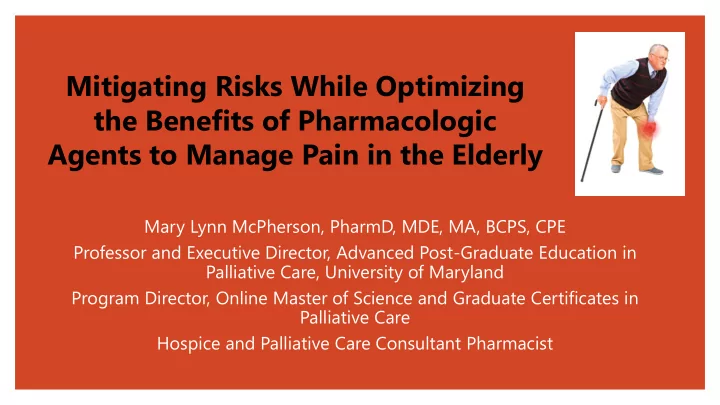
Mitigating Risks While Optimizing the Benefits of Pharmacologic Agents to Manage Pain in the Elderly

Mary Lynn McPherson, PharmD, MDE, MA, BCPS, CPE Professor and Executive Director, Advanced Post-Graduate Education in Palliative Care, University of Maryland Program Director, Online Master of Science and Graduate Certificates in Palliative Care Hospice and Palliative Care Consultant Pharmacist

slide-2
SLIDE 2
  • 1. Describe the pharmacokinetic and pharmacodynamic changes

associated with aging, including absorption, distribution, metabolism and excretion.

  • 2. Propose non-pharmacologic and pharmacologic avenues for
  • ptimizing pain management in older adults and patients near

the end-of-life.

Learning Objectives

slide-3
SLIDE 3
  • NIH study found 53% of people > 65 years old reported having

bothersome pain in the last month

  • Three-quarters of them reported having pain in more than one loation
  • Bothersome pain was associated with decreased physical capacity
  • Complicating things – 75% of people > 65 years have > 2 chronic

conditions

  • We are undertreating pain in older adults, especially those with

severe dementia

Are our elderly in pain?

slide-4
SLIDE 4

Organ System Dermatology Gastrointestinal Cardiovascular Pulmonary Rheumatology Endocrine Nephrology Immune Neurology Oncology Miscellaneous

Diseases associated with chronic pain

slide-5
SLIDE 5

Organ System Examples Dermatology Pressure or ischemic ulcers, burns, scleroderma Gastrointestinal Constipation, irritable bowel disease, diverticulitis, inflammatory bowel disease Cardiovascular Advanced heart disease, peripheral vascular disease Pulmonary Advanced chronic obstructive pulmonary disease, pleurisy Rheumatology Osteoarthritis, rheumatoid arthritis, gout, pseudogout, polymyalgia rheumatica, spinal stenosis/LBP , osteoporotic fracture Endocrine Diabetic neuropathy, Paget’s disease Nephrology Chronic cystitis, end stage renal disease Immune Herpes zoster, post-herpetic neuralgia, HIV/AIDs neuropathy Neurology Headache, peripheral neuropathies, compressive neuropathies, radiculopathies, Parkinson’s disease, post-stroke pain Oncology Cancer Miscellaneous Depression, tendonitis, bursitisz

Diseases associated with chronic pain

slide-6
SLIDE 6
  • Sensory
  • Please tell me all of the places you experience pain or discomfort
  • What does it feel like?
  • What words come to mind?
  • Is your pain or discomfort with you all of the time or does it come and go?
  • How long has it been present?
  • What makes it better, what makes it worse?
  • Emotional Impact
  • Has pain affected your mood, sense of well-being, energy level?
  • Are you worried about your pain or what may be causing it?

Elements of a comprehensive geriatric pain assessment

slide-7
SLIDE 7
  • Functional Impact
  • Has pain affected your ability to do every day activities? To do things you enjoy?
  • How about relating with others? If so, how?
  • Sleep
  • Has pain affected your sleep?
  • Do you have trouble falling asleep or need to take drugs to help you sleep on

account of your pain?

  • Coping Styles
  • What things do you do to help you cope with your pain? This could be listening to

your favorite music, praying, sitting still, or isolating yourself from others

Elements of a comprehensive geriatric pain assessment

slide-8
SLIDE 8
  • Attitudes and Beliefs
  • Do you have any thoughts or opinions about experiencing pain at this point in

your life that you believe would be important for me to know?

  • Do you have any thoughts or opinions about specific pain treatments that you

believe would be important for me to know?

  • Treatment Expectations and Goals
  • What do you think is likely to happen with the treatment I have recommended?
  • What are the most important things you hope will happen as a result of the

treatment?

  • Resources
  • Is there anyone at home or in the community that you can turn to for help and

support when your pain is really bad?

Elements of a comprehensive geriatric pain assessment

slide-9
SLIDE 9
  • Emotional Impact
  • Has pain affected your mood, sense of well-being, energy level?
  • Are you worried about your pain or what may be causing it?
  • Functional Impact
  • Has pain affected your ability to do every day activities? To do things you

enjoy?

  • How about relating with others? If so, how?

Elements of a comprehensive geriatric pain assessment

slide-10
SLIDE 10
slide-11
SLIDE 11
slide-12
SLIDE 12
slide-13
SLIDE 13
  • Physical therapy
  • Interventional approaches
  • Exercise / Weight loss
  • Psychological support
  • Cognitive behavioral therapy
  • Self-management programs

Non-Drug Interventions

slide-14
SLIDE 14

What about analgesics in older adults?

slide-15
SLIDE 15
  • Absorption
  • Possibly reduced intestinal absorption of agents requiring active transport
  • Reduced first-pass metabolism
  • Increased absorption of some high-clearance drug
  • Decreased absorption of drugs from prodrugs

Pharmacokinetic Changes in the Elderly

Clin Geriat Med 28 (2012) 273-286.

slide-16
SLIDE 16
  • Distribution
  • Altered free fraction of some drugs
  • Increased free fraction of albumin-bound drugs
  • Decreased free fraction of alpha-1-glycoprotein bound drugs
  • Altered volume of distribution
  • Increased half-life for lipophilic drug
  • Increased permeability of blood-brain barrier

Pharmacokinetic Changes in the Elderly

Clin Geriat Med 28 (2012) 273-286.

slide-17
SLIDE 17
  • Metabolism
  • Delayed metabolism of high clearance drugs
  • Excretion
  • Increased half-life for water-soluble drugs

Pharmacokinetic Changes in the Elderly

Clin Geriat Med 28 (2012) 273-286.

slide-18
SLIDE 18

Acetaminophen NSAIDs Coanalgesics Opioids

Safest? Most toxic?

slide-19
SLIDE 19
  • First line for older adults with mild to moderate pain
  • Analgesic, antipyretic
  • What’s the maximum daily dose of acetaminophen?
  • Caution with liver disease, alcoholism

Acetaminophen

slide-20
SLIDE 20
  • Commonly used to treat musculoskeletal pain in older adults
  • Heart disease, renal disease, GI issues
  • Only 40% of older adults on a NSAID have cytoprotective therapy

prescribed

  • Cardiovascular risk – COX-2 selective vs. nonselective NSAIDs?
  • Drug-drug interactions
  • Aspirin, SSRIs, antihypertensives

NSAIDs

slide-21
SLIDE 21
  • Antidepressants
  • SSRIs? TCA? SNRIs?
  • TCAs < 100 mg/day not shown to increase risk of cardiac death
  • > 100 mg was associated with greater number of cardiac deaths
  • Gabapentinoids?
  • Dose-related adverse effects
  • Adjustment with renal impairment

Adjuvant Analgesics

slide-22
SLIDE 22
  • Are opioids for chronic-non-cancer pain effective in older adults?
  • Is precribing opioids safe in frail older adults?
  • What are some guidelines for prescribing opioid for older adults?
  • Are older adults are at risk for addiction to opioids?
  • What is appropriate in renal disease (ESRD/dialysis)?

Opioids

slide-23
SLIDE 23

Step 2 - 3 Agents - Opioids

  • Codeine
  • Hydrocodone
  • Oxymorphone
  • Meperidine
  • Morphine
  • Hydromorphone
  • Oxycodone
  • Levorphanol
  • Methadone
  • Fentanyl
  • Tramadol
  • Tapentadol
  • Agonist/Antagonist or

partial agonists

  • Buprenorphine
  • Butorphanol
slide-24
SLIDE 24

Variables Effecting Therapy

  • Agent Variables
  • Mechanism of action and efficacy
  • Available dosage formulations
  • Pharmacokinetics (distribution, onset, peak and duration of action, t 1/2,

method of elimination from body, presence of active metabolites)

  • Side effects and toxicities
  • Cost (Total cost impact)
  • Patient Variables
  • Renal, hepatic function, body habitus
  • Pregnancy, breastfeeding
slide-25
SLIDE 25

First Line Opioids

  • Morphine
  • Oxycodone
  • Hydromorphone
  • Methadone
  • Buprenorphine
  • Fentanyl

Pain Pract 2008;8:287-313

25

slide-26
SLIDE 26
  • Majority glucuronidated
  • M3G (paradoxical neuroexcitatory effects)
  • M6G (analgesia)
  • Buprenorphine
  • Up to 30% metabolized by 3A4
  • No clinically important drug interactios

Morphine and Buprenorphine

slide-27
SLIDE 27
  • Fentanyl
  • Potent 3A4 inhibitors (ritonavir, ketoconazole, clarithromycin) increases

fentanyl

  • Inactive metabolites
  • Methadone
  • Metabolized by N-demethylation to inactive metabolite
  • 3A4 and 2D6 primary enzymes

Fentanyl and Methadone

slide-28
SLIDE 28
  • Oxycodone
  • Extensively metabolized to noroxycodone, oxymorphone and glucuronide

metabolites

  • Weakly analgesic
  • Hydromorphone
  • Generally not involved in major drug interactions
  • HM3G can be a neuroexcitatory metabolite

Oxcodone and Hydromorphone

slide-29
SLIDE 29

Agent Related Variables

  • Common Adverse Effects
  • Constipation
  • Nausea/vomiting
  • Sedation, confusion
  • Uncommon Adverse Effects
  • Respiratory depression
  • Pruritus
slide-30
SLIDE 30
  • Link potential treatment benefits with important patient goals (e.g.,

increased ability to perform activities of daily living)

  • Use medication combinations (in which each analgesic works by a

different mechanism) to enhance analgesic effectiveness

  • Acetaminophen remains first-line pharmacologic treatment for older

adults with mild-to-moderate pain

  • Avoid long-term use of oral nonsteroidal anti-inflammatory drugs, given

their significant cardiovascular, gastrointestinal, and renal risks

  • Trial of opioid is appropriate for patients not responsive to first-line

therapies and who continue to experience significant functional impairment due to pain

Key Points

slide-31
SLIDE 31
  • Consider serotonin-norepinephrine reuptake inhibitors or selective

serotonin reuptake inhibitors in patients with comorbid depression and pain

  • Implement surveillance plan (e.g., efficacy, tolerability, adherence)

with each new treatment

  • Physical activity (including PT, exercise, or other movement-based

programs such as tai chi) constitutes a core component of managing persistent pain in older patients

Key Points

slide-32
SLIDE 32
  • Educate older patients about safety and efficacy of cognitive

behavioral and movement-based therapies and identify local practitioners or agencies that provide them

  • Determine whether treatment goals are being met; if goals are not

met, medication should be tapered and discontinued, physical and

  • ccupational therapy prescription modified, or both.

Key Points

slide-33
SLIDE 33

Mitigating Risks While Optimizing the Benefits of Pharmacologic Agents to Manage Pain in the Elderly

Mary Lynn McPherson, PharmD, MDE, MA, BCPS, CPE Professor and Executive Director, Advanced Post-Graduate Education in Palliative Care, University of Maryland Program Director, Online Master of Science and Graduate Certificates in Palliative Care Hospice and Palliative Care Consultant Pharmacist

slide-34
SLIDE 34