Particle in a static E-field Consider a charge particle q - - PowerPoint PPT Presentation

particle in a static e field
SMART_READER_LITE
LIVE PREVIEW

Particle in a static E-field Consider a charge particle q - - PowerPoint PPT Presentation

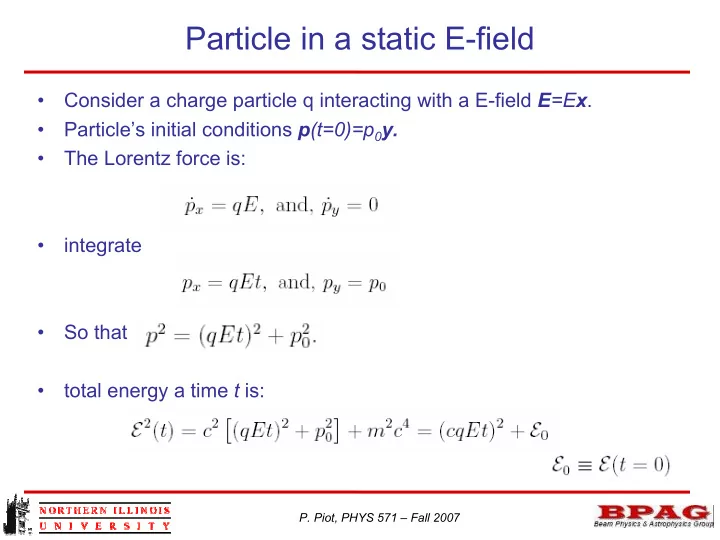
Particle in a static E-field Consider a charge particle q interacting with a E-field E =E x . Particles initial conditions p (t=0)=p 0 y. The Lorentz force is: integrate So that total energy a time t is: P. Piot,


slide-1
SLIDE 1
  • P. Piot, PHYS 571 – Fall 2007

Particle in a static E-field

  • Consider a charge particle q interacting with a E-field E=Ex.
  • Particle’s initial conditions p(t=0)=p0y.
  • The Lorentz force is:
  • integrate
  • So that
  • total energy a time t is:
slide-2
SLIDE 2
  • P. Piot, PHYS 571 – Fall 2007

Particle in a static E-field

  • The velocity is then
  • Integrate
  • Similarly for y axis we have
  • Integrate
slide-3
SLIDE 3
  • P. Piot, PHYS 571 – Fall 2007

Particle in a static E-field

  • Explicit t as a function of y
  • And insert in x(t)
  • Note the NR limit
slide-4
SLIDE 4
  • P. Piot, PHYS 571 – Fall 2007

Particle in a static E-field

slide-5
SLIDE 5
  • P. Piot, PHYS 571 – Fall 2007

Particle in a static B-field

  • Consider a charge particle q interacting with a B-field B=Ez.
  • Particle’s initial conditions p(t=0)=p0y.
  • The Lorentz force is:
  • From
  • We get the 3 equations
slide-6
SLIDE 6
  • P. Piot, PHYS 571 – Fall 2007

Particle in a static B-field

  • These are a system of 3 coupled ODEs of the form

with

  • We can cast the transverse equations into one equation
  • Whose solution is so finally ( )
slide-7
SLIDE 7
  • P. Piot, PHYS 571 – Fall 2007

Particle in a static B-field

  • This is the equation of an helix with axis

along z and radius R

  • R is the gyro-radius
  • ω is the gyro-frequency
  • In SI units: