Performance metrics for caches Basic performance metric: hit ratio h - - PDF document

performance metrics for caches
SMART_READER_LITE
LIVE PREVIEW

Performance metrics for caches Basic performance metric: hit ratio h - - PDF document

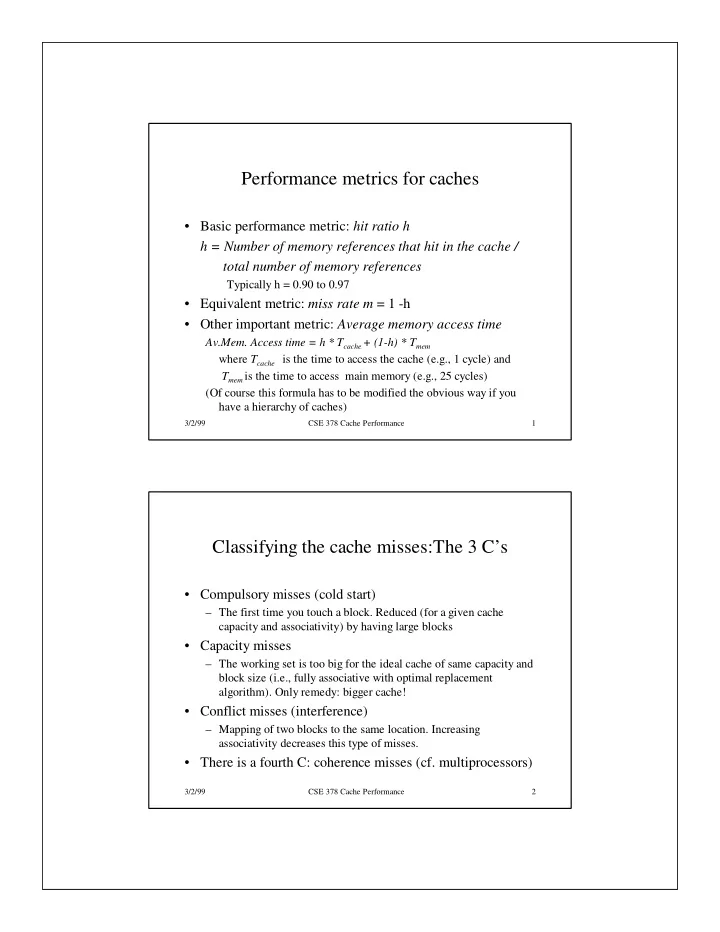
Performance metrics for caches Basic performance metric: hit ratio h h = Number of memory references that hit in the cache / total number of memory references Typically h = 0.90 to 0.97 Equivalent metric: miss rate m = 1 -h Other


slide-1
SLIDE 1

3/2/99 CSE 378 Cache Performance 1

Performance metrics for caches

  • Basic performance metric: hit ratio h

h = Number of memory references that hit in the cache / total number of memory references

Typically h = 0.90 to 0.97

  • Equivalent metric: miss rate m = 1 -h
  • Other important metric: Average memory access time

Av.Mem. Access time = h * Tcache + (1-h) * Tmem where Tcache is the time to access the cache (e.g., 1 cycle) and Tmem is the time to access main memory (e.g., 25 cycles) (Of course this formula has to be modified the obvious way if you have a hierarchy of caches)

3/2/99 CSE 378 Cache Performance 2

Classifying the cache misses:The 3 C’s

  • Compulsory misses (cold start)

– The first time you touch a block. Reduced (for a given cache capacity and associativity) by having large blocks

  • Capacity misses

– The working set is too big for the ideal cache of same capacity and block size (i.e., fully associative with optimal replacement algorithm). Only remedy: bigger cache!

  • Conflict misses (interference)

– Mapping of two blocks to the same location. Increasing associativity decreases this type of misses.

  • There is a fourth C: coherence misses (cf. multiprocessors)
slide-2
SLIDE 2

3/2/99 CSE 378 Cache Performance 3

Parameters for cache design

  • Goal: Have h as high as possible without paying too much

for Tcache

  • The bigger the cache size, the higher h.

– True but too big a cache increases Tcache – Limit on the amount of “real estate” on the chip (although this limit is starting to disappear)

  • The larger the cache associativity, the higher h.

– True but too much associativity is costly because of the number of comparators required and might also slow down Tcache

  • Block (or line) size

– For a given application, there is an optimal block size but that

  • ptimal block size varies from application to application

3/2/99 CSE 378 Cache Performance 4

Parameters for cache design (ct’d)

  • Write policy (see later)

– There are several policies with, as expected, the most complex giving the best results

  • Replacement algorithm (for set-associative caches)

– Not very important for caches (will be very important for paging systems)

  • Split I and D-caches vs. unified caches.

– On-chip caches need to be split because of pipelining that requests an instruction every cycle. Allows for different design parameters for I-caches and D-caches – Second and higher level caches are unified (mostly used for data)

slide-3
SLIDE 3

3/2/99 CSE 378 Cache Performance 5

Example of cache hierarchies (don’t quote me on

these numbers)

MICRO L1 L2 Alpha 21064 8K(I), 8K(D), WT, 1-way, 32B 128K to 8MB,WB, 1-way,32B Alpha 21164 8K(I), 8K(D), WT, 1-way, 32B ,D l-u fr. 96K, WB, on-chip, 3-way,32B,l-u free Alpha 21264 64K(I), 64K(D),?, 2-way, ? up to 16MB Pentium 8K(I),8K(D),both, 2-way, 32 B Depends Pentium II 16K(I),16K(D), WB, 4-way(I),2-way(D), 32B,l-u free 512K,32B,4-way, tightly-coupled

3/2/99 CSE 378 Cache Performance 6

Examples (cont’d)

PowerPC 620 32K(I),32K(D),WB 8-way, 64B 1MB TO 128MB, WB, 1-way MIPS R10000 32K(I),32K(D),l-u, 2-way, 32B 512K to 16MB, 2-way, 32B

slide-4
SLIDE 4

3/2/99 CSE 378 Cache Performance 7

Back to associativity

  • Advantages

– Reduces conflict misses

  • Disadvantages

– Needs more comparators – Access time is longer (need to choose among the comparisons, i.e., need of a multiplexor) – Replacement algorithm is needed and could get more complex as associativity grows

3/2/99 CSE 378 Cache Performance 8

Replacement algorithm

  • None for direct-mapped
  • Random or LRU or pseudo-LRU for set-associative caches

– Not a very important factor for performance, mostly in large caches – LRU means that the entry in the set which has not been used for the longest time will be replaced (think about a stack)

slide-5
SLIDE 5

3/2/99 CSE 378 Cache Performance 9

Impact of associativity on performance

Direct-mapped 2-way 4-way 8-way Typical curve. Biggest improvement from direct- mapped to 2-way; then 2 to 4-way then incremental Miss ratio

3/2/99 CSE 378 Cache Performance 10

Impact of block size

  • Recall block size = number of bytes stored in a cache entry
  • On a cache miss the whole block is brought into the cache
  • For a given cache capacity, advantages of large block size:

– decrease number of blocks: requires less real estate for tags – decrease miss ratio IF the programs exhibit good spatial locality – increase transfer efficiency between cache and main memory

  • For a given cache capacity, drawbacks of large block size:

– increase latency of transfers – might bring unused data IF the programs exhibit poor spatial locality – Might increase the number of capacity misses

slide-6
SLIDE 6

3/2/99 CSE 378 Cache Performance 11

Impact of block size on performance

Miss ratio 8 bytes 16 bytes 32 bytes 64 bytes 128 bytes Typical form of the curve. The knee might appear for different block sizes depending on the application and the cache capacity

3/2/99 CSE 378 Cache Performance 12

Performance revisited

  • Recall Av.Mem. Access time = h * Tcache + (1-h) * Tmem
  • We can expand on Tmem as Tmem = Tacc + b * Ttra

– where Tacc is the time to send the address of the block to main memory and have the DRAM read the block in its own buffer, and – Ttra is the time to transfer one word (4 bytes) on the memory bus from the DRAM to the cache, and b is the block size (in words)

  • For example, if Tacc = 5 and Ttra = 1, what cache is best

between

– C1 (b1 =1 ) and C2 (b2 = 4) for a program with h1 = 0.85 and h2=0.92 assuming Tcache = 1 in both cases.

slide-7
SLIDE 7

3/2/99 CSE 378 Cache Performance 13

Writing in a cache

  • On a write hit, should we write:

– In the cache only (write-back) policy – In the cache and main memory (or higher level cache) (write- through) policy

  • On a cache miss, should we

– Allocate a block as in a read (write-allocate) – Write only in memory (write-around)

3/2/99 CSE 378 Cache Performance 14

Write-through policy

  • Write-through (aka store-through)

– On a write hit, write both in cache and in memory – On a write miss, the most frequent option is write-around, I.e., write only in memory

  • Pro:

– consistent view of memory ; – memory is always coherent (better for I/O); – more reliable (no error detection-correction “ECC” required for cache

  • Con:

– more memory traffic (can be alleviated with write buffers)

slide-8
SLIDE 8

3/2/99 CSE 378 Cache Performance 15

Write-back policy

  • Write-back (aka copy-back)

– On a write hit, write only in cache (requires dirty bit) – On a write miss, most often write-allocate (fetch on miss) but variations are possible – We write to memory when a dirty block is replaced

  • Pro-con reverse of write through

3/2/99 CSE 378 Cache Performance 16

Cutting back on write backs

  • In write-through, you write only the word (byte) you

modify

  • In write-back, you write the entire block

– But you could have one dirty bit/word so on replacement you’d need to write only the words that are dirty

slide-9
SLIDE 9

3/2/99 CSE 378 Cache Performance 17

Hiding memory latency

  • On write-through, the processor has to wait till the memory

has stored the data

  • Inefficient since the store does not prevent the processor to

continue working

  • To speed-up the process have write buffers between cache

and main memory

– write buffer is a (set of) temporary register that contains the contents and the address of what to store in main memory – The store to main memory from the write buffer can be done while the processor continues processing

  • Same concept can be applied to dirty blocks in write-back

policy

3/2/99 CSE 378 Cache Performance 18

Coherency: caches and I/O

  • In general I/O transfers occur directly to/from memory

from/to disk

  • What happens for memory to disk

– With write-through memory is up-to-date. No problem – With write-back, need to “purge” cache entries that are dirty and that will be sent to the disk

  • What happens from disk to memory

– The entries in the cache that correspond to memory locations that are read from disk must be invalidated – Need of a valid bit in the cache (or other techniques)