Fluctuations of the Fluctuations of the superconducting order - - PowerPoint PPT Presentation

fluctuations of the fluctuations of the superconducting
SMART_READER_LITE
LIVE PREVIEW

Fluctuations of the Fluctuations of the superconducting order - - PowerPoint PPT Presentation

Fluctuations of the Fluctuations of the superconducting order parameter superconducting order parameter as an origin of the Nernst Nernst effect effect as an origin of the Karen Michaeli and Alexander M. Finkelstein Nernst Effect- -


slide-1
SLIDE 1

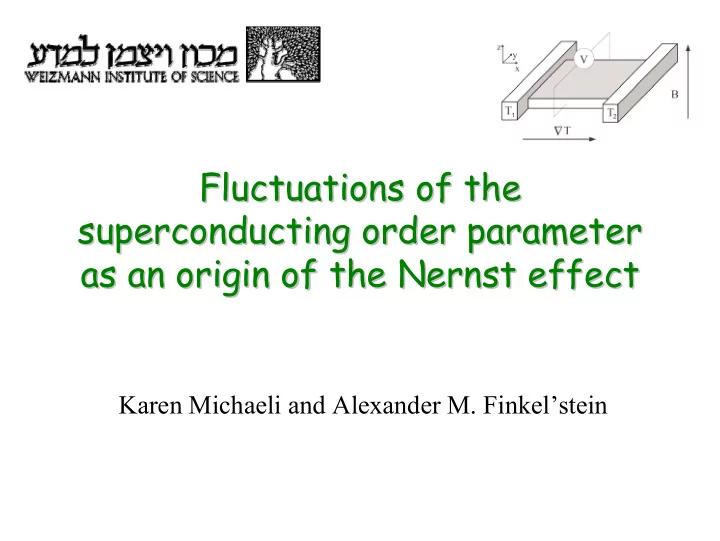
Fluctuations of the Fluctuations of the superconducting order parameter superconducting order parameter as an origin of the as an origin of the Nernst Nernst effect effect

Karen Michaeli and Alexander M. Finkel’stein

slide-2
SLIDE 2

Nernst Effect Nernst Effect-

  • High

High Tc Tc Materials Materials

The Nernst signal

Usually explained by the existence of vortices. Pairing must survive above TC

.

.

Disappearance of phase coherence at TC although the gap is still finite

  • Y. Wang, et al 2005

Anderson, 2007 Raghu, et al, 2008 Mukerjee and Huse 2004 B T E

x y

⋅ −∇ = ν

slide-3
SLIDE 3

Nernst Effect Nernst Effect – – Conventional Conventional Superconductors Superconductors

  • A. Pourret, et al 2007

The strong Nernst signal above Tc can not be explained by the vortex-like fluctuations.

The Nernst signal

B T E

x y

⋅ −∇ = ν It has been suggested that the fluctuations of the order parameter cause the effect.

85 . 15 . 0 Si

Nb

slide-4
SLIDE 4

The Boltzamann equation for the distribution function:

Nernst Effect Nernst Effect -

  • Metals

Metals

The electric current in response to temperature gradient in a system with two species of particles (electrons and holes): The electric current : The longitudinal electric current:

( ) ( )

h d e d e

f d e f d e δ π δ π

k k

v k v k j

∫ ∫

+ − = 2 2

( ) ( )

2

2 2

= ∇ ⎥ ⎦ ⎤ ⎢ ⎣ ⎡ − ∂ ∂ = ∫ T T d v d v f d e j

x d x e

τ ε τ ε ε ε π

k k k k k k

k The transverse electric current:

( ) ( ) ( ) [ ]

2

2

≠ − − ∇ ∂ ∂ = ∫ τ ω τ ω τ ε ε ε π

C C x d y e

T T d v f d e j

k k k k

k mc eB

C =

ω

( ) ( ) ( )

k B v v k

k k k k

∂ ⋅ × ∇ ⋅ ∂ ∂ = ε δ ε τ δ

h e h e

f c e T T f f

/ /

m

slide-5
SLIDE 5

Under the approximation of a constant density of states:

Particle-hole symmetry does constrain the magnitude of the Nernst effect.

For the collective modes the effective density of states is far from being a constant. The neutral modes are not deflected by the Lorentz force. The charged modes such as fluctuations of superconducting

  • rder parameter generate the

Nernst effect.

( ) ( ) ( )

2 2

2 2

= ∂ ∂ ∇ =

k k k k

ε ε ε ν π ε τ τ ω f d T T d v e j

d x F C y e

slide-6
SLIDE 6

Particle-hole symmetry does constrain the magnitude of the Nernst effect.

The neutral modes are not deflected by the Lorentz force. The charged modes such as fluctuations of superconducting

  • rder parameter contribute to the

Nernst effect. Under the approximation of a constant density of states:

( ) ( ) ( )

2 2

2 2

= ∂ ∂ ∇ =

k k k k

ε ε ε ν π ε τ τ ω f d T T d v e j

d x F C y e

slide-7
SLIDE 7

2 2 y xy xx xx xy N x xy xx

E e T α σ α σ σ σ − = = −∇ +

The The Nernst Nernst Coefficient Coefficient

αxx vanishes under the approximation of a constant density of states

xx xy N

e σ α ≈

  • A. Pourret, et al 2007

⎟ ⎟ ⎠ ⎞ ⎜ ⎜ ⎝ ⎛ ∇ ⎟ ⎟ ⎠ ⎞ ⎜ ⎜ ⎝ ⎛ = ⎟ ⎟ ⎠ ⎞ ⎜ ⎜ ⎝ ⎛ T E j j

E

κ α α σ ~

slide-8
SLIDE 8

( )

T T v ∇ ε ε

The The Nernst Nernst Coefficient Coefficient

The vertex of the temperature gradient is: Integrating over the frequency ε terms that in the electric conductivity are real becomes imaginary. For example - the Aslamazov-Larkin term at B→0 lnT/Tc<<1 : L is the propagator of the fluctuations of the superconducting order parameter: χ – is zero under the constant density of states approximation

( ) ( ) ( ) [ ]

2 1

, , 4 2 ω ω ω π ω π ω η q q q j

A R P d AL e

L L n T d d T T e − ∂ ∂ ∇ ∝

+ 1 2 ,

8 ln 1

⎥ ⎦ ⎤ ⎢ ⎣ ⎡ + + = T i q T T L

C A R

πω χω η ν m

slide-9
SLIDE 9

Nernst Effect Nernst Effect-

  • Kubo Formula

Kubo Formula

Luttinger approach –

  • Introducing a gravitational field that is coupled to the Hamiltonian density:
  • Deriving the Kubo formula for the linear response to the field:

The E.O.M for the density matrix:

( ) ( ) ( )

∫ ∫

+ = dr r h r e dr r h H

st

γ

= ∇ +

E

j h &

( ) ( ) [ ]

t H dt t d i ρ ρ , =

( )

γ

β

∇ =

− E E H E

j j e r j

Luttinger connected between the response to the gravitational field and the temperature gradient. Luttinger approach – Thermal conductivity:

  • J. M. Luttinger 1964.
slide-10
SLIDE 10

Magnetization Magnetization

There has been a long discussion about the contribution of magnetization to the thermoelectric transport currents. For example: Obraztsov Sov. Phys. Solid State 1965 Smrcka and Streda J. Phys. C 1977 Cooper, Halperin and Ruzin PRB 1997 In the presence of magnetic field the thermodynamic expression for the heat contains the magnetization term: The heat current that describes the change in the entropy. The Kubo formula is not enough the contribution from the magnetization must be added.

MdB. + dN

  • dE

= TdS = dQ μ

slide-11
SLIDE 11

Nernst Effect Nernst Effect-

  • Quantum Kinetic Equation

Quantum Kinetic Equation

( )

⎟ ⎟ ⎠ ⎞ ⎜ ⎜ ⎝ ⎛ ⇔ ⎟ ⎟ ⎠ ⎞ ⎜ ⎜ ⎝ ⎛ =

> < A K R T T

G G G G G G G t r t r G

~

' ' ; , ˆ

The Keldysh Green function: The current response to temperature gradient :

( ) ( ) ( ) ( )

[ ]

< Δ

∇ ∇ + ∇ ∇ = T L T e T G T e i

e e

ˆ ˆ 2 ˆ ˆ v v j

The fluctuations of the order parameter The quasi-particles excitations ve and vΔ are the renormalized velocities and are the solution of the quantum kinetic equation.

( )

' , ' ; , ; ˆ

1 1

t t T G r r ∇

( )

' , ' ; , ; ˆ

1 1

t t T L r r ∇

( ) [

]

1 1 1

ˆ ' , ' ; , ˆ

Π − = λ t t L r r

slide-12
SLIDE 12

Nernst Effect Nernst Effect-

  • Magnetization

Magnetization

⎟ ⎠ ⎞ ⎜ ⎝ ⎛ − + = ∇ ε ; ' , 2 ' ; ˆ r r r r R T G

( )

ε ε ε ∂ − ∂ ∇ ⋅ − ; ' ˆ r r R G T T

( )

ε ; ' ; ˆ r r − ∇T G Translation invariant part Local equilibrium part

( ) ( )

ˆ L T L T L ∇ Π − = ∇

The Peltier coefficient is related to the flow of entropy According to the third law of thermodynamics

→ α

when

→ T

1

99999 ln

⎥ ⎥ ⎥ ⎥ ⎦ ⎤ ⎢ ⎢ ⎢ ⎢ ⎣ ⎡ ∂ ∂ − B

( )

ε π ε ; ' 2 lim

'

r r

r r

− ∇ =

< → ∫

MG T T d ie j y

e

slide-13
SLIDE 13

The The Peltier Peltier Coefficient Coefficient

The contributing diagrams: c eDH

c

4 = Ω and the magnetization: ( )

∑∑

∞ =

⎪ ⎭ ⎪ ⎬ ⎫ ⎪ ⎩ ⎪ ⎨ ⎧ ⎥ ⎦ ⎤ ⎢ ⎣ ⎡ ⎟ ⎠ ⎞ ⎜ ⎝ ⎛ − ⎟ ⎟ ⎠ ⎞ ⎜ ⎜ ⎝ ⎛ + Ω + + − − ∂ ∂ − = 2 1 4 2 / 1 2 1 ln ln

N C m C mag xy

m

T N T T eB B

ω

ψ π ω ψ ν π α

π 4 ~

C C

Ω = Ω

T

C /

~ Ω

~ ~ ~

slide-14
SLIDE 14

The The Peltier Peltier Coefficient Coefficient

( ) ( )

B T T T e

C C xy

/ ln 192 Ω ≈ α T

C <<

Ω 1 ln <<

C

T T

Classical fluctuations – coincide with the Phenomenological and microscopic result of Ussishkin et al, 2002 and Ussishkin 2003

85 . 15 .

Si Nb

sec 187 .

2

cm D =

mK TC 380 =

mK T MF

C

385 =

Experimental data from A. Pourret, et al 2007 film of thickness nm 35 and

X

T

C /

~ Ω

slide-15
SLIDE 15

The The Peltier Peltier Coefficient Coefficient

( )

C C xy

T T T e / ln 24

2

π α Ω ≈ T

C <<

Ω 1 ln >>

C

T T

X

C C T

/ ~ Ω

slide-16
SLIDE 16

The The Peltier Peltier Coefficient Coefficient

T

C <<

Ω 1 ln >>

C

T T

Quantum fluctuations – τ ω 1 < < T The diagrams yield contributions of the order: ⎟ ⎟ ⎠ ⎞ ⎜ ⎜ ⎝ ⎛ − ⎟ ⎠ ⎞ ⎜ ⎝ ⎛

C

T T T ln ln 1 ln ln τ The logarithmically divergent terms are canceled out by the magnetization Trace of the third law of thermodynamics

X

C C T

/ ~ Ω

slide-17
SLIDE 17

The The Peltier Peltier Coefficient Coefficient – – High Magnetic field High Magnetic field

T

C >>

Ω

( )

C xy

B B eT / ln 3 2

C

Ω ≈ α 1 ln >>

C

B B

The diagrams include contributions proportional to . T

C

Ω The Nernst signal goes to zero at T→0. These terms are canceled out by the magnetization. Consistent with the third law of thermodynamics.

X

C C T

/ ~ Ω

X

slide-18
SLIDE 18

X

C C T

/ ~ Ω

αxy

The The Peltier Peltier Coefficient as a Function of the Coefficient as a Function of the Magnetic Field Magnetic Field

slide-19
SLIDE 19

X

C C T

/ ~ Ω

αxy

The The Peltier Peltier Coefficient as a Function of the Coefficient as a Function of the Magnetic Field Magnetic Field

( ) ( )

B T T T e

C C xy

/ ln 192 Ω ≈ α

slide-20
SLIDE 20

Summary Summary

  • The contribution from the fluctuations of the superconducting order parameter to

the Nernst effect is dominant and can be observed far away from the transition.

  • The important role of the magnetization is in canceling the quantum contributions,

thus making the Nernst signal compatible with the third law of thermodynamics.

  • As a consequence of the constrain imposed by the third law of thermodynamics, the

phase diagram is less rich and diverse than one expects in the vicinity of a quantum phase transition.

  • The Nernst effect provides an excellent opportunity to test the use of the quantum

kinetic equation in the description of thermoelectric transport phenomena.

  • Our results are different in few aspects from the expressions for the Peltier

coefficient recently obtained using the Kubo formula by Serbyn, Skvortsov, Varlamov, and Galitski.