Field of a moving particle in a dielectric The E- and B-field - - PowerPoint PPT Presentation

field of a moving particle in a dielectric
SMART_READER_LITE
LIVE PREVIEW

Field of a moving particle in a dielectric The E- and B-field - - PowerPoint PPT Presentation

Field of a moving particle in a dielectric The E- and B-field associated to a uniformly moving particle in vacuum are given by and where Previously we considered the case b <<1 P. Piot, PHYS 571 Fall 2007 Field


slide-1
SLIDE 1
  • P. Piot, PHYS 571 – Fall 2007

Field of a moving particle in a dielectric

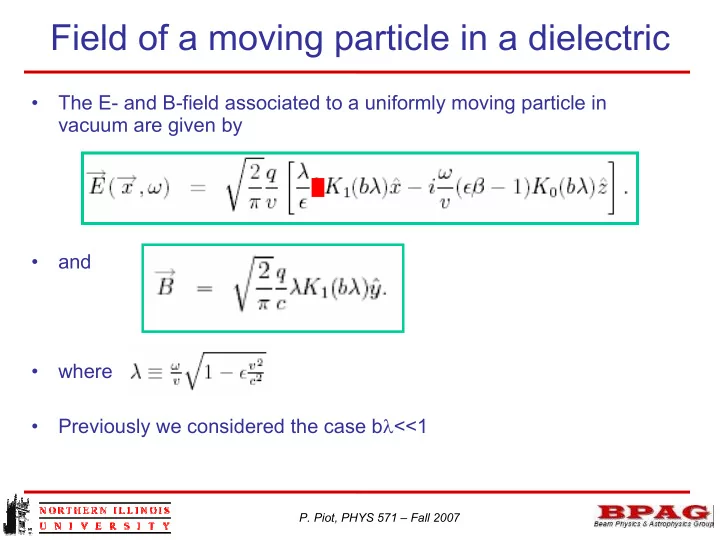
  • The E- and B-field associated to a uniformly moving particle in

vacuum are given by

  • and
  • where
  • Previously we considered the case bλ<<1
slide-2
SLIDE 2
  • P. Piot, PHYS 571 – Fall 2007

Field in the limit bλ>>1

  • We now consider the extreme case bλ>>1. The modified Bessel

functions have the asymptotic expansion:

  • And the field associated to a uniformly moving charged particle takes

the form

slide-3
SLIDE 3
  • P. Piot, PHYS 571 – Fall 2007

Cerenkov condition

  • We saw that to get radiation (or energy loss) we needed either λ or ε

to be complex.

  • When investigating dielectric screening effects we considered the

case ε ∈C

  • We now consider the case where λ is a pure imaginary number and ε

∈R.

  • from
  • ….
slide-4
SLIDE 4
  • P. Piot, PHYS 571 – Fall 2007

Cerenkov condition

  • Consider the model for permittivity

ω ε ε=1 ω=ω0 1/β2 ωL ω0

slide-5
SLIDE 5
  • P. Piot, PHYS 571 – Fall 2007

Energy loss

  • Explicit the asymptotic form of the e.m. field in the energy loss

equation.

  • gives
slide-6
SLIDE 6
  • P. Piot, PHYS 571 – Fall 2007

Frank-Tamm energy loss formula

  • But λ ∈I so λ∗/λ=-1 so finally
  • This is Frank-Tamm formula derived in 1937.
  • History:

– Cerenkov observed the radiation in Vavilov’s labs (1934) – Frank and Tamm explained the effect (1937) – Cerenkov, Frank and Tamm share Nobel prize (1958)

slide-7
SLIDE 7
  • P. Piot, PHYS 571 – Fall 2007

Direction of propagation

  • The direction of the wave is given by k, k perpendicular to E and B.

Let θc be the angle between the velocity of the particle and k then

  • From

Velocity of light in the considered medium

slide-8
SLIDE 8
  • P. Piot, PHYS 571 – Fall 2007

Shock wave feature

  • Cerenkov radiation consists of a shock wave
  • Effect similar to the Mach effect
slide-9
SLIDE 9
  • P. Piot, PHYS 571 – Fall 2007

Shock wave feature I

  • Cerenkov radiation consists of a shock wave
  • Effect similar to the Mach effect
slide-10
SLIDE 10
  • P. Piot, PHYS 571 – Fall 2007

Shock wave feature II

  • The Shock wave feature inferred geometrically can be derived from

the wave equation

  • So A takes the same form as in vacuum under “renormalization”
  • So we can directly write the potentials as
slide-11
SLIDE 11
  • P. Piot, PHYS 571 – Fall 2007

Shock wave feature III

  • Consider
  • On another hand
  • So
  • Solve for (t-t’) :

causality

slide-12
SLIDE 12
  • P. Piot, PHYS 571 – Fall 2007

Shock wave feature IV

  • For Cerenkov radiation (v>cm), to obtain t-t’ real positive we need

ζ.v>0 and (ζ.v)2>(v2-cm

2)ζ2.

  • That is
  • So
  • Thus potentials and fields exist at time t only within a cone with apex

lying at the present time position of the particle and apex angle

slide-13
SLIDE 13
  • P. Piot, PHYS 571 – Fall 2007

Shock wave feature V

  • The 4-potential is given by
  • The denominator is
  • Expliciting (t-t’) we gives
slide-14
SLIDE 14
  • P. Piot, PHYS 571 – Fall 2007

Shock wave feature VI

  • So finally the potentials are
  • In practice the singularity is smeared by the frequency-dependence
  • f ε(ω) which implies cm(ω)…

singularity