Static and dynamic verification Static and dynamic V&V Software - - PowerPoint PPT Presentation

static and dynamic verification static and dynamic v v
SMART_READER_LITE
LIVE PREVIEW

Static and dynamic verification Static and dynamic V&V Software - - PowerPoint PPT Presentation

1 2 Static and dynamic verification Static and dynamic V&V Software inspections Concerned with analysis of the static system Static representation to discover problems (static verification verification) May be supplement by


slide-1
SLIDE 1

1

1

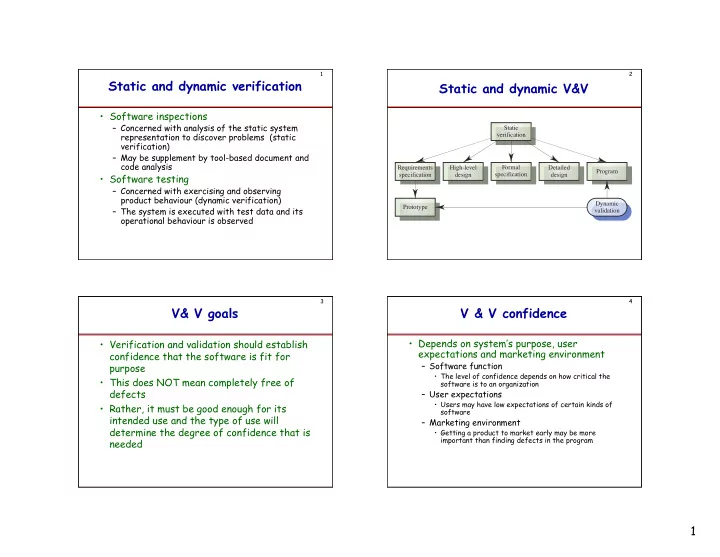
Static and dynamic verification

  • Software inspections

– Concerned with analysis of the static system representation to discover problems (static verification) – May be supplement by tool-based document and code analysis

  • Software testing

– Concerned with exercising and observing product behaviour (dynamic verification) – The system is executed with test data and its

  • perational behaviour is observed

2

Static and dynamic V&V

Formal specification High-level design Requirements specification Detailed design Program Prototype Dynamic validation Static verification

3

V& V goals

  • Verification and validation should establish

confidence that the software is fit for purpose

  • This does NOT mean completely free of

defects

  • Rather, it must be good enough for its

intended use and the type of use will determine the degree of confidence that is needed

4

V & V confidence

  • Depends on system’s purpose, user

expectations and marketing environment

– Software function

  • The level of confidence depends on how critical the

software is to an organization

– User expectations

  • Users may have low expectations of certain kinds of

software

– Marketing environment

  • Getting a product to market early may be more

important than finding defects in the program

slide-2
SLIDE 2

2

5

  • Careful planning is required to get the most
  • ut of testing and inspection processes
  • Planning should start early in the

development process

  • The plan should identify the balance

between static verification and testing

  • Test planning is about defining standards

for the testing process rather than describing product tests

V & V planning

6

Software inspections

  • Involve people examining the source

representation with the aim of discovering anomalies and defects

  • Do not require execution of a system so

may be used before implementation

  • May be applied to any representation of

the system (requirements, design, test data, etc.)

  • Very effective technique for discovering

errors

7

Inspection success

  • Many different defects may be

discovered in a single inspection

– In testing, one defect may mask another so several executions are required

  • The reuse domain and programming

knowledge

– reviewers are likely to have seen the types of error that commonly arise

8

Inspections and testing

  • Inspections and testing are complementary

and not opposing verification techniques

  • Both should be used during the V & V

process

  • Inspections can check conformance with a

specification but not conformance with the customer’s real requirements

  • Inspections cannot check characteristics

such as performance, usability, etc.

slide-3
SLIDE 3

3

9

Program inspections

  • Formalized approach to document reviews
  • Intended explicitly for defect

DETECTION (not correction)

  • Defects may be logical errors, anomalies in

the code that might indicate an erroneous condition (e.g. an uninitialized variable) or non-compliance with standards

10

Inspection pre-conditions

  • A precise specification must be available
  • Team members must be familiar with the
  • rganization standards
  • Syntactically correct code must be available
  • An error checklist should be prepared
  • Management must accept that inspection will

increase costs early in the software process

  • Management must not use inspections for staff

appraisal

11

The inspection process

Inspection meeting Individual preparation Overview Planning Rework Follow-up 12

Inspection procedure

  • System overview presented to inspection

team

  • Code and associated documents are

distributed to inspection team in advance

  • Inspection takes place and discovered

errors are noted

  • Modifications are made to repair

discovered errors

  • Re-inspection may or may not be required
slide-4
SLIDE 4

4

13

Inspection teams

  • Made up of at least 4 members
  • Author of the code being inspected
  • Inspector who finds errors,
  • missions and inconsistencies
  • Reader who reads the code to the

team

  • Moderator who chairs the meeting

and notes discovered errors

14

Inspection checklists

  • Checklist of common errors should be used

to drive the inspection

  • Error checklist is programming language

dependent

  • The 'weaker' the type checking, the larger

the checklist

  • Examples: Initialization, loop termination,

array bounds, etc.

Inspection checks Inspection checks

slide-5
SLIDE 5

5

17

Inspection rate

  • 500 statements/hour during overview
  • 125 source statement/hour during

individual preparation

  • 90-125 statements/hour can be inspected
  • Inspection is therefore an expensive

process

  • Inspecting 500 lines costs about 40 man/

hours effort = $$

18

Automated static analysis

  • Static analysers are software tools for

source text processing

  • They parse the program text and try to

discover potentially erroneous conditions and bring these to the attention of the V & V team

  • Very effective as an aid to inspections. A

supplement to but not a replacement for inspections

19

Static analysis checks

20

Stages of static analysis

  • Control flow analysis. Checks for loops with

multiple exit or entry points, finds unreachable code, etc.

  • Data use analysis. Detects uninitialized

variables, variables written twice without an intervening assignment, variables which are declared but never used, etc.

  • Interface analysis. Checks the consistency of

routine and procedure declarations and their use

slide-6
SLIDE 6

6

21

Stages of static analysis

  • Information flow analysis. Identifies the

dependencies of output variables. Does not detect anomalies itself but highlights information for code inspection or review

  • Path analysis. Identifies paths through the

program and sets out the statements executed in that path. Again, potentially useful in the review process

  • Both these stages generate vast amounts
  • f information. Must be used with care.

LINT static analysis

138% more lint_ex.c #include <stdio.h> printarray (Anarray) int Anarray; { printf(“%d”,Anarray); } main () { int Anarray[5]; int i; char c; printarray (Anarray, i, c); printarray (Anarray) ; } 139% cc lint_ex.c 140% lint lint_ex.c lint_ex.c(10): warning: c may be used before set lint_ex.c(10): warning: i may be used before set printarray: variable # of args. lint_ex.c(4) :: lint_ex.c(10) printarray, arg. 1 used inconsistently lint_ex.c(4) :: lint_ex.c(10) printarray, arg. 1 used inconsistently lint_ex.c(4) :: lint_ex.c(11) printf returns value which is always ignored 23

Use of static analysis

  • Particularly valuable when a language

such as C is used which has weak typing and hence many errors are undetected by the compiler

  • Less cost-effective for languages like

Java that have strong type checking and can therefore detect many errors during compilation