Outline 15-441/641: Computer Networks Routing hierarchy BGP - - PowerPoint PPT Presentation

outline 15 441 641 computer networks
SMART_READER_LITE
LIVE PREVIEW

Outline 15-441/641: Computer Networks Routing hierarchy BGP - - PowerPoint PPT Presentation

9/14/2019 Outline 15-441/641: Computer Networks Routing hierarchy BGP Inter-domain Routing Internet structure 15-441 Fall 2019 Profs Peter Steenkiste & Justine Sherry External BGP (E-BGP) Internal BGP (I-BGP) Fall 2019


slide-1
SLIDE 1

9/14/2019 1

15-441/641: Computer Networks BGP – Inter-domain Routing

15-441 Fall 2019 Profs Peter Steenkiste & Justine Sherry Fall 2019 https://computer-networks.github.io/fa19/

Outline

  • Routing hierarchy
  • Internet structure
  • External BGP (E-BGP)
  • Internal BGP (I-BGP)

2

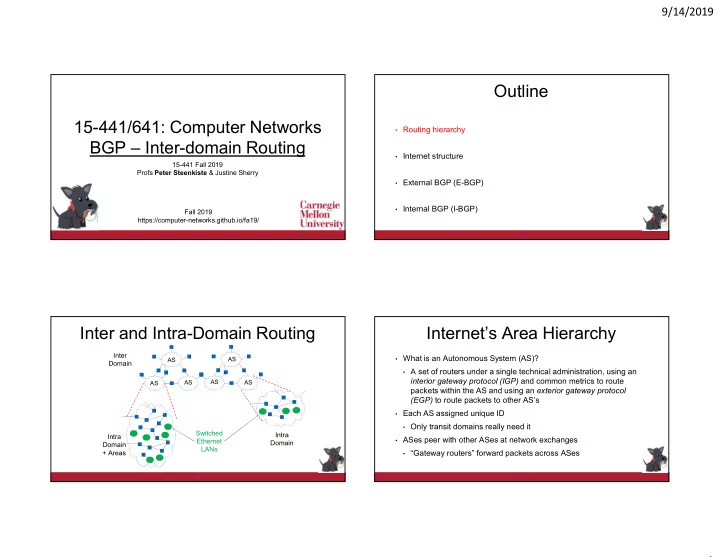
Inter and Intra-Domain Routing

3

Inter Domain Intra Domain Intra Domain + Areas Switched Ethernet LANs

AS AS AS AS AS AS

Internet’s Area Hierarchy

  • What is an Autonomous System (AS)?
  • A set of routers under a single technical administration, using an

interior gateway protocol (IGP) and common metrics to route packets within the AS and using an exterior gateway protocol (EGP) to route packets to other AS’s

  • Each AS assigned unique ID
  • Only transit domains really need it
  • ASes peer with other ASes at network exchanges
  • “Gateway routers” forward packets across ASes

4

slide-2
SLIDE 2

9/14/2019 2

AS Numbers (ASNs)

5

ASNs are 16 bit values 64512 through 65535 are “private”

  • Genuity: 1
  • MIT: 3
  • CMU: 9
  • UC San Diego: 7377
  • AT&T: 7018, 6341, 5074, …
  • UUNET: 701, 702, 284, 12199, …
  • Sprint: 1239, 1240, 6211, 6242, …

ASNs represent units of routing policy

A Logical View of the Internet?

6

  • Logical consequence of hierarchy: repeat the

intra-domain solutions at inter-net level

  • Based on IP and OSPF style routing protocol
  • Not so fast!

AS AS AS AS AS AS AS

A more Realistic View of the Internet

7

Tier 1 Tier 1

Tier 2 Tier 2 Tier 2

Tier 3

  • ASes are commercial entities
  • They must make money!
  • They play different roles in the

Internet

  • Tier 1 ISP: global, internet wide

connectivity

  • Tier 2 ISP: regional or country-wide
  • Tier 3 ISP: local
  • This is an emergent property:
  • Businesses specialize
  • Business build relationships

Customer Provider

A More Interesting Example

8

ISP X

ISP Y ISP Z

ISP P

Transit ($$) Transit ($$$) Transit ($$ 1/2) Transit ($$) Transit ($$$) Transit ($) Transit ($$) Transit ($$$)

ISP Q

Transit ($$$) Peering Peering

slide-3
SLIDE 3

9/14/2019 3

Policy and Economics Rules

  • WHY?
  • Consider the economics of the Internet
  • Why does an ISP forward packets?
  • Emergent property: “Valley-free” routing
  • Number links as (+1, 0, -1) for provider, peer and customer
  • In any path should only see sequence of +1, followed by at most
  • ne 0, followed by sequence of -1
  • -1 → 0 → +1corresponds to a valley and means an ISP is

forwarding packets for free

  • Worse: it is paying its providers for forwarding

9

Outline

  • Routing hierarchy
  • Internet structure
  • External BGP (E-BGP)
  • Internal BGP (I-BGP)

10

History

  • Mid-80s: EGP
  • Reachability protocol (no shortest path)
  • Did not accommodate cycles (assumes tree topology)
  • Evolved when all networks connected to NSF backbone
  • Commercialization led to richer topologies – Result: BGP introduced

as routing protocol

  • Latest version is BGP-4 - supports CIDR
  • Primary objective:
  • Connectivity not performance
  • Respect business relationships
  • Allow for local policies in each AS

11

Choices

  • Link state or distance vector?
  • Constraint: there is no universal metric – local policy decisions
  • Problems with link state:
  • If routers do not use the same metric – you get loops!
  • ISPs do not want to expose policies to other AS’s
  • Link state database too large – entire Internet
  • Problems with distance-vector:
  • Bellman-Ford algorithm may converge slowly
  • Problems with “count to infinity”

12

slide-4
SLIDE 4

9/14/2019 4

Solution: Distance Vector with Path

  • Each routing update carries the entire path to the destination
  • Loops are detected as follows:
  • When AS gets route, check if its AS number is already in the path
  • If yes, reject route
  • If no, add self and (possibly) advertise route further
  • Advantage:
  • Metrics are local
  • The AS chooses a path based on its policies, while
  • The routing protocol ensures there are no loops

13

Policy-based Routing: Path Selection versus Path Advertising

1.

AS1 selects its path to X based on local policies

  • Based on reachability information it receives from its neighbors

2.

AS1 advertise its path to X selectively based on local policies

  • It uses local policies to decide who to advertise it to

14

AS 1 AS 2

AS X

?

Destination

Interconnecting BGP Peers

  • BGP uses TCP to connect peers
  • Advantages:
  • Simplifies BGP
  • No need for periodic refresh - routes are valid until withdrawn, or

the connection is lost

  • Allows incremental updates (no packet losses)
  • Disadvantages
  • Congestion control on a routing protocol?
  • Poor interaction with other traffic during high load

15

Hop-by-hop Model

  • BGP only advertises routes that it uses to its neighbors
  • Consistent with the hop-by-hop Internet paradigm
  • e.g., AS1 cannot forward AS2’s packets to other AS’s in a manner

different than what AS2 has chosen

  • Worse: can lead to forwarding loops
  • BGP enforces policies by
  • 1. choosing paths from multiple alternatives and
  • 2. controlling advertisement to other AS’s

16

slide-5
SLIDE 5

9/14/2019 5

Examples of BGP Policies

  • A multi-homed stub AS refuses to act as transit
  • Limit path advertisement
  • A multi-homed AS can become transit for some AS’s
  • Only advertise paths to some AS’s
  • An AS can favor or disfavor certain AS’s for traffic transit from itself
  • By choosing those paths among the options

17

Some Examples

18

ISP X

ISP Y ISP Z

ISP P

Transit ($$) Transit ($$$) Transit ($$ 1/2) Transit ($$) Peering Transit ($$$) Transit ($) Transit ($$) Transit ($$$) Transit ($$)

BGP Messages

  • Open
  • Announces AS ID
  • Determines hold timer – interval between keep_alive or update

messages, zero interval implies no keep_alive

  • Keep_alive
  • Sent periodically (but before hold timer expires) to peers to ensure

connectivity.

  • Sent in place of an UPDATE message
  • Notification
  • Used for error notification
  • TCP connection is closed immediately after notification

19

BGP UPDATE Message

  • List of withdrawn routes
  • Network layer reachability information
  • List of reachable prefixes
  • Path attributes
  • Origin
  • Path
  • Metrics: used by policies for path selection
  • All prefixes advertised in message have the same path attributes

20

slide-6
SLIDE 6

9/14/2019 6

AS_PATH

  • List of traversed AS’s

21

AS 500 AS 300 AS 200 AS 100

180.10.0.0/16 300 200 100 170.10.0.0/16 300 200 170.10.0.0/16 180.10.0.0/16

LOCAL PREF

  • Local (within an AS) mechanism to provide relative priority among BGP

routers (e.g. R3 over R4)

22

R1 R2 R3 R4

I-BGP

AS 256 AS 300 Local Pref = 500 Local Pref = 800 AS 100

R5

AS 200

LOCAL PREF – Common Uses

  • Routers have a default LOCAL PREF
  • Can be changed for specific ASes
  • Peering vs. transit
  • Prefer to use peering connection, why?
  • In general, customer > peer > provider
  • Use LOCAL PREF to ensure this

23

Multi-Exit Discriminator (MED)

  • Hint to external neighbors about the preferred path into an AS
  • Non-transitive attribute
  • Different AS choose different scales
  • Used when two AS’s connect to each other in more than one place

24

slide-7
SLIDE 7

9/14/2019 7

MED

  • Hint to R1 to use R3 over R4 link
  • Cannot compare AS40’s values to AS30’s

25

R1 R2 R3 R4

AS 30 AS 40 180.10.0.0 MED = 120 180.10.0.0 MED = 200 AS 10 180.10.0.0 MED = 50

MED

26

  • MED is typically used in provider/subscriber scenarios
  • It can lead to unfairness if used between ISP because it may

force one ISP to carry more traffic:

SF NY

  • ISP1 ignores MED from ISP2
  • ISP2 obeys MED from ISP1
  • ISP2 ends up carrying traffic most of the way

ISP1 ISP2

Path Selection Criteria

  • Attributes + external (policy) information
  • Rough ordering for path selection
  • Highest LOCAL-PREF
  • Captures business relationships and other factors
  • Shortest AS-PATH
  • Lowest origin type
  • Lowest MED (if routes learned from same neighbor)
  • eBGP over iBGP-learned
  • Lowest internal routing cost to border router
  • Tie breaker, e.g., lowest router ID

27

Routing and Forwarding in the Internet: Prefixes

Network ID Node ID

Prefix “grows” along path

slide-8
SLIDE 8

9/14/2019 8

BGP and Prefixes

  • BGP advertisements specify prefix reachability
  • Prefix  network ID in a CIDR world
  • BGP can also merge advertisements:
  • Example: 4 “/20” advertisements that share the top 18 bits in their

prefix can become a single “/18” adv., if the reachability information is the same

  • Can also leverage the longest prefix rule to merge entries:
  • Example: if only three of the prefix share reachability information,

you can create a “/18” and a “/20” prefix

29

Example

  • Client advertise their prefixes
  • Provider one can merge advertisements
  • If C4 uses Provider 2, it will be longer prefix

30 201.10.0.0/21 201.10.0.0/22 201.10.4.0/24 201.10.5.0/24 201.10.6.0/23

Provider 1

C2 C1 C3 C4

Provider 2

201.11.0.0/16

Advertise

Adv /23 Adv /21 Adv /22 Adv /24 Adv /23 Adv /24 Adv 201.10/6.0/23

Outline

  • Routing hierarchy
  • Internet structure
  • External BGP (E-BGP)
  • Internal BGP (I-BGP)

31

Internal vs. External BGP

32

R3 R4 R1 R2 E-BGP

  • (External) BGP can be used by R3 and R4 to learn routes
  • How do R1 and R2 learn routes?
  • Border gateways also need to run an internal routing protocol
  • Establish connectivity between routers inside AS
  • I-BGP: uses same messages as E-BGP

AS1 AS2

slide-9
SLIDE 9

9/14/2019 9

I-BGP Route Advertisements

  • I-BGP uses different rules about re-advertising prefixes:
  • Prefix learned from E-BGP can be advertised to I-BGP neighbor and vice-versa, but
  • Prefix learned from I-BGP neighbors cannot be advertised to other I-BGP neighbors →

direct connections (TCP) for I-BGP routers

  • Reason: AS PATH is the same AS so there is a danger of looping

33

R3 R4 R1 R2 E-BGP I-BGP

AS1 AS2

How Do ISPs Peer?

  • Public peering: use network to connect

large number of ISPs in Internet eXchange Point (IXP)

  • Managed by IXP operator
  • Layer 2 private network
  • Efficient: can have 100s of ISPs
  • Has led to increase in peering
  • Private peering: directly connect ISP

border routers

  • Set up as private connection
  • Typically done in an Internet eXchange Point

(IXP)

R R R R R R R R

Important Concepts

  • Wide area Internet structure and routing driven by economic

considerations

  • Customer, providers and peers
  • BGP designed to:
  • Provide hierarchy that allows scalability
  • Allow enforcement of policies related to structure
  • Mechanisms
  • Path vector – scalable, hides structure from neighbors, detects

loops quickly

35