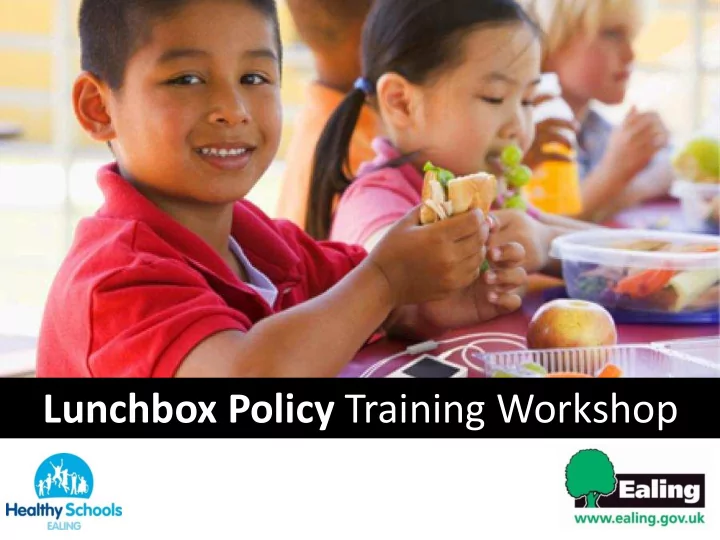
SLIDE 1
Lunchbox Policy Training Workshop
SLIDE 2 Aim of this workshop
fidence to introduce a lunchbox policy
ledge on what is a health packed lunch
ice str trategie ies and information
lth and nutrition of pupils
SLIDE 3
Improves healt lth of f pupil ils Requirement for HSL SL Bronze Improves attain inment, concentratio ion & behavio iour An activity to get your HSL SL Silv Silver
Why have a packed lunch policy?
SLIDE 4 Facts
Only 1 in 3 pupils have 5 or more fruit and veg every day* FSA survey in 2004 found more junk than healthy items***
>
*HRBS ***Epidemiology of Community Health, 2010
SLIDE 5 Facts
**NCMP 2014/15
21% reception pupils &
38% Year 6 pupils are overweight **
SLIDE 6
Fact: 1 in 100 lunches meet the standards of school meals
SLIDE 7 54%
Sandwiches
82% 61% 85% 19%
Confectionary/crisps Sweetened drinks Fruit Veges
What are pupils eating for lunch?
Survey of 1300 lunch boxes carried out by the FSA, 2004
SLIDE 8 What are the barriers to introducing a Packed Lunch Policy?
School meal foods i.e. puddings Parent support Pupil and staff support Monitoring Your time Food safety & storage
SLIDE 9
Provides information, tips and solutions Includes good practice from schools Has three parts:
About the Lunchbox Policy Toolkit
Background Step by step guide Resources
SLIDE 10
SLIDE 11
What steps are required to develop a successful packed lunch policy?
ACTIVITY:
SLIDE 12 Six steps to a packed lunch policy
STEP 1
PROJECT PLANNING TASK GROUP
STEP 2
CARRY OUT A PACKED LUNCH AUDIT
STEP 3
DISCUSSION AND CONSULTATION
STEP 4
WRITE THE PACKED LUNCH POLICY
STEP 5
MARKEING, PROMOTION, AND COMMUNICATION
STEP 6
REVIEW, MONITORING & EVALUATION
SLIDE 13
ACTIVITY: page 18
SLIDE 14
STEP 1 PROJECT PLANNING TASK GROUP
Choose a lead person and set up a group of pupils & staff to work on policy Tips: Involve pupils and staff Governors and parents can also be included Can use an existing group such as a SNAG or school council
SLIDE 15
STEP 2 CARRY OUT A PACKED LUNCH AUDIT Audit (or survey) results show clear picture of the issue and provide useful baseline data. Tips: Share results with whole school community Carry out audit again after 6/12 months to learn impact
SLIDE 16 STEP 2 AUDIT TOOLS
Paper audit completed by pupils Paper audit completed by staff Photo audit Online survey
SLIDE 17
TYPICAL PACKED LUNCH
8 TSP FAT 7 TSP SUGAR CASE STUDY: Typical packed lunch
SLIDE 18 STEP 3 DISCUSSION & CONSULTATION Need to consult pupils, parents, catering staff, SMSAs, staff and governors. Who leads? Usually the school council When to consult? Parent evenings, health fairs, sport days, after school etc.. Tips:
- Have a display or taster session
- Communicate findings through newsletter
SLIDE 19 How to consult with stakeholders
Graffiti wall at parent evening Pupil survey Suggestion box Parent questionnaire, survey or letter Focus group Solution tree in dining room
SLIDE 20
STEP 3 CONSULTATION METHODS Need to consult pupils & parents. Can also involve teachers, governors & caterers.
Pupil questionnaire Parent questionnaire
SLIDE 21
STEP 3 CONSULTATION METHODS
Pupil Survey Monkey
SLIDE 22
STEP 3 CONSULTATION METHODS
Request feedback from parents using the letter templates
SLIDE 23 STEP 4 WRITE THE PACKED LUNCH POLICY Use consultation and results to guide policy Write the policy using the template in the toolkit Include: food allowed, not allowed, reward ideas,
- ffender process, dissemination, review.
Tips:
- Review WSFP to ensure consistency
- Display summary poster in reception/dining hall
SLIDE 24
Packed lunch policy example
Page 31-32
SLIDE 25
Packed lunch policy poster
SLIDE 26
Packed lunch policy poster
SLIDE 27
Packed lunch policy poster
SLIDE 28
STEP 5 Marketing, promotion & communication
Consider suggestions from consultation Promote through classroom activities Make parents aware i.e. induction pack, reception, parent meetings, letters home, newsletter
SLIDE 29
Promotion – healthy eating assembly
Hold a healthy eating assemble and invite parents along This could be part of your Young Ambassador programme
SLIDE 30
Promotion – pupil sticker or poster competition
SLIDE 31 CASE STUDY: Gifford’s lunchbox competition
SCHOOL IDEAS: Pupils at Gifford Primary School designed a healthy
reproduced the winning lunchbox for every pupil in the school.
SLIDE 32
STEP 5 Support for families
SLIDE 33
STEP 5 Support for families
SLIDE 34
STEP 5 Support for families
SLIDE 35
STEP 5 Support for families
SLIDE 36
STEP 5 Support for cost concerns
Perceived cost of healthy food is a major concern of a packed lunch policy for parents.
Use these posters to debunk this myth.
SLIDE 37
STEP 5 Support for families
SLIDE 38
STEP 5 Support for cost concerns
Food budgeting workshops teach parents how to prepare healthy packed lunches on a budget.
Parent workshop
SLIDE 39
STEP 5 Activity for parents and pupils
SLIDE 40
Healthy lunch website - Customise own leaflet Customise to include your school’s logo and cover image, food types, and it can be translated into thirteen different languages.
SLIDE 41
STEP 6 Review, monitor & evaluate Build time to evaluate success of policy i.e. repeat lunchbox audit (after 6, 12 months) Tips: Train pupils, SMSAs or staff to monitor lunchboxes Promote messages in assembles Regularly review – build review into policy Reward pupils who make healthy choices
SLIDE 42 Encourage pupils & parents to follow the policy
How? Policy should outline what happens when policy is disregarded. Ideas:
- Slip note into lunchboxes
- Process for reoffenders
- Include in your induction pack
SLIDE 43
Encourage pupils & parents to follow the policy
Subtler approach Send out weekly newsletter explaining rules Use incentives to encourage pupil participation:
Rewards could include stationary, song on music player, seat at royal table
SLIDE 44
Token reward system – St John Fisher Primary
Total cost: Container: £4 from Poundland Tokens: 2000 for £40 from ebay http://www.ebay.co.uk/itm/151545465301?_trksid=p20 57872.m2749.l2649&ssPageName=STRK%3AMEBIDX%3 AIT
SLIDE 45
Token reward system £££– Stanhope Primary
Total cost: Token holder: £272 2000 tokens for £150 http://www.strikingdisplays.co. uk/100mm-token-tube- collector.html#thumb
SLIDE 46
Other token collector options
SLIDE 47
Prize box - Hamborough Primary
SLIDE 48 What are the solutions to introducing a Packed Lunch Policy?
School meal food – Friday cake day, change desserts Parent support – workshops, consultation Pupil support – consultation, rewards, education Compliance – slip notes, procedure Monitoring – Year 6 pupils, SMSAs Cost – budgeting posters, workshops Food safety – Fridge, gel packs, frozen juice, ice in container
SLIDE 49
Planning checklist
SLIDE 50
ACTIVITY:
Let’s look through the Lunchbox Policy Toolkit
SLIDE 51
ACTIVITY:
Write a packed lunch policy for your school
SLIDE 52
Where to access the resources
1
SLIDE 53
Where to access the resources
2
SLIDE 54
Where to access the resources
3
SLIDE 55
Thank you for attending