LCS 11: Cognitive Science Linguistic relativity Linguistic - - PowerPoint PPT Presentation

lcs 11 cognitive science
SMART_READER_LITE
LIVE PREVIEW

LCS 11: Cognitive Science Linguistic relativity Linguistic - - PowerPoint PPT Presentation

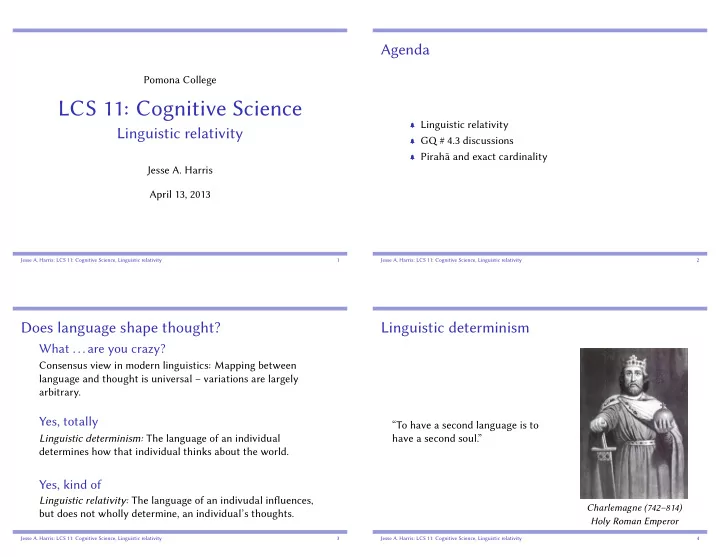
Agenda Pomona College LCS 11: Cognitive Science Linguistic relativity Linguistic relativity GQ # 4.3 discussions Pirah and exact cardinality Jesse A. Harris April 13, 2013 Jesse A. Harris: LCS 11: Cognitive Science, Linguistic


slide-1
SLIDE 1

Pomona College

LCS 11: Cognitive Science

Linguistic relativity

Jesse A. Harris April 13, 2013

Jesse A. Harris: LCS 11: Cognitive Science, Linguistic relativity 1

Agenda

֠ Linguistic relativity ֠ GQ # 4.3 discussions ֠ Pirahã and exact cardinality

Jesse A. Harris: LCS 11: Cognitive Science, Linguistic relativity 2

Does language shape thought?

What . . . are you crazy?

Consensus view in modern linguistics: Mapping between language and thought is universal – variations are largely arbitrary.

Yes, totally

Linguistic determinism: The language of an individual determines how that individual thinks about the world.

Yes, kind of

Linguistic relativity: The language of an indivudal influences, but does not wholly determine, an individual’s thoughts.

Jesse A. Harris: LCS 11: Cognitive Science, Linguistic relativity 3

Linguistic determinism

“To have a second language is to have a second soul.”

Charlemagne (742–814) Holy Roman Emperor

Jesse A. Harris: LCS 11: Cognitive Science, Linguistic relativity 4

slide-2
SLIDE 2

Linguistic determinism

“The limits of my language mean the limits of my world.” (Actually intended to determine the boundaries of philosophical thought; Wittgenstein later abandoned this project.)

Ludwig Wittgenstein (1889–1951)

Jesse A. Harris: LCS 11: Cognitive Science, Linguistic relativity 5

Sapir Whorf hypothesis

“We dissect nature along lines laid down by our native language.” ∼Whorf

◮ Somewhat misleading: Sapir and

Whorf never jointly proposed the idea.

◮ Yet, variants can be found in both

authors’ writings, to differing extremes.

◮ Seemingly presupposes that thought is

dependent (or even reducible) to a kind of internal language.

Edward Sapir (1884–1939) Benjamin Whorf (1897–1941)

Circular reasoning

  • Whofian. Eskimos are greatly influenced by their language

in their perception of snow. For example, they have N words for snow [N varies widely – see Pullum], whereas English only has one, snow. Having all these different words makes them think of snow very differently than, say, Americans do.

  • Skeptic. How do you know they think of snow differently?
  • Whorfian. Look at all the words they have for it! N of them!

Parody from Greg Murphy (1996), cited in Bloom & Keil (2001)

Jesse A. Harris: LCS 11: Cognitive Science, Linguistic relativity 7

Substance

(1)

  • a. Two pens
  • b. # Much pen

Count noun

(2)

  • a. # Two dirts
  • b. Much dirt

Mass noun

slide-3
SLIDE 3

Substance

(3)

  • a. Two waters
  • b. Much water

Count noun Mass noun

Substance

Classifiers

Yucatec Mayan nouns refer to substances and receive a numerical classifier for shape (flat, oblong, round, people) when noun is in a counting context.

Jesse A. Harris: LCS 11: Cognitive Science, Linguistic relativity 10

Lucy and Gaskins (2001)

Initial item Shape condition Substance

English More likely to compare in terms of shape. Mayan More likely to compare in terms of material.

Jesse A. Harris: LCS 11: Cognitive Science, Linguistic relativity 11

“These findings suggest that aspect

  • f grammar can in fact shape the

way speakers of a language conceptualize the shapes and materials of objects.”

Open question

What do you think? Is this conclusion warranted? Lera Boroditsky

slide-4
SLIDE 4

Grammatical gender

Languages encode items with grammatical gender: masculine, feminine, neutral. Largely arbitrary. German hard, heavy, jagged, metal, serrated, useful Spanish golden, intricate, little lovely, shiny and tiny Lera Boroditsky

Jesse A. Harris: LCS 11: Cognitive Science, Linguistic relativity 13

“These findings once again indicate that people’s thinking about objects is influenced by the grammatical genders thier native language assigns to the objects’ names. It appears that even a small fluke of grammar (the seemingly arbitrary assignment of a noun to be masculine or feminine) can have an effect on how people think about thinkgs in the world.”

Open question

What do you think? Is this conclusion warranted? Lera Boroditsky

Boas Jakobson Principle

“If different languages influence their speakers’ minds in varying ways, this is not because of what each language allows people to think but rather because of the kinds of information each language habitually obliges people to think about.” (Deutscher, 2011)

Franz Boas (1858–1942) Roman Jakobson (1896–1982)

GQ # 4.2

For many deep contrasts, there is, in fact, a continuum of possible values. The case of linguistic relativity is no different. On one extreme, we might argue that our language completely determines our thought and world-view. On the other extreme, we might argue that language and thought are entirely

  • independent. Frank et al (2008) offer a nice compromise between

the two views. First, briefly summarize their position with respect to how language impacts the use of exact numbers. Second, do you think that the case of verbal evidentiality in Matses, as discussed at the end of chapter 6 of Deutscher, shows something similar, but in a different subject matter? Or is the Matses case entirely different? Why or why not? (This answer is

  • pen ended, so just offer a short, simple position.)

Group leaders: Orren, Devon, Tatiana, Alex, Natasha, Sarah, Lea Lynn, Noah, Cole

slide-5
SLIDE 5

Pirahã

◮ Language in Brazilian Amazon

(N = 300-350)

◮ Hunting-gathering tribe ◮ Constrained productivity

  • 1. Only 3 pronouns
  • 2. A relative counting system
  • 3. Arguably, no subordination,

no recursion

Jesse A. Harris: LCS 11: Cognitive Science, Linguistic relativity 17

Pirahã

“My own view then is that the case

  • f Pirahã illustrates, perhaps as well

as any example ever discussed in the literature, the kind of bi-directional causal relationship between language and culture that Boas and Sapir would have expected us to find.“

http://itre.cis.upenn.edu/∼myl/languagelog/archives/001387.html

Jesse A. Harris: LCS 11: Cognitive Science, Linguistic relativity 18

Pirahã

Relative numbers hói few hoí fewer baagiso many

  • Fig. 1. Proportion of Pirahã speakers using each of the three proposed

quantity words in Pirahã. Sets with different quantities were presented in increasing order and participants were asked to describe their quantity. Jesse A. Harris: LCS 11: Cognitive Science, Linguistic relativity 19

Pirahã

The lack of linguistic terms for exact quantity did not affect the Piraha’s performance on analog matching tasks, only those that required remembering larger cardinalities.

◮ Language plays a “compressive role” allowing efficient

encoding

◮ Able to use verbally mediated memory system to encode

and retrieve these items more efficiently.

Jesse A. Harris: LCS 11: Cognitive Science, Linguistic relativity 20

slide-6
SLIDE 6

Evidentiality

Evidentiality

Marking the source of knowledge via linguistic means.

◮ About a quarter of the world’s languages exhibit some

grammatical markers of evidentiality: Matses, Croatian, Salish, Eastern Pomo, Navajo, Korean, etc.

◮ Types of evidentiality vary across languages: direct

evidence, indirect, through reason, hearsay, from an authority, from well-known lore, etc.

◮ Ways of expressing evidentiality varies as well: clitics,

verb or mood classes, limited to types of connectives, full verbal paradigms, etc.

Jesse A. Harris: LCS 11: Cognitive Science, Linguistic relativity 21

Evidentiality

Discussion question

How do languages with evidentiality compare with languages with different linguistic expressions of time? Do they reveal anything in particular about the plausibility of linguistic determinism? How about a weakened version of linguistic relativity?

Jesse A. Harris: LCS 11: Cognitive Science, Linguistic relativity 22

֠ Reading: Sacks, 2010 chapter ֠ Writing response due April 19 (moved back 2 days) any time. ֠ Begin unit on vision (Hoffman, 2000) next Wednesday.

Jesse A. Harris: LCS 11: Cognitive Science, Linguistic relativity 23