LCS 11: Cognitive Science Results of evaluations Physicalism - - PowerPoint PPT Presentation

lcs 11 cognitive science
SMART_READER_LITE
LIVE PREVIEW

LCS 11: Cognitive Science Results of evaluations Physicalism - - PowerPoint PPT Presentation

Agenda Pomona College LCS 11: Cognitive Science Results of evaluations Physicalism Physicalism GQ 2.1 discussion Ramachandran 2005, ch. 12 Face blindness (prosopagnosia) Jesse A. Harris Capgras syndrome Phantom limb


slide-1
SLIDE 1

Pomona College

LCS 11: Cognitive Science

Physicalism

Jesse A. Harris February 15, 2013

Jesse A. Harris: LCS 11: Cognitive Science, Physicalism 1

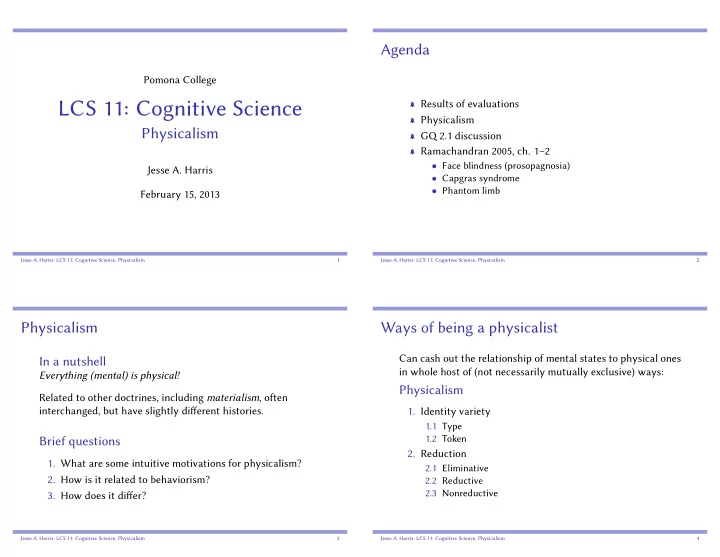
Agenda

֠ Results of evaluations ֠ Physicalism ֠ GQ 2.1 discussion ֠ Ramachandran 2005, ch. 1–2

  • Face blindness (prosopagnosia)
  • Capgras syndrome
  • Phantom limb

Jesse A. Harris: LCS 11: Cognitive Science, Physicalism 2

Physicalism

In a nutshell

Everything (mental) is physical! Related to other doctrines, including materialism, often interchanged, but have slightly different histories.

Brief questions

  • 1. What are some intuitive motivations for physicalism?
  • 2. How is it related to behaviorism?
  • 3. How does it differ?

Jesse A. Harris: LCS 11: Cognitive Science, Physicalism 3

Ways of being a physicalist

Can cash out the relationship of mental states to physical ones in whole host of (not necessarily mutually exclusive) ways:

Physicalism

  • 1. Identity variety

1.1 Type 1.2 Token

  • 2. Reduction

2.1 Eliminative 2.2 Reductive 2.3 Nonreductive

Jesse A. Harris: LCS 11: Cognitive Science, Physicalism 4

slide-2
SLIDE 2

Type vs. Token Physicalism

Terminology

What is meant by the term type? How does it differ from a token?

Type Physicalism

Each type of mental state is identical to a particular type or kind of physical state.

Token Physicalism

Each token of mental state has a physical realization.

Jesse A. Harris: LCS 11: Cognitive Science, Physicalism 5

Ways to be a reductionist

Reductive/Eliminative physicalism

Mental states are a mere fiction; part of a ‘folk psychology’ that can be eliminated once neuroscience is complete enough; Mental states map onto or reduce entirely to physical ones.

Nonreductive physicalism

All is physical, but mental states cannot be explain solely in terms of physical ones.

Jesse A. Harris: LCS 11: Cognitive Science, Physicalism 6

Eliminative/Reductive physicalism

Jesse A. Harris: LCS 11: Cognitive Science, Physicalism 7

Eliminative/Reductive physicalism

◮ Does reductionist

neuroscience presuppose the very mental constructs it wants to explain away?

◮ Does understanding the

neural substrate explain mental phenomenon?

Jesse A. Harris: LCS 11: Cognitive Science, Physicalism 8

slide-3
SLIDE 3

Nonreductive physicalism

Mental reality without the bloat!

◮ Strong, but non-reductive, relation between mental and

physical.

◮ Mental events are dependent on physical ones;

supervene, in philosophical parlance.

Example

The sensation of pain is associated with firing of particular types of nerves, including c-fibers. How would the reductionist explain this? How about the nonreductionist?

Jesse A. Harris: LCS 11: Cognitive Science, Physicalism 9

Consciousness and common sense

It is just a plain fact about the world that it contains conscious mental states and events, but it is hard to see how mere physical systems could have consciousness. ...It is easy enough to imagine a universe without it, but if you do, you will see that you have imagined a universe which is truly meaningless. (Searle 1984, 16)

Jesse A. Harris: LCS 11: Cognitive Science, Physicalism 10

Group discussions

Take any ONE of the unique disorders described in Ramachandran (2005) in chapters 1-2, which includes Capgras syndrome, phantom limbs, synesthesia, blindsight, anosognosia (lack of insight), etc., in which damage to the brain is associated with specific behavioral deficits, and briefly relate the patients’ particular experience to the physicalist viewpoint. In other words, are the unique experiences expected or supported under Physicalism? Why or why not? Group leaders: Devin, Tatiana, Sierra, Audrey, Jun, Hana, Lea Lynn, Ally, Becca

Jesse A. Harris: LCS 11: Cognitive Science, Physicalism 11

Face blindness (prosopagnosia)

Damage to fusiform gyrus in temporal lobe results in inability to recognize faces, but spares other visual and cognitive functions.

http://www.youtube.com/watch?v=vwCrxomPbtY#t=42s Jesse A. Harris: LCS 11: Cognitive Science, Physicalism 12

slide-4
SLIDE 4

Face blindness (prosopagnosia)

Brief question

What struck you about the interview? What strategies did she use to attempt to overcome her condition?

◮ In additional to developmental prosopagnosia, there are

also congenital forms of the condition.

◮ Sufferers often don’t realize they lack the ability to

recognize faces. Remind anyone of Umwelt?

Jesse A. Harris: LCS 11: Cognitive Science, Physicalism 13

Capgras’ syndrome

Amygdala

Anatomical area associated with emotional learning, stimulated by arousal, related to many disorders.

◮ Increased response for social

phobia

◮ Decreased response for

psychopathy

Capgras syndrome

Close friends, family members, or even emotionally significant

  • bjects are perceived as impostors. Only affects visual

processing.

http://www.youtube.com/watch?v=dqBGzkz1oDU#t=1m55s Jesse A. Harris: LCS 11: Cognitive Science, Physicalism 14

Phantom limbs

“A sailor accidentally cut off his right index finger. For forty years afterwards he was plagued by an intrusive phantom of the finger rigidly extended, as it was when cut off. Whenever he moved his hand towards his face – for example, to eat or scratch his nose – he was afraid that this phantom finger would poke his eye out. (He knew this to be impossible, but the feeling was irresistible.) He then ...lost all sensation of having any fingers. The phantom finger disappeared too.”

The Man who Mistook his Wife for a Hat; Oliver Sacks. p. 67.

Jesse A. Harris: LCS 11: Cognitive Science, Physicalism 15

Phantom limbs

The syndrome

Perceive sensation from missing organ.

http://www.youtube.com/watch?v=CTSN9phMZzk#t=4m

Remapping of sensory areas

Phantom limbs arise from re-mapping of sensory areas associated with the arm to those of the face

Organization of motor strip (Penfield)

Jesse A. Harris: LCS 11: Cognitive Science, Physicalism 16

slide-5
SLIDE 5

Phantom limbs

Mirror box therapy

Nerve damage prior to amputation can results in a “paralyzed phantom limb” causing chronic paint. Getting visual feedback of

  • ther limb allows the brain to

remap pain signals and reduce pain.

Jesse A. Harris: LCS 11: Cognitive Science, Physicalism 17

Next time

Functionalism

A competitor to physicalism; a mental state does not depend

  • n any particular physical state, but rather the role it plays in

the cognitive system.

Turing test

Functionalism applied to computers; Alan Turing famously devised a test to answer whether machines can show intelligent behavior. Ascribe intelligence to a machine if we cannot reliably distinguish it from a human.

◮ Cunningham, 2000, pp. 38-53 ◮ Turing, 1950

Jesse A. Harris: LCS 11: Cognitive Science, Physicalism 18