
SLIDE 1
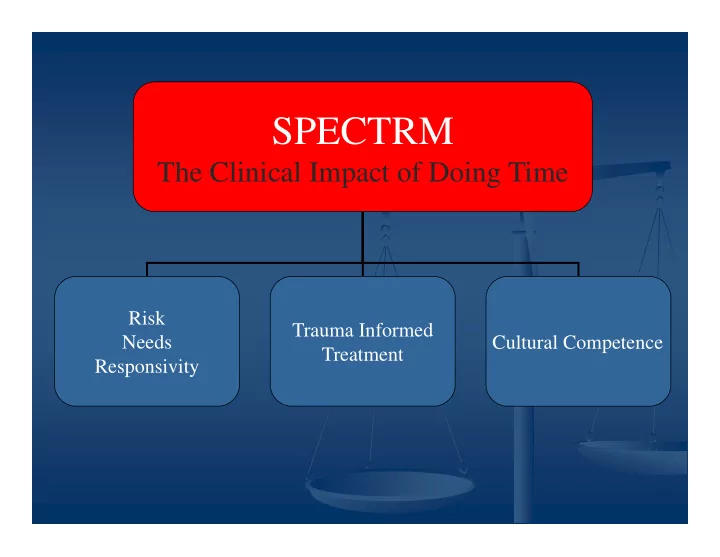
SPECTRM
The Clinical Impact of Doing Time
Risk Needs Responsivity Trauma Informed Treatment Cultural Competence
SPECTRM The Clinical Impact of Doing Time Risk Trauma Informed - - PowerPoint PPT Presentation
SPECTRM The Clinical Impact of Doing Time Risk Trauma Informed Needs Cultural Competence Treatment Responsivity S ENSITIZING P ROVIDERS to the E FFECTS of C ORRECTIONAL INCARCERATION on T REATMENT and R ISK M ANAGEMENT About SPECTRM The
Risk Needs Responsivity Trauma Informed Treatment Cultural Competence
SENSITIZING PROVIDERS to the EFFECTS of CORRECTIONAL INCARCERATION on TREATMENT and RISK MANAGEMENT
The Challenge: Clinical Impact of Doing Time The Approach: Cultural Competence The Technology: Cognitive Behavioral The Objective: Therapeutic Engagement
The first night's the toughest, no doubt about it. They march you in naked as the day you were born, skin burning and half blind from that delousing shit they throw on you, and when they put you in that cell...and those bars slam home... that's when you know it's for real. A whole life blown away in the blink of an eye. Nothing left but all the time in the world to think about it.
Risk Needs Responsivity Trauma Informed Treatment Cultural Competence
Risk
Match treatment intensity to level of risk
Needs
Treat the offender, not the offense
Responsivity
Modality must be one to which offender is responsive
CBT Engagement
General
Responsive to learning styles
e.g. CBT
Specific
Responsive to socio-biological personality
factors
Engagement Challenges
Motivation
Motivational Interviewing
Stigma CJ culture Adaptation
SPECTRM
Treatment outcome and premature
Treatment outcome related to patient effort Manner of therapist related to engagement and
effort
Readiness of the program for the population Readiness of the person for the program
Risk Needs Responsivity Trauma Informed Treatment Cultural Competence
Inmate trauma history prevalence
33% of men 55% of women
Incarceration experience
Verbal and physical victimization Witness violence Fear of violence
Consequences
Isolation Hypervigilance Emotional reactivity
Intervention principles
Safe environment Processing of Trauma Identification of coping strategies
The Clinical Impact of Doing Time
Risk Needs Responsivity Trauma Informed Treatment Cultural Competence
Cultural Awareness
Similarities and differences between groups
Cultural Sensitivity
Emotional expression Problems, struggles and joys
Cultural Competence
Beliefs, norms and values Knowledge and skills to incorporate
Cultural Proficiency
Meaning of symptoms, illness, stressors Meaning of treatment Relationship with professionals
Overcoming mistrust Communication Rapport Disclosure
Using “natural” community support
These walls are kind of funny. First you hate 'em, then you get used to 'em. Enough time passes, gets so you depend on them. That's institutionalized.
“Those of us who do assessment research in correctional settings must continually remember that we are dealing with atypical, highly biased samples of people exposed to massive situational influences specifically designed to alter their attitudes, personality and behavior. Incarceration is a massive intervention that affects every aspect of a person’s life for extended periods of time.”
Megargee, 1995
The Environment: Problems, Struggles (and Joys?)
Psychological Environment
Constant threat of danger – of violence
Social Environment
Racial/Ethnic associations Urban/Rural differences Gangs/Organizations DOC’s rules/Inmate Code
Physical Environment
Jail vs. Prison Gen Pop vs. MH Housing vs. SHU
Attitudes Beliefs Language Behavior Meaning Values
Prison and jail populations typically value strength in all its manifestations - from physical strength to self reliance. Projecting an image of being tough and menacing as an example is highly adaptive in these environments.
Cultural Competence
Meaning?
Prison and jail populations typically are characterized by presumptive distrust – distrust of staff – distrust of peers. Guardedness and secretiveness are adaptive attitudes within correctional environments.
Cultural Competence
Meaning?
“Snitches get stitches” is a prison and jail belief shared by everyone. While snitching goes on all the time in prison and jail – because information is a commodity that can be traded for gain – everyone is aware of the consequences of being caught – of being identified as a snitch.
Cultural Competence
Meaning?
Prison and jail are environments of constant danger and threat of
be characterized as hypervigilence.
Cultural Competence
Meaning?
“Punk City” - “Push up on” - “Kite” - “Boomerang” - “Newjack”- “Hang up” – “Juice” - “Box” – “Bing” – “Hole” – “SHU” – “Shank” – “Gun” – “Bug” – “MO” – “Skittle” – “703” – “Jailin”
Cultural Competence
Meaning?
Do Your Own Time Mind Your Own Business Trust No One Show Respect Ignore Others’ Infractions Don’t Steal Don’t Snitch Don’t Show Weakness Don’t Stare
VALUE Do Your Own Time Trust No One Don’t Snitch Don’t Show Weakness MEANING Isolate Manipulate Don’t share information Look aggressive
Readiness of the program for the population Readiness of the person for the program
I have trouble sleepin' at night. I have bad dreams like I'm
to remember where I am.
Client Readiness: RAP
War stories
Psycho-Education: Setting Differences and Similarities: Scripts
Cognitive Behavioral Technology: ABCD analysis
CONNECTING
Be willing to listen and learn: Where were you and what was it
like?
EXPLORING
Be aware of differences and similarities in the two cultures: What are the cues?
CHANGING
Be neutral: Is it working for you here?
“The insane criminal has nowhere any
home: no age or nation has provided a place for him. He is everywhere unwelcome and objectionable. The prisons thrust him out; the hospitals are unwilling to receive him…And yet humanity and justice, the sense of common danger, and a tender regard for a deeply degraded brother-man, all agree that something should be done for him—that some plan must be devised different from, and better than any that has yet been tried, by which he may be properly cared for, by which his malady may be healed, and his criminal propensity
Howard Jarvis, American Journal of Insanity, 1857