Cognitive Complexity of Phonological Patterns James Rogers Dept. - - PDF document

cognitive complexity of phonological patterns
SMART_READER_LITE
LIVE PREVIEW

Cognitive Complexity of Phonological Patterns James Rogers Dept. - - PDF document

UDel Cognitive Science 1 Cognitive Complexity of Phonological Patterns James Rogers Dept. of Computer Science Earlham College jrogers@cs.earlham.edu Slide 1 http://cs.earlham.edu/~jrogers/slides/UDel.ho.pdf Joint work with Jeff Heinz, U.


slide-1
SLIDE 1

UDel Cognitive Science 1 Slide 1

Cognitive Complexity of Phonological Patterns

James Rogers

  • Dept. of Computer Science

Earlham College jrogers@cs.earlham.edu http://cs.earlham.edu/~jrogers/slides/UDel.ho.pdf Joint work with Jeff Heinz, U. Delaware, Geoff Pullum and Barbara Scholz, U.Edinburgh, and a raft of Earlham College undergrads. Portions of this work completed while in residence at the Radcliffe Institute for Advanced Study Slide 2

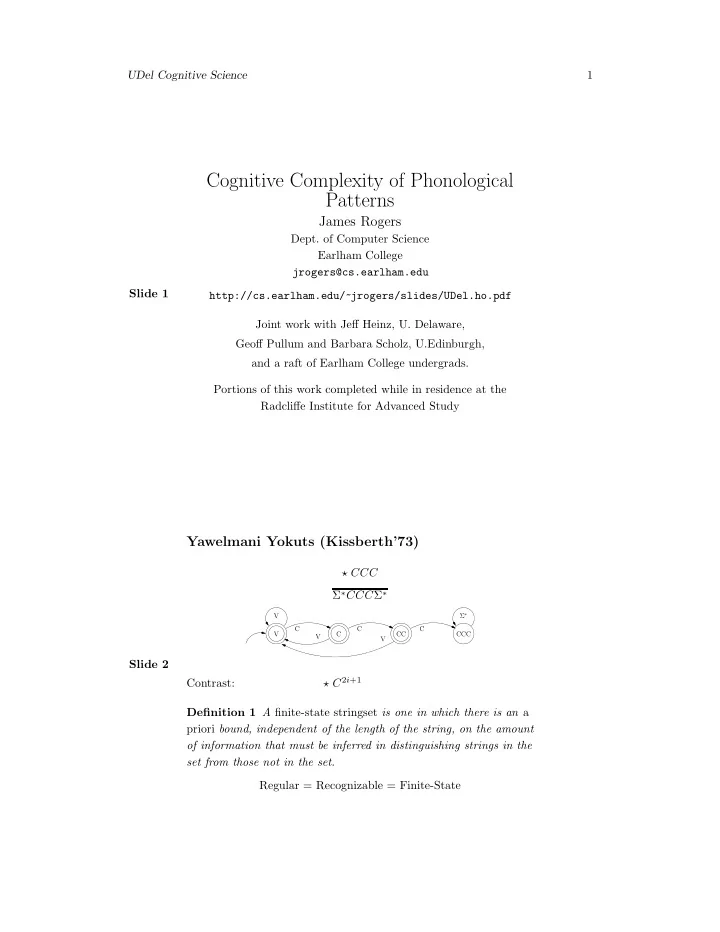
Yawelmani Yokuts (Kissberth’73)

⋆ CCC Σ∗CCCΣ∗

C C V C C V CC Σ∗ CCC V V

Contrast: ⋆ C2i+1 Definition 1 A finite-state stringset is one in which there is an a priori bound, independent of the length of the string, on the amount

  • f information that must be inferred in distinguishing strings in the

set from those not in the set. Regular = Recognizable = Finite-State

slide-2
SLIDE 2

UDel Cognitive Science 2 Slide 3

Cognitive Complexity of Simple Patterns

Sequences of ‘A’s and ‘B’s which end in ‘B’: S0 − → AS0, S0 − → BS0, S0 − → B

A B B A

(A + B)∗B Sequences of ‘A’s and ‘B’s which contain an odd number of ‘B’s: S0 − → AS0, S0 − → BS1, S1 − → AS1, S1 − → BS0, S1 − → ε

A B A B

(A∗BA∗BA∗)∗A∗BA∗ Slide 4

Some More Simple Patterns

Sequences of ‘A’s and ‘B’s which contain at least one ‘B’: S0 − → AS0, S0 − → BS1, S1 − → AS1, S1 − → BS1, S1 − → ε

A B A, B

A∗B(A + B)∗ Sequences of ‘A’s and ‘B’s which contain exactly one ‘B’: S0 − → AS0, S0 − → BS1, S1 − → AS1, S1 − → ε

B A, B A B A

A∗BA∗

slide-3
SLIDE 3

UDel Cognitive Science 3 Slide 5

Dual characterizations of complexity classes

Computational classes

  • Characterized by abstract computational mechanisms
  • Equivalence between mechanisms
  • Tools to determine structural properties of stringsets

Descriptive classes

  • Characterized by the nature of information about the

properties of strings that determine membership

  • Independent of mechanisms for recognition
  • Subsume wide range of types of patterns

Slide 6

Cognitive Complexity from First Principles

What kinds of distinctions does a cognitive mechanism need to be sensitive to in order to classify an event with respect to a pattern? Reasoning about patterns

  • What objects/entities/things are we reasoning about?
  • What relationships between them are we reasoning with?
slide-4
SLIDE 4

UDel Cognitive Science 4 Slide 7

Some Assumptions about Linguistic Behaviors

  • Perceive/process/generate linear sequence of (sub)events
  • Can model as strings—linear sequence of abstract symbols

– Discrete linear order (initial segment of N). – Labeled with alphabet of events Partitioned into subsets, each the set of positions at which some event occurs. Slide 8

Word models

D, ⊳, ⊳+, Pσσ∈Σ (+1) D, ⊳, Pσσ∈Σ (<) D, ⊳+, Pσσ∈Σ D — Finite ⊳+ — Linear order on D ⊳ — Successor wrt ⊳+ Pσ — Subset of D at which σ occurs (Pσ partition D) CCV C = {0, 1, 2, 3}, {i, i + 1 | 0 ≤ i < 3}, {0, 1, 3}C, {2}V

  • D

⊳ PC PV

slide-5
SLIDE 5

UDel Cognitive Science 5 Slide 9

Adjacency—Substrings VCVCV C

Definition 2 (k-Factor) v is a factor of w if w = uvx for some u, v ∈ Σ∗. v is a k-factor of w if it is a factor of w and |v| = k. Fk(w) def =    {v ∈ Σk | (∃u, x ∈ Σ∗)[w = uvx]} if |w| ≥ k, {w}

  • therwise.

F2(CV CV CV ) = {CV, V C} F7(CV CV CV ) = {CV CV CV } Slide 10

Strictly Local Stringsets—SL

Strictly k-Local Definitions —Grammar is set of permissible k-factors G ⊆ Fk({⋊} · Σ∗ · {⋉}) w | = G def ⇐ ⇒ Fk(⋊ · w · ⋉) ⊆ G L(G) def = {w | w | = G} e.g.: G = {⋊C, CV, V C, C⋉}, L(G) = CV (CV )∗C Definition 3 (Strictly Local Sets) A stringset L over Σ is Strictly Local iff there is some strictly k-local definition G over Σ (for some k) such that L is the set of all strings that satisfy G

slide-6
SLIDE 6

UDel Cognitive Science 6 Slide 11

SL Hierarchy

Definition 4 (SL) A stringset is Strictly k-Local if it is definable with an SLk definition. A stringset is Strictly Local (in SL) if it is SLk for some k. Theorem 1 (SL-Hierarchy) SL2 SL3 · · · SLi SLi+1 · · · SL Every Finite stringset is SLk for some k: Fin ⊆ SL. There is no k for which SLk includes all Finite languages. Slide 12

⋆ CCC is SL3

G¬CCC = F3({⋊} · Σ∗ · {⋉}) −{CCC}

⋉ ⋉ ⋊ ⋊CV VCCCV C C V V

Membership in an SLk stringset depends only on the individual k-factors which occur in the string.

slide-7
SLIDE 7

UDel Cognitive Science 7 Slide 13

Scanners

Q D

a b a b a b a b a b a b a b a b a a a ∈ φ a b b · · · · · · · · · · · · · · ·

k

a · · · b · · ·

k k

b

G :

Recognizing an SLk stringset requires only remembering the k most recently encountered symbols. Slide 14

Scanners as FSA

V V ⋊V CC ⋊C V C CV ⋊ V C V C V C V V C V C C V C

M def = Q, Σ, q0, δ, F Q def = Fk−1(Σ∗) ∪ {⋊} ·

0≤i<k−1[{Fi<k−1(Σ∗)}]

qo def = ⋊ δ(σ · v, γ) def = u ⇔ u = v · γ ∈ Q ∨ u = σ · v · γ = ⋊ · v · γ ∈ Q F def = Q

slide-8
SLIDE 8

UDel Cognitive Science 8 Slide 15

Character of Strictly k-Local Sets

Theorem (Suffix Substitution Closure): A stringset L is strictly k-local iff whenever there is a string x of length k − 1 and strings w, y, v, and z, such that w ·

k−1

  • x

· y ∈ L v · x · z ∈ L then it will also be the case that w · x · z ∈ L E.g.: But ⋆ CCC is not SL2: V · V C · CV ∈⋆ CCC C · V C · V C ∈⋆ CCC V · V C · V C ∈⋆ CCC C · C · V C ∈⋆ CCC V · C · CV ∈⋆ CCC C · C · CV ∈⋆ CCC Slide 16

Cognitive interpretation of SL

  • Any cognitive mechanism that can distinguish member strings

from non-members of a (properly) SLk language must be sensitive, at least, to the length k blocks of consecutive events that occur in the presentation of the string.

  • If the strings are presented as sequences of events in time, then

this corresponds to being sensitive, at each point in the string, to the immediately prior sequence of k − 1 events.

  • Any cognitive mechanism that is sensitive only to the length k

blocks of consecutive events in the presentation of a string will be able to recognise only SLk languages.

slide-9
SLIDE 9

UDel Cognitive Science 9 Slide 17

Cambodian 2 1

´ H L ´ L ` H ` H ´ H

  • In words of all sizes, primary stress

falls on the final syllable.

  • In words of all sizes, secondary stress

falls on all heavy syllables.

  • Light syllables occur only immedi-

ately following heavy syllables.

  • Light monosyllables do not occur.

Slide 18

Cambodian

⋊ 2 L ´ H ´ L ` H 1

´ L ` H ` H ´ H ´ H L

slide-10
SLIDE 10

UDel Cognitive Science 10 Slide 19

Cambodian—Primary stress falls on the final syllable ` H 1 2 ´ H L ⋊ ´ L

` H ` H ´ H ´ H ´ L L

Slide 20

Cambodian—Light syllables occur only immediately following heavy syllables ⋊ 2 L ´ H ´ L ` H 1

´ L ` H ` H ´ H ´ H L

slide-11
SLIDE 11

UDel Cognitive Science 11 Slide 21

Cambodian—Minimized

1 2

´ H L ⋊ ´ L ` H 2 1

L ´ L ` H ` H ´ H ´ H

Slide 22

Alawa

2 1 4 3

σ σ ´ σ ´ σ σ σ

⋊σ ´ σ σ⋉ ⋊ ´ σ ⋉ ⋆ ⋊σ ´ σ ⋉ ⋊σ σ ´ σσ⋉ ⋊´ σ σ ⋉ ⋆ ⋊σ σ ⋉ GAlawa = { ⋊σσ, ⋊σ´ σ, ⋊´ σσ, σσσ, σσ´ σ, σ´ σσ, ´ σσ⋉, ⋊´ σ⋉ }

slide-12
SLIDE 12

UDel Cognitive Science 12 Slide 23

Alawa

2 1 4 3

σ σ ´ σ ´ σ σ σ

3 4 2 1 σ´ σ ´ σσ ´ σ´ σ σσ ⋊´ σ ⋊σ ⋊ σ σ σ σ ´ σ σ ´ σ ´ σ

Slide 24

Arabic (Bani-Hassan)

6 1 8 7 2 5 3 4 σ1 ´ σ0 ´ σ0 ´ σ2 ´ σ1 ` σ1 ` σ2 ` σ1 ` σ2 ´ σ1 ´ σ2 ` σ0 σ0 ` σ1 ` σ2 ` σ0 σ0 σ1 σ0 σ0 σ1 σ1 ´ σ1 ´ σ2 σ0 σ0 σ0

GArabicBH = {· · · } −{σ ´ σ0⋉ | σ ∈ σ0, σ1, σ2} LArabicBH = L{··· } ∩ Lσ ´

σ0⋉

slide-13
SLIDE 13

UDel Cognitive Science 13 Slide 25

Arabic (Classical)

3 2 1 4

´ σ0 ´ σ1 σ0 σ1 σ0 σ0 σ0 σ1 ´ σ2 ´ σ2 σ1 σ2 ´ σ1 σ2 σ1

⋊σ1

k−1

  • σ0 · · · σ0

´ σ2⋉ ⋊ ´ σ2

k−1

  • σ0 · · · σ0

σ1⋉ ⋆ ⋊σ1

k−1

  • σ0 · · · σ0

σ1⋉ Slide 26

Strictly Local Stress Patterns

Heinz’s Stress Pattern Database (ca. 2007)—109 patterns 9 are SL2 Abun West, Afrikans, . . . Cambodian,. . . Maranungku 44 are SL3 Alawa, Arabic (Bani-Hassan),. . . 24 are SL4 Arabic (Cairene),. . . 3 are SL5 Asheninca, Bhojpuri, Hindi (Fairbanks) 1 is SL6 Icua Tupi 28 are not SL Amele, Bhojpuri (Shukla Tiwari), Ara- bic Classical, Hindi (Keldar), Yidin,. . . 72% are SL, all k ≤ 6. 49% are SL3.

slide-14
SLIDE 14

UDel Cognitive Science 14 Slide 27

The Problematic Case—Some-` σ 2 3 1

´ σ ´ σ ` σ ` σ , ` σ , ` σ σ σ σ

⋊´ σ

k−1

σ · · · σ ` σ⋉ ⋊´ σ` σ

k−1

σ · · · σ σ⋉ ⋆ ´ σ

k−1

σ · · · σ σ⋉ Slide 28

Locally definable stringsets

f ∈ Fk(⋊ · Σ∗ · ⋉) w | = f def ⇐ ⇒ f ∈ Fk(⋊ · w · ⋉) ϕ ∧ ψ w | = ϕ ∧ ψ def ⇐ ⇒ w | = ϕ and w | = ψ ¬ϕ w | = ¬ϕ def ⇐ ⇒ w | = ϕ Definition 5 (Locally Testable Sets) A stringset L over Σ is Locally Testable iff (by definition) there is some k-expression ϕ

  • ver Σ (for some k) such that L is the set of all strings that satisfy

ϕ: L = L(ϕ) def = {w ∈ Σ∗ | w | = ϕ} SLk ≡

  • fi∈G

[¬fi] LTk

slide-15
SLIDE 15

UDel Cognitive Science 15 Slide 29

Some-` σ 1 3 2

` σ σ ´ σ ´ σ σ σ ` σ ` σ ` σ

ϕSome-`

σ =

(⋊´ σ ∨ ´ σ⋉)

Starts or ends with ´ σ

∧ ` σ

Some ` σ Slide 30

LT Automata

a a b b b a b a b a b a b a b a b a b a

Boolean Network

a Yes No

Accept Reject

b a b b a a a b a b

  • a

b

Membership in an LTk stringset depends only on the set of k-Factors which occur in the string. Recognizing an LTk stringset requires only remembering which k-factors occur in the string.

slide-16
SLIDE 16

UDel Cognitive Science 16 Slide 31

Character of Locally Testable sets

Theorem 2 (k-Test Invariance) A stringset L is Locally Testable iff there is some k such that, for all strings x and y, if ⋊ · x · ⋉ and ⋊ · y · ⋉ have exactly the same set of k-factors then either both x and y are members of L or neither is. Definition 6 (k-Local Equivalence) w ≡L

k v def

⇐ ⇒ Fk(⋊w⋉) = Fk(⋊v⋉). Slide 32

LT Hierarchy

Definition 7 (LT ) A stringset is k-Locally Testable if it is definable with an LTk-expression. A stringset is Locally Testable (in LT) if it is LTk for some k. Theorem 3 (LT-Hierarchy) LT2 LT3 · · · LTi LTi+1 · · · LT

slide-17
SLIDE 17

UDel Cognitive Science 17 Slide 33

Cognitive interpretation of LT

  • Any cognitive mechanism that can distinguish member strings

from non-members of a (properly) LTk language must be sensitive, at least, to the set of length k contiguous blocks of events that occur in the presentation of the string—both those that do occur and those that do not.

  • If the strings are presented as sequences of events in time, then

this corresponds to being sensitive, at each point in the string, to the set of length k blocks of events that occurred at any prior point.

  • Any cognitive mechanism that is sensitive only to the
  • ccurrence or non-occurrence of length k contiguous blocks of

events in the presentation of a string will be able to recognise

  • nly LTk languages.

Slide 34

Arabic (Classical)

3 2 1 4

σ1 ´ σ2 ´ σ0 σ1 σ0 ´ σ1 σ0 ´ σ1 σ1 σ1 σ0 σ2 σ0 ´ σ2 σ2

⋊σ1

k−1

  • σ0 · · · σ0 ´

σ1

k−1

  • σ0 · · · σ0 ⋉

≡L

k

⋊σ1

k−1

  • σ0 · · · σ0 ´

σ1

k−1

  • σ0 · · · σ0 ´

σ1

k−1

  • σ0 · · · σ0 ⋉
slide-18
SLIDE 18

UDel Cognitive Science 18 Slide 35

FO(+1)

Models: D, ⊳, Pσσ∈Σ First-order Quantification (over positions in the strings) x ⊳ y w, [x → i, y → j] | = x ⊳ y def ⇐ ⇒ j = i + 1 Pσ(x) w, [x → i] | = Pσ(x) def ⇐ ⇒ i ∈ Pσ ϕ ∧ ψ . . . ¬ϕ . . . (∃x)[ϕ(x)] w, s | = (∃x)[ϕ(x)] def ⇐ ⇒ w, s[x → i] | = ϕ(x)] for some i ∈ D FO(+1)-Definable Stringsets: L(ϕ) def = {w | w | = ϕ}. One-´ σ = L((∃x)[´ σ(x) ∧ (∀y)[´ σ(y) → x ≈ y] ]) Arabic (Classical) is FO(+1) Slide 36

Character of the FO(+1) Definable Stringsets

Definition 8 (Locally Threshold Testable) A set L is Locally Threshold Testable (LTT) iff there is some k and t such that, for all w, v ∈ Σ∗: if for all f ∈ Fk(⋊ · w · ⋉) ∪ Fk(⋊ · v · ⋉) either |w|f = |v|f or both |w|f ≥ t and |v|f ≥ t, then w ∈ L ⇐ ⇒ v ∈ L. Theorem 4 (Thomas) A set of strings is First-order definable

  • ver D, ⊳, Pσσ∈Σ iff it is Locally Threshold Testable.

Membership in an FO(+1) definable stringset depends only on the multiplicity of the k-factors, up to some fixed finite threshold, which occur in the string.

slide-19
SLIDE 19

UDel Cognitive Science 19 Slide 37

LTT Automata

a a b b a b a a a b a b a b b a b a b a b

Boolean Network

Yes No

Accept Reject

φ a b a a b b b a b a b a

  • Slide 38

Cognitive interpretation of FO(+1)

  • Any cognitive mechanism that can distinguish member strings

from non-members of a (properly) FO(+1) stringset must be sensitive, at least, to the multiplicity of the length k blocks of events, for some fixed k, that occur in the presentation of the string, distinguishing multiplicities only up to some fixed threshold t.

  • If the strings are presented as sequences of events in time, then

this corresponds to being able count up to some fixed threshold.

  • Any cognitive mechanism that is sensitive only to the

multiplicity, up to some fixed threshold, (and, in particular, not to the order) of the length k blocks of events in the presentation

  • f a string will be able to recognize only FO(+1) stringsets.
slide-20
SLIDE 20

UDel Cognitive Science 20 Slide 39

No H before ´ H is not FO(+1)

Primary stress on leftmost heavy syllable ⋆ H . . . ´ H ⋊

2kt

  • `

LL · · · ` LL ´ HH

2kt

  • `

LL · · · ` LL ` HH

2kt

  • `

LL · · · ` LL ⋉ ≡L

k,t

⋆ ⋊ ` LL · · · ` LL

  • 2kt

` HH ` LL · · · ` LL

  • 2kt

´ HH ` LL · · · ` LL

  • 2kt

⋉ Slide 40

First-Order(<) definable stringsets

D, ⊳+, Pσσ∈Σ First-order Quantification over positions in the strings x ⊳+ y w, [x → i, y → j] | = x ⊳+ y def ⇐ ⇒ i < j Pσ(x) w, [x → i] | = Pσ(x) def ⇐ ⇒ i ∈ Pσ ϕ ∧ ψ . . . ¬ϕ . . . (∃x)[ϕ(x)] w, s | = (∃x)[ϕ(x)] def ⇐ ⇒ w, s[x → i] | = ϕ(x)] for some i ∈ D

slide-21
SLIDE 21

UDel Cognitive Science 21 Slide 41

Star-Free stringsets

Definition 9 (Star-Free Set) The class of Star-Free Sets (SF) is the smallest class of languages satisfying:

  • Fin ⊆ SF.
  • If L1, L2 ∈ SF then:

L1 · L2 ∈ SF, L1 ∪ L2 ∈ SF, L1 ∈ SF. Theorem 5 (McNauthton and Papert) A set of strings is First-order definable over D, ⊳+, Pσσ∈Σ iff it is Star-Free. Slide 42

Cognitive interpretation of SF (FO(<))

  • Any cognitive mechanism that can distinguish member strings

from non-members of a (properly) SF language must be sensitive, at least, to both the order and the multiplicity of the length k blocks of events, for some fixed k, that occur in the presentation of the string, distinguishing multiplicities only up to some fixed threshold t.

  • If the strings are presented as sequences of events in time, then

this corresponds to being able not only to count events up to some threshold but also to track the sequence in which those events occur.

  • Any cognitive mechanism that is sensitive only to the order

and the multiplicity of the length k blocks of events, for some fixed k, that occur in the presentation of the string, distinguishing multiplicities only up to some fixed threshold t will be able to recognise only SF languages.

slide-22
SLIDE 22

UDel Cognitive Science 22 Slide 43

Sub-Regular Hierarchies

LT FO MSO Prop Restricted Reg ? ? Fin SF < SP PT LTT +1 SL

Slide 44

Yidin

  • Primary stress on the leftmost heavy syllable, else the initial

syllable

  • Secondary stress iteratively on every second syllable in both

directions from primary stress

  • No light monosyllables

Explicitly:

  • Exactly one ´

σ (One-´ σ)

  • ´

L implies no H (No-H-with-´ L)

  • σ and `

σ/´ σ alternate (Alt)

  • First H gets primary stress

(No-H-before- ´ H)

  • ´

L only if initial (Nothing-before-´ L)

  • No ´

L monosyllables (No ⋊´ L⋉)

slide-23
SLIDE 23

UDel Cognitive Science 23 Slide 45

Classifying Conjunctive Constraints

  • One-´

σ (∃!x)[´ σ(x)] (LTT1,2)

  • No-H-before- ´

H ¬(∃x, y)[x ⊳+ y ∧ H(x) ∧ ´ H(y)] (SF)

  • No-H-with-´

L ¬(H ∧ ´ L) (LT1)

  • Nothing-before-´

L ¬σ ´ L (SL2)

  • Alt

¬σσ ∧ ¬´ σ´ σ ∧ ¬´ σ` σ ∧ ¬` σ´ σ ∧ ¬` σ` σ (SL2)

  • No ⋊´

L⋉ ¬⋊´ L⋉ (SL3) Yidin is SF Slide 46

Combining Conjunctive Constraints

  • One-´

σ

1 ´ H, ´ L ´ H, ´ L

  • No-H-before- ´

H

2 3 4 ´ H H, ` H ´ H

  • One-´

σ ∩ No-H-before- ´ H

0/3 1/4 1/2 1/3 0/2 H H, ` H ´ H, ´ L ´ H ´ H ´ L ´ L

slide-24
SLIDE 24

UDel Cognitive Science 24 Slide 47

  • No-H-with-´

L

6 7 5 H, ´ H, ` H H, ´ H, ` H ´ L ´ L

  • Nothing-before-´

L

8 9 10 ´ L ´ L

  • Alt

13 12 11 σ ´ σ, ` σ ´ σ, ` σ σ ´ σ, ` σ σ

  • No ⋊´

L⋉

14 15 16 ´ L

Slide 48

Yidin

6 7 1 4 5 2 3

` H L ` L ` L L ´ L L L ´ H L ` L ´ H H ` L

slide-25
SLIDE 25

UDel Cognitive Science 25 Slide 49

Precedence—Subsequences

Definition 10 (Subsequences) v ⊑ w def ⇐ ⇒ v = σ1 · · · σn and w ∈ Σ∗ · σ1 · Σ∗ · · · Σ∗ · σn · Σ∗ Pk(w) def = {v ∈ Σk | v ⊑ w} P≤k(w) def = {v ∈ Σ≤k | v ⊑ w}

σσ

σ σ ´ σ σ ` σ σ

σσ, σ´ σ, ´ σσ, σ` σ, ` σσ

σ´ σ, σσ, ´ σ` σ σσ, σ` σ, ´ σσ σ` σ, σσ

P2(σσ´ σσ` σσ) = {σσ, σ´ σ, σ` σ, ´ σσ, ´ σ` σ, ` σσ} P≤2(σσ´ σσ` σσ) = {ε, σ, ´ σ, ` σ, σσ, σ´ σ, σ` σ, ´ σσ, ´ σ` σ, ` σσ} Slide 50

Strictly Piecewise Stringsets—SP

Strictly k-Piecewise Definitions G ⊆ Σ≤k w | = G def ⇐ ⇒ P≤k(w) ⊆ P≤k(G) L(G) def = {w ∈ Σ∗ | w | = G} GNo-H-before- ´

H = {HH, H `

H, ` HH, ` H ` H, ´ HH, ´ H ` H, . . .}

*

L ´ H L H L L L L L H ´ H L

Membership in an SPk stringset depends only on the individual (≤ k)-subsequences which do and do not occur in the string.

slide-26
SLIDE 26

UDel Cognitive Science 26 Slide 51

Character of the Strictly k-Piecewise Sets

Theorem 6 A stringset L is Strictly k-Piecewise Testable iff it is closed under subsequence: wσv ∈ L ⇒ wv ∈ L Every naturally occurring stress pattern requires Primary Stress ⇒ No naturally occurring stress pattern is SP. But SP can forbid multiple primary stress: ¬´ σ´ σ Slide 52 Yidin constraints wrt SP

6 7 1 4 5 2 3

` H L ` L ` L L ´ L L L ´ H L ` L ´ H H ` L

  • One-´

σ is not SP ⋆ σσ ⊑ σ´ σσ

  • No-H-before- ´

H is SP2 ¬H ´ H

  • No-H-with-´

L is SP2 ¬H ´ L ∧ ¬´ LH

  • Nothing-before-´

L is SP2 ¬σ ´ L

  • Alt is not SP

⋆ σσ´ σ ⊑ σ` σσ´ σ

  • No ⋊´

L⋉ is not SP ⋆ ´ L ⊑ ´ LL

slide-27
SLIDE 27

UDel Cognitive Science 27 Slide 53

Cognitive interpretation of SP

  • Any cognitive mechanism that can distinguish member strings

from non-members of a (properly) SPk stringset must be sensitive, at least, to the length k (not necessarily consecutive) sequences of events that occur in the presentation of the string.

  • If the strings are presented as sequences of events in time, then

this corresponds to being sensitive, at each point in the string, to up to k − 1 events distributed arbitrarily among the prior events.

  • Any cognitive mechanism that is sensitive only to the length k

sequences of events in the presentation of a string will be able to recognize only SPk stringsets. Slide 54

k-Piecewise Testable Stringsets

PTk-expressions p ∈ Σ≤k w | = p def ⇐ ⇒ p ⊑ w ϕ ∧ ψ w | = ϕ ∧ ψ def ⇐ ⇒ w | = ϕ and w | = ψ ¬ϕ w | = ¬ϕ def ⇐ ⇒ w | = ϕ k-Piecewise Testable Languages (PTk): L(ϕ) def = {w ∈ Σ∗ | w | = ϕ} One-´ σ = L(´ σ ∧ ¬´ σ´ σ) Membership in an PTk stringset depends only on the set of (≤ k)-subsequences which occur in the string. SPk is equivalent to

pi∈G[¬pi]

slide-28
SLIDE 28

UDel Cognitive Science 28 Slide 55

Character of Piecewise Testable sets

Theorem 7 (k-Subsequence Invariance) A stringset L is Piecewise Testable iff there is some k such that, for all strings x and y, if x and y have exactly the same set of (≤ k)-subsequences then either both x and y are members of L or neither is. w ≡P

k v def

⇐ ⇒ P≤k(w) = P≤k(v). Slide 56 Yidin constraints wrt PT

6 7 1 4 5 2 3

` H L ` L ` L L ´ L L L ´ H L ` L ´ H H ` L

  • One-´

σ is PT2 ´ σ ∧ ¬´ σ´ σ

  • No-H-before- ´

H is SP2 ¬H ´ H

  • No-H-with-´

L is SP2 ¬H ´ L ∧ ¬´ LH

  • Nothing-before-´

L is SP2 ¬σ ´ L

  • Alt is not PT

2k

  • σ`

σ · · · σ` σ ≡ P

k 2k

  • σ`

σ · · · σ` σ ` σ

  • No ⋊´

L⋉ is PT2 ´ L → (σ ´ L ∨ ´ Lσ)

slide-29
SLIDE 29

UDel Cognitive Science 29 Slide 57

Cognitive interpretation of PT

  • Any cognitive mechanism that can distinguish member strings

from non-members of a (properly) PTk stringset must be sensitive, at least, to the set of length k subsequences of events that occur in the presentation of the string—both those that do occur and those that do not.

  • If the strings are presented as sequences of events in time, then

this corresponds to being sensitive, at each point in the string, to the set of all length k subsequences of the sequence of prior events.

  • Any cognitive mechanism that is sensitive only to the set of

length k subsequences of events in the presentation of a string will be able to recognize only PTk stringsets. Slide 58

Yidin wrt Local and Piecewise Constraints

One-´ σ LTT1,2 PT2 Some-´ σ LT1 PT1 At-Most-One-´ σ LTT1,2 SP2 No-H-before- ´ H SF SP2 No-H-with-´ L LT1 SP2 Nothing-before-´ L SL2 SP2 Alt SL2 SF No ⋊´ L⋉ SL3 PT2 Yidin is co-occurence of SL and PT constraints or of LT and SP constraints

slide-30
SLIDE 30

UDel Cognitive Science 30 Slide 59

Local and Piecewise Hierarchies

LT FO MSO Prop Restricted Reg ? ? Fin SF < SP PT LTT +1 SL Slide 60

MSO definable stringsets

D, ⊳, ⊳+, Pσσ∈Σ First-order Quantification (positions) Monadic Second-order Quantification (sets of positions) ⊳+ is MSO-definable from ⊳.

slide-31
SLIDE 31

UDel Cognitive Science 31 Slide 61

Character of the MSO-definable sets

Theorem 8 (Medvedev, B¨ uchi, Elgot) A set of strings is MSO-definable over D, ⊳, ⊳+, Pσσ∈Σ iff it is regular. Theorem 9 (Chomsky Sch¨ utzenberger) A set of strings is Regular iff it is a homomorphic image of a Strictly 2-Local set. Theorem 10 MSO = ∃MSO over strings. Slide 62

Cognitive interpretation of Finite-state

  • Any cognitive mechanism that can distinguish member strings

from non-members of a finite-state stringset must be capable of classifying the events in the input into a finite set of abstract categories and are sensitive to the sequence of those categories.

  • Subsumes any recognition mechanism in which the amount of

information inferred or retained is limited by a fixed finite bound.

  • Any cognitive mechanism that has a fixed finite bound on the

amount of information inferred or retained in processing sequences of events will be able to recognize only finite-state stringsets.

slide-32
SLIDE 32

UDel Cognitive Science 32 Slide 63

Local and Piecewise Hierarchies

LT FO MSO Prop Restricted Reg ? ? Fin SF < SP PT LTT +1 SL