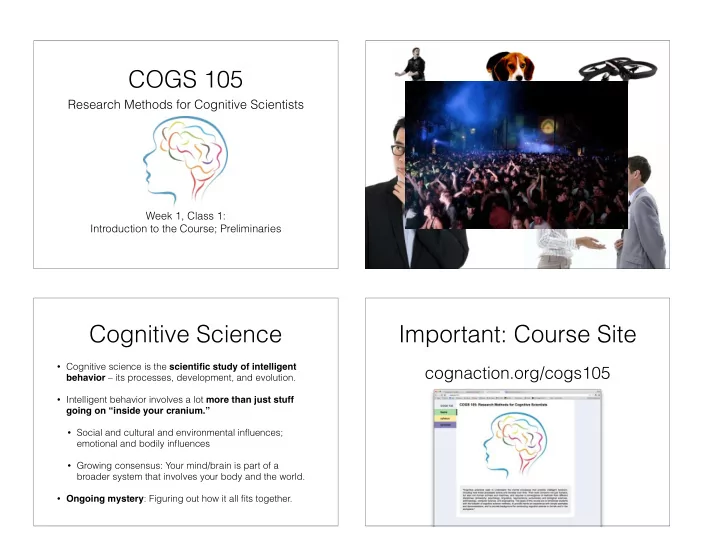
COGS 105 Research Methods for Cognitive Scientists Week 1, Class 1: - - PowerPoint PPT Presentation

cogs 105
SMART_READER_LITE
LIVE PREVIEW

COGS 105 Research Methods for Cognitive Scientists Week 1, Class 1: - - PowerPoint PPT Presentation

COGS 105 Research Methods for Cognitive Scientists Week 1, Class 1: Introduction to the Course; Preliminaries Cognitive Science Important: Course Site Cognitive science is the scientific study of intelligent cognaction.org/cogs105 behavior


slide-1
SLIDE 1

COGS 105

Research Methods for Cognitive Scientists

Week 1, Class 1: Introduction to the Course; Preliminaries

Cognitive Science

  • Cognitive science is the scientific study of intelligent

behavior – its processes, development, and evolution.

  • Intelligent behavior involves a lot more than just stuff

going on “inside your cranium.”

  • Social and cultural and environmental influences;

emotional and bodily influences

  • Growing consensus: Your mind/brain is part of a

broader system that involves your body and the world.

  • Ongoing mystery: Figuring out how it all fits together.

Important: Course Site

cognaction.org/cogs105

slide-2
SLIDE 2

Who Are You People? Outline of Course Learning Outcomes Readings

slide-3
SLIDE 3

Grading

Up to bonus 5%! 20% x 3 = 60% exams 30% labs 10% final paper

Lecture Slides

  • Yes, a simplified version of the

lecture slides will be provided each week.

  • Study guides will be supplied

1 week prior to exams.

No Section This Week

  • Note, there will be no sections this

week; we start next week.

  • Monday was a holiday; no material to

discuss.

Let’s Start

slide-4
SLIDE 4

method 1 method 2 method 3 method 4 method 5 method 6 … computer science anthropology philosophy psychology the big questions frame the scientific value of our methods

What Thinks?

Complex Dog Cognition?

  • Chaser the border collie can respond uniquely to
  • ver 1,000 English words.

Big Questions

  • Big concepts and questions: What is thinking? What is

intelligence? What is consciousness?

  • If we assume something does think, how can we find
  • ut what kind of thinking it does?
  • All kinds: Perception, action, problem solving,

language, memory, learning, etc.

  • Cognitive science is hopeless without rigorous

methodologies, especially empirical and computational methodology.

slide-5
SLIDE 5

Multi-Methodological…

  • Philosophy
  • Psychology
  • Anthropology
  • Neuroscience
  • Biologist
  • Linguist
  • Mathematician
  • Computational scientist
  • Artificial Intelligence

Philosophy Approach

  • Many important questions about thinking cannot be

addressed experimentally, so use logic and reason to address them.

  • Is it possible for non-biological systems (e.g.,

computers) to have thoughts?

  • What is the connection between the mental and

physical?

  • Is there free will?
  • Consciousness???
  • Dr. Carolyn Jennings, UCM Philosopher and Cognitive Scientist

Psychological Approach

  • Thinking is expressed through behavior, so experiment

with behavior to infer what is going on in thinking.

  • Reflexes? Tapping?
  • Simple and choice responding
  • Categorizing
  • Talking, reading
  • Planning, readoning, gaming, etc.
  • Music? Art? Dating? Emotion?
  • Dr. Eric Walle

UC Merced Psychologist

Anthropological Approach

  • Thinking occurs naturally in social and cultural

contexts, so observe behavior in situ to infer thinking mechanisms.

  • Compare across cultures, social situations, languages
  • Compare across evolutionary history, in terms of

biology as well as culture and society

  • Dr. Holley Moyes

UCM Anthropologist

slide-6
SLIDE 6

Neuroscience Approach

  • Thinking in biological organisms requires neurons,

so observe and experiment with the brain to infer thought mechanisms.

  • Molecules and DNA? Ion channels?
  • Spiking patterns across the brain?
  • Brain areas? Networks?
  • Dr. Ramesh Balasubramaniam

Butovens Médé, Ph.D. student

Biological Approach

  • Thinking occurs in all sufficiently complex

biological organisms, so use simpler organisms as models of thinking mechanisms.

  • Model organisms can be controlled more easily.
  • How simple can we get?
  • What aspects are general across organisms?
  • Ethical issues.
  • Dr. Suzanne Sindi

some dude

  • Dr. David Ardell

interdisciplinary project!

Linguistic Approach

  • Thoughts may be symbolic in nature, and language

is the quintessential symbolic system, so study language to infer thought mechanisms.

  • Sounds? Words?
  • Grammar? Meaning?
  • Discourse?
  • Dr. Stephanie Shih

UC Merced Cognitive Scientist and Linguist

Mathematical Approach

  • Theories of thinking are most powerful and testable

when formalized, so use mathematical expressions from which properties can be derived, proven, tested…

  • Dr. Roummel Marcia
  • Dr. Suzanne Sindi

Applied Mathematics UC Merced

slide-7
SLIDE 7

Computational Approach

  • Theories of thinking can be setup as computer

programs, so run those programs to hone, explore, and test theories!

  • Models might be based on ideas from the brain or other

areas (such as logic or rule systems; see Reading 2)

  • Models are typically very complex
  • Dr. Anne Warlaumont

UC Merced Cognitive Science, Hardcore Neural Computationalist

Artificial Intelligence

  • Thinking is not tied to biological substrates, so let’s

build machines that implement thinking mechanisms.

  • Can be quite different from cognitive models.
  • How similar are artificial systems to the way humans

think?

  • Dr. Paul Maglio

UC Merced Cognitive Scientist talking to IBM about Watson

Does Watson Think?

  • Is Watson intelligent?
  • For a primer on these

issues, which are now a half-century old, check

  • ut the required Reading

1 + online activity.

Multi-Methodological…

  • Philosophy
  • Psychology
  • Anthropology
  • Neuroscience
  • Biologist
  • Linguist
  • Mathematician
  • Computational scientist
  • Artificial Intelligence
slide-8
SLIDE 8

See you Thursday!

  • Remember, no sections held this week; let’s start

next week!

  • Thursday: Following along our line of discussion

about the history and goals of cognitive science.