Logistics and Such COGS 105 Research Methods for Cognitive - - PowerPoint PPT Presentation

logistics and such cogs 105
SMART_READER_LITE
LIVE PREVIEW

Logistics and Such COGS 105 Research Methods for Cognitive - - PowerPoint PPT Presentation

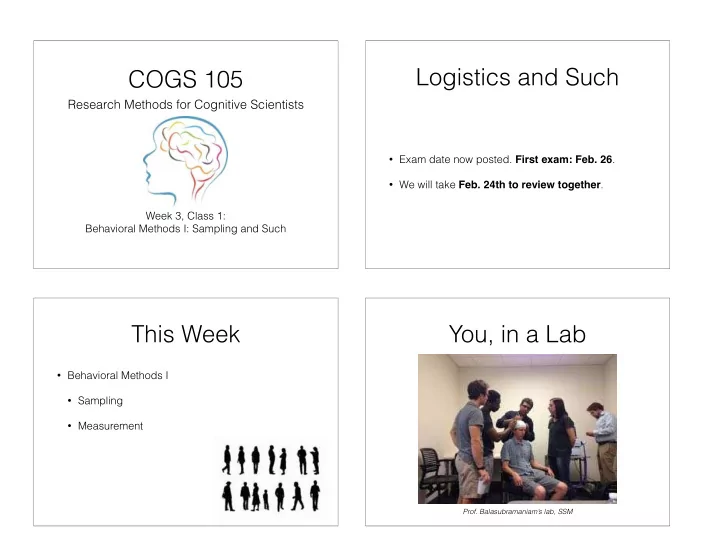
Logistics and Such COGS 105 Research Methods for Cognitive Scientists Exam date now posted. First exam: Feb. 26 . We will take Feb. 24th to review together . Week 3, Class 1: Behavioral Methods I: Sampling and Such This Week You, in a


slide-1
SLIDE 1

COGS 105

Research Methods for Cognitive Scientists

Week 3, Class 1: Behavioral Methods I: Sampling and Such

Logistics and Such

  • Exam date now posted. First exam: Feb. 26.
  • We will take Feb. 24th to review together.

This Week

  • Behavioral Methods I
  • Sampling
  • Measurement

You, in a Lab

  • Prof. Balasubramaniam’s lab, SSM
slide-2
SLIDE 2

You, in a Lab

  • Prof. Dale’s office or… ahem… his “laboratory”

Reaction Time

Your standard “reaction time lab”; being replaced by the internet!

Question

How do we determine who we are going to run in

  • ur laboratory tasks, and

how we are going to get them to participate?

Who, what, where, when… but why?

Sampling

  • The techniques we will be discussing today apply

across a variety of behavioral research contexts.

  • Surveys and polls (e.g., online surveys)
  • Database analysis (e.g., user logs, customer

logs)

  • Behavior in the laboratory (e.g., RT!)
slide-3
SLIDE 3

In most cases…

…as cognitive scientists we are forever trapped in drawing inferences about people and their cognitive processes using very coarsely and crudely collected samples…

So…

…always be wary of how you are making generalizations about people; always critique, question, explore and expand the ways that you sample from people and measure their behavior…

Basics of Sampling Sampling

From required readings

slide-4
SLIDE 4

Sampling Model

  • Identify the population you are interested in
  • Draw a fair, representative sample
  • Very difficult to draw a fair, representative

sample.

  • Very difficult to know if you can generalize to

contexts such as time and place.

Proximal Similarity Model

  • Reason from our sample to a population: What can

we generalize to? What situations / populations are similar to our sample?

  • Lets us generalize to that context: “So, my study

shows that people who are like X in condition Y will do Z.”

  • You can visualize the “proximal similarity model”

this way…

Proximal Similarity Model

your “zone of generalization”

External Validity

  • Does my task and do my participants approximate

the population “external to my study” that I want to generalize to?

  • Threats to external validity… people, places, and

times most common issues.

slide-5
SLIDE 5

W E I R D estern ducated ndustrialized ich emocratic

We’ll talk more about this problem later this semester…

We are all WEIRD

Jones, 2010

Sampling Terminology

  • Theoretical population: “the population you would

like to generalize to.”

  • Accessible population: “the population that will be

accessible to you.”

  • Sampling frame: list of available participants or

also procedures for doing that sampling.

  • Sample: the folks you recruited.

Sampling Terminology

“At this point, you should appreciate that sampling is a difficult multi-step process and that there are lots of places you can go wrong. In fact, as we move from each step to the next in identifying a sample, there is the possibility of introducing systematic error or bias.”

slide-6
SLIDE 6

Statistical Ideas Statistical Terms

  • Response = one or more responses are provided

by participants in our sample; measured behavior in some way. (this measure is your variable)

  • You can calculate a statistic from several

responses across individuals. This is a property of your sample.

  • You are trying to estimate a parameter; a “true”

statistic in your broader population.

Statistical Terms (in RT)

  • Response = A single reaction time score (RT) to
  • ne of our words.
  • You can calculate a statistic from several

responses across individuals; for example what is your sample’s average RT to common words.

  • You are trying to estimate a parameter; a “true”

statistic in your broader population; is the “average person’s” RT to common words truly faster than the RT responses to uncommon words?

slide-7
SLIDE 7

Sampling Distribution Example… from RT!

  • When we reason about common vs. uncommon

words and which induces faster mental processes, we are trying to make an inference from a single experiment.

  • This single experiment will have variability, it will
  • nly approximate the ‘true’ mean.
  • The idea of a sampling distribution is what our

average reaction times might look like if we did this experiment an infinite number of times.

SD vs. SE

  • Standard deviation (SD) is a measure in our
  • riginal units of the variability of our measurement.

There is a SD of RT.

  • Standard error (SE) is an estimate of “how off” we

probably are in our experiment from the true value; it is estimated from the SD.

  • SE = SD / sqrt(N)

Example

  • Let’s go from RT’s to something stupidly simple.
  • Imagine labeling heads 1 and tails 0 and conducting a

really boring coin flip experiment. (response = 0 or 1)

  • What is the true average score in the game

(parameter)?

  • Well, we know it, 0.5, ja?
  • But this little scenario lets us see how SD and SE work.

It’s really quite simple, if unintuitive at first.

slide-8
SLIDE 8

go to R script

SE = SD / sqrt(sample size)

Summary

  • Standard deviation describes your sample; it is the

tendency for your scores to vary, in the original units (e.g., a coin flip will tend to vary from the mean by 0.5, since the mean is 0.5 but heads is 1 and tails is 0).

  • Standard error is used to estimate how precise your

statistic is for estimating the parameter; you want to infer to the “true mean” of the distribution.

  • Importantly: SE depends on how much data you have

collected! How big is your sample!? The bigger, the more accurate your estimate of the “true average.”

Types of Sampling Probability Sampling

  • “any method of sampling that utilizes some form of

random selection. In order to have a random selection method, you must set up some process

  • r procedure that assures that the different units in

your population have equal probabilities of being chosen.” (reading)

slide-9
SLIDE 9

Probability Sampling

  • Simple random sampling: “Make sure that

everyone accessible through your sampling frame has an equal chance of being in the sample.”

  • Often: random number generators.
  • E.g., Excel’s “rand()” function.
  • Ensures representativeness when you use large

numbers; “proportional representation.”

“Drawing Lots” Better Way…

  • You know… computers.
  • Back in the day (which was I guess, in this case,

before readily available computing tools), figuring

  • ut the best way to sample randomly was a big

big deal!

  • Researchers and engineers used to buy random

number books. You can still buy ‘em on Amazon!

slide-10
SLIDE 10

Reviews Are Hilarious Probability Sampling

  • Stratified random sampling: divide up your

population into separate groups and draw a simple random sample from each.

  • Each level is called a “stratum.”
  • Ensures that you have equal representation of

two strata of interest.

  • E.g., if one subgroup is super small.

Example from our RT

  • Common words are way more common than uncommon

words… but we include them in our study in equal proportion because we’d like our results to be as comparable as possible. This is essentially a “stratified” approach.

  • Crucial observation here:
  • Note that this also means that reasoning about sampling

also applied to the stimuli in our tasks!

  • You can also ask “How do I sample from words for

my study, because I want to generalize to all words.”

slide-11
SLIDE 11

Probability Sampling

  • Cluster (area) random sampling: before sampling

from your population, randomly choose a set of spatial (or “geographic”) clusters of interest to you.

  • Relevant to survey methodologies.
  • Cannot sample a whole state, for example, so we

first randomly sample from districts, then perform a sample on those districts.

Nonprobability Sampling

  • Accidental, haphazard, or convenience sampling occurs in

situations where you cannot easily control the availability of representative samples, so you draw from what is immediately available.

  • “Take ‘em as they come.”
  • “Clipboard at the mall.”
  • Purposive: You have a population segment you are interested

in and you pursue data on those folks; “malls, clipboards.”

  • Whole bunch of purposive sampling approaches: expert

sampling, heterogeneity sampling, … (see reading)

SONA

  • Is SONA probability sampling or

nonprobability sampling?

  • It is nonprobability sampling;

convenience samples!

  • We often assume people sign up

haphazardly (it is almost random) … but is it?

  • What other problems are there

with SONA? Think of issues with generalization.

Next class…

  • Measurement issues; “constructs”; reliability and

validity.