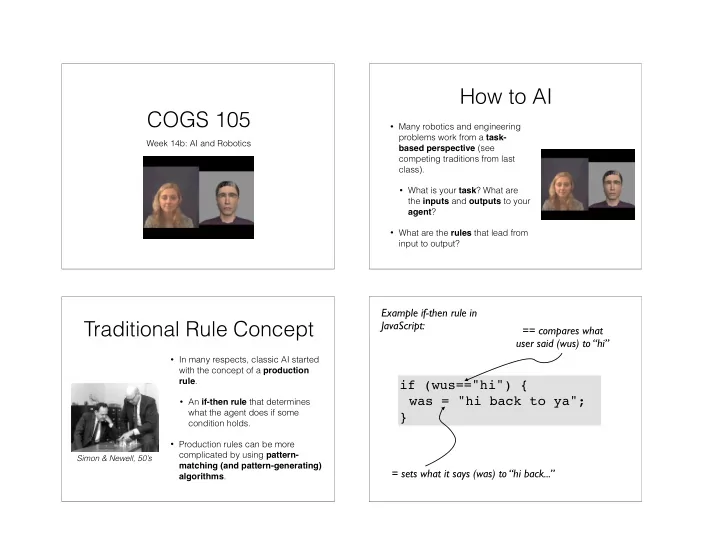
How to AI COGS 105 Many robotics and engineering problems work from - - PowerPoint PPT Presentation

how to ai cogs 105
SMART_READER_LITE
LIVE PREVIEW

How to AI COGS 105 Many robotics and engineering problems work from - - PowerPoint PPT Presentation

How to AI COGS 105 Many robotics and engineering problems work from a task- Week 14b: AI and Robotics based perspective (see competing traditions from last class). What is your task ? What are the inputs and outputs to your agent ?


slide-1
SLIDE 1

COGS 105

Week 14b: AI and Robotics

How to AI

  • Many robotics and engineering

problems work from a task- based perspective (see competing traditions from last class).

  • What is your task? What are

the inputs and outputs to your agent?

  • What are the rules that lead from

input to output?

Traditional Rule Concept

  • In many respects, classic AI started

with the concept of a production rule.

  • An if-then rule that determines

what the agent does if some condition holds.

  • Production rules can be more

complicated by using pattern- matching (and pattern-generating) algorithms.

Simon & Newell, 50’s

Example if-then rule in JavaScript:

if (wus=="hi") { was = "hi back to ya"; }

== compares what 
 user said (wus) to “hi” = sets what it says (was) to “hi back...”

slide-2
SLIDE 2

Other pattern matches...

if (wus.indexOf("mother")>=0) { ... if (wus=="hi" || wus=="hello" || wus=="hey" || wus=="hiya") { ... if (wus.length > 10) { ...

indexOf = check to see if the word “mother” appears in what they said. length = how long, in characters, is what they said? || = “or”, to check multiple possible patterns

Where Do 
 Rules Come From?

  • Imagine trying to build an artificial agent that can

engage in conversations.

  • What does the agent need to know?
  • Words
  • How to line up words into sentences
  • How to choose which sentence topics to pursue
  • How to stay on topic
  • How to guide the flow of conversation (e.g.,

question answer)

Where Do 
 Rules Come From?

  • Imagine trying to build an artificial agent that can

engage in conversations.

  • What does the agent need to know?
  • Morphology
  • Syntax
  • Semantics
  • Pragmatics / Discourse
  • Pragmatics / Discourse


Where Do 
 Rules Come From?

http://talkbank.org/

slide-3
SLIDE 3

Conversation Analysis

  • The analysis of interaction using video and audio,

and then careful hand-coding and observation.

  • Qualitative method.
  • Many of the methods in conversation analysis can

be transformed, in simple ways, into production

  • rules. For example, the adjacency pair.
  • E.g., offer/refusal (or acceptance), question-

answer, compliment-response

“SEMAINE” Project

Example: USC ICT Projects

  • USC’s Institute for Creative Technologies
  • They develop sophisticated intelligent virtual

characters that can engage in interaction using sets of sophisticated rules.

http://prod1.standardpatient.org/

Another: SimCoach

slide-4
SLIDE 4

ELITE

Cutting Edge: 
 Authoring Tools

  • The field of virtual agents is especially active in

developing and testing authoring tools, to make it easier for researchers or people in industry to create artificial agents.

  • These tools have a “point and click” strategy, and

allow users to build large repositories of pattern- matching algorithms (production rules, with some spice) without having to program.

RoundTable

  • https://authoring.simcoach.org/
slide-5
SLIDE 5

demo from previous year (just for illustration) demo from previous year (just for illustration) demo from previous year (just for illustration)

A Simple Interpreter Designed for this Purpose

slide-6
SLIDE 6

cognaction.org/ cogs105/chatagent

Two AI Cultures GOFAI-based… Embodied Dynamic Situated Hybrid Systems…

Robotics / AI

  • The field is massive. Even just the tools built into

this artificial, virtual software agent exemplify the array of domains of this field. HCI action modeling speech recognition speech synthesis computational linguistics

Various Issues in AI, Etc.

  • One problem faced by

engineers and scientists is that robotic systems are becoming complicated enough that it is difficult to do “on board.”

  • Solution: The cloud.

From reading #2

slide-7
SLIDE 7

Benefits

  • Increased computational power “off board”: using

high-performance servers to process / crunch numbers off the system itself.

  • Increased distribution of robotic (or AI) agents

can solve a problem faster, “in parallel.”

From reading #2

Involvement of CogSci

  • If you know how to code, you can be involved in all

stages…

  • …machine learning, neural networks, computer

vision, etc.

  • If you do not or do not want to code, you can still be

involved by…

  • …designing usability studies, serving as a “domain

expert” to help coders, analyze human behavior, etc.

Phamduy et al.

with children

Project Ideas

  • I can open up the chatbot

system for you to create your

  • wn chat agent.
  • You can use the Braitenberg

system to do some exploration

  • f agent-based simulations

(extending the last lab).

  • You can do a usability study

(ask me for readings, explaining how to do it).