Logistics and Such COGS 105 Research Methods for Cognitive - - PowerPoint PPT Presentation

logistics and such cogs 105
SMART_READER_LITE
LIVE PREVIEW

Logistics and Such COGS 105 Research Methods for Cognitive - - PowerPoint PPT Presentation

Logistics and Such COGS 105 Research Methods for Cognitive Scientists Labs start this week Youll start very simple: Introductions, and playing with bots; submit a very short 100-word response on CROPS . Over the next few weeks, in


slide-1
SLIDE 1

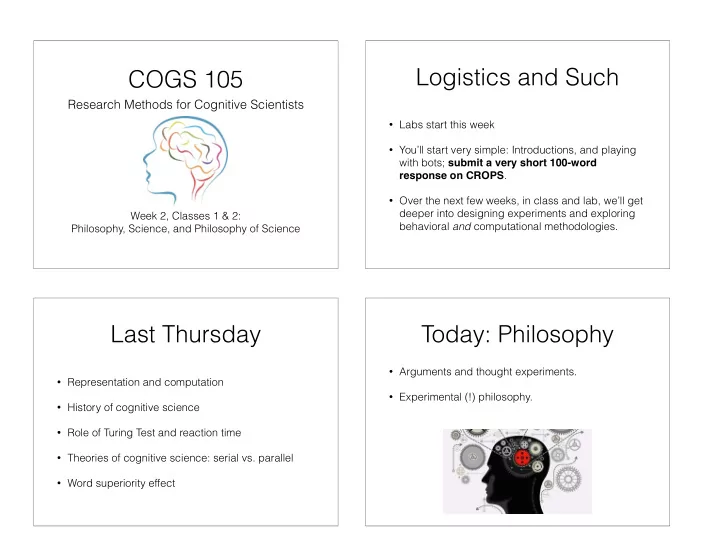
COGS 105

Research Methods for Cognitive Scientists

Week 2, Classes 1 & 2: Philosophy, Science, and Philosophy of Science

Logistics and Such

  • Labs start this week
  • You’ll start very simple: Introductions, and playing

with bots; submit a very short 100-word response on CROPS.

  • Over the next few weeks, in class and lab, we’ll get

deeper into designing experiments and exploring behavioral and computational methodologies.

Last Thursday

  • Representation and computation
  • History of cognitive science
  • Role of Turing Test and reaction time
  • Theories of cognitive science: serial vs. parallel
  • Word superiority effect

Today: Philosophy

  • Arguments and thought experiments.
  • Experimental (!) philosophy.
slide-2
SLIDE 2

Thought Experiment

  • Fancy term, often used in physics:

Gedankenexperiment.

  • Types: Constructive vs. destructive.
  • Constructive: Used positively to argue for or

develop a thesis.

  • Destructive: To show that an idea or person (and

their idea) is really absurd and shouldn’t be invited to the party.

Destructive Types

  • [i] Show a contradiction.
  • [ii] Show a bizarreness (e.g., Jackson’s Mary)
  • [iii] Explore the effect of conceptual distinctions.
  • [iv] Counter thought experiments.

Negative Types

  • [i] Show a contradiction.
  • [ii] Show a bizarreness (e.g., Jackson’s Mary)
  • [iii] Explore the effect of conceptual distinctions.
  • [iv] Counter thought experiments.

Jackson’s Mary

  • Example: Frank Jackson vs. Daniel Dennett
  • Jackson doesn’t like physicalism.
  • Physicalism: The thesis that all mental experience and

activity can be reduced to physical states of the brain.

  • Dennett likes physicalism.
  • Jackson made up a famous story of “Mary the Color

Scientist” to show that physicalism can’t be true of conscious experience. Here’s how it goes…

~1980’s

slide-3
SLIDE 3

Mary the color expert

Mary

  • Mary has a complete description of the

neurophysiology of color

  • She understands the physical properties of the

spectrum

  • She understands from receptors all the way into the

visual system for recognizing colors

  • She is the world’s expert on color perception
slide-4
SLIDE 4

But…

  • She’s raised in a black and white room
  • Does her initial experience of real color

perception add to her understanding of color?

  • Frank Jackson says heck yes, man!
  • So, it cannot simply be reduced to a perfect

understanding of the physical properties of color experience.

Negative Types

  • [i] Show a contradiction.
  • [ii] Show a bizarreness (e.g., Jackson’s Mary)
  • [iii] Explore the effect of conceptual distinctions.
  • [iv] Counter thought experiments.

Negative Types

  • [i] Show a contradiction.
  • [ii] Show a bizarreness (e.g., Jackson’s Mary)
  • [iii] Explore the effect of conceptual distinctions.
  • [iv] Counter thought experiments (Dennett).
slide-5
SLIDE 5

just as i thought!

Counter Thought Experiment

from the readings…

Constructive Types

  • To a certain extent, less common in philosophy of

mind; more common in the natural sciences. However, positive / more constructive thought experiments can help us clear up conceptual confusions or become more convinced of an idea.

Newton’s explanation of orbital gravity.

slide-6
SLIDE 6

Status of Thought Experiments

  • Is a thought experiment just a well-designed

argument? (Norton, discussed in reading)

  • Can a thought experiment actually teach us

something new about the world? (Brown, discussed in reading)

  • Example provided: Galileo’s attack on Aristotle’s

theory of gravity (heavier things fall faster)

Debunking Aristotle ?

Dennett, 2014

Dennett: Thought experiments are “intuition pumps.” “thinly veiled appeals to intuition which fail when carefully analyzed”

“Conscious”

  • “Conscious” has many meanings
  • Wakefulness
  • Coma
  • Sleep
  • Special awareness
  • Conscious of his hair loss
  • Adjective for “on purpose”
  • He consciously insulted my hair loss

Because it has historically been so difficult to study scientifically… the study

  • f consciousness has

been ripe ground for the development of thought experiments.

slide-7
SLIDE 7

Phenomenal consciousness

  • Philosophers use “conscious” and “consciousness” to

refer to a special kind of philosophical and scientific problem

  • The “aboutness” of mental states
  • Look out at a particular tree; you are conscious of that

tree

  • The “feeling” of mental states
  • Pain, love, perception: They all accompany a unique

“sense” of being in these states

Qualia

  • Term used to refer to the states of “feeling” or

“aboutness”

  • We are blessed with the ability to have qualia
  • Here, have a quale…

Usually, visual scenes are 
 rich in the qualia they invoke…

“China Brain”

slide-8
SLIDE 8

“Zombie Experiments”

carneades.org

Old Davidson is dead Davidson’s “zombie”

“Swampman”

From Stanford Encyclopedia of Philosophy

slide-9
SLIDE 9

Experimental Philosophy

  • Philosopher’s are now collecting their own data!
  • The idea: Equip philosophical discussion and

theory with data from the intuitions of everyday people or (in some cases) even philosophers themselves.

  • Among other benefits, it might help notice

problems with assumptions or concepts that we take for granted “in the armchair.”

Burn the armchair! Knobe Effect

  • Joshua Knobe (Yale) adapted a scenario that used

to be used all the time in thought experiments.

  • Except this time: He created experimental

conditions and collected data from people about how they treat the scenario.

The Idea

  • What determines blame, moral responsibility, etc.?
  • Intention?

intend to do bad/good things we bear moral responsibility for that action bad things happen good things happen

slide-10
SLIDE 10

Knobe Effect (scenario)

Yahoo! CEO

Yahoo! CEO Marissa Mayer is brought a proposal for a new algorithm on Yahoo! that can make tons of cash but will result in violation of privacy for all who use Yahoo!

negative scenario

She says “The privacy issue is

  • irrelevant. Go forth and

implement the new algorithm.” Lo and behold privacy is violated, and everyone’s credit cards are stolen for… League of Legends upgrades… Did she cause privacy violation intentionally?

Knobe Effect (scenario)

Yahoo! CEO

Yahoo! CEO Marissa Mayer is brought a proposal for a new algorithm on Yahoo! that can make tons of cash but will result in improvement of privacy for all who use Yahoo!

positive scenario

She says “The privacy issue is

  • irrelevant. Go forth and

implement the new algorithm.” Lo and behold privacy is improved, and everyone’s credit cards are safe from… League of Legends upgrades… Did she cause privacy improvement intentionally?

Here’s how it goes…

‘These data show that the process is actually much more complex,’ argues Knobe. Instead, the moral character of an action’s consequences also seems to influence how non-moral aspects of the action – in this case, whether someone did something intentionally or not – are judged.

Wikipedia

The Idea

  • What determines blame, moral responsibility, etc.?
  • Intention?

intend to do bad/good things we bear moral responsibility for that action bad things happen good things happen

slide-11
SLIDE 11

Next week!

  • Josh Knobe visits the Cognitive Science group from

Yale, giving a talk on experimental philosophy in

  • ur Mind, Technology and Society seminar.
  • Details: cogsci.ucmerced.edu

See you Thursday!