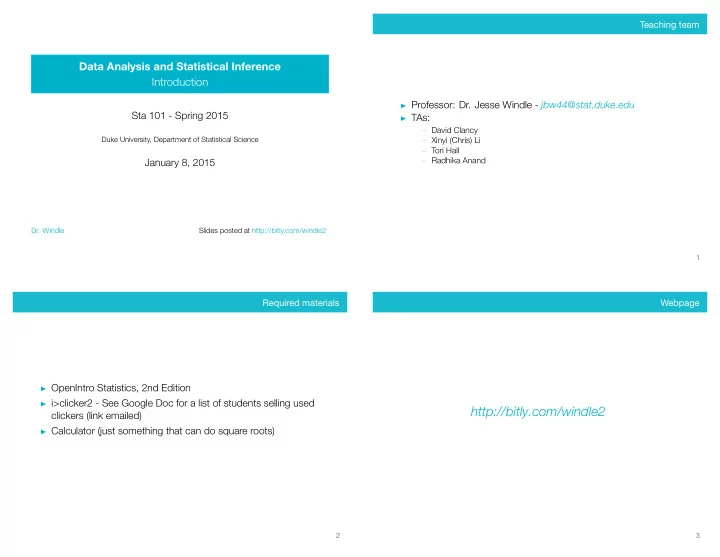
SLIDE 1 Data Analysis and Statistical Inference Introduction
Sta 101 - Spring 2015
Duke University, Department of Statistical Science
January 8, 2015
Slides posted at http://bitly.com/windle2
Teaching team ▶ Professor: Dr. Jesse Windle - jbw44@stat.duke.edu ▶ TAs:
– David Clancy – Xinyi (Chris) Li – Tori Hall – Radhika Anand
1
Required materials ▶ OpenIntro Statistics, 2nd Edition ▶ i>clicker2 - See Google Doc for a list of students selling used
clickers (link emailed)
▶ Calculator (just something that can do square roots)
2
Webpage
http://bitly.com/windle2
3
SLIDE 2 Grading
Component Weight Attendance & participation + peer evaluation 7.5% Problem sets 10% Labs 10% Readiness assessments 10% Performance assessments 2.5% Project 1 5% Project 2 10% Midterm 1 10% Midterm 2 10% Final 25%
▶ The exact ranges for letter grades will be determined after the
final exam.
▶ The more evidence there is that the class has mastered the
material, the more generous the curve will be.
4
Course goals and objectives ▶ Recognize the importance of data collection, identify limitations in data
collection methods, and determine how they affect the scope of inference.
▶ Use statistical software to summarize data numerically and visually, and to
perform data analysis.
▶ Have a conceptual understanding of the unified nature of statistical inference. ▶ Apply estimation and testing methods to analyze single variables or the
relationship between two variables in order to understand natural phenomena and make data-based decisions.
▶ Model numerical response variables using a single or multiple explanatory
variables.
▶ Interpret results correctly, effectively, and in context without relying on
statistical jargon.
▶ Critique data-based claims and evaluate data-based decisions. ▶ Complete two research projects: one that focuses on statistical inference and
- ne that focuses on modeling.
5
Learning units and course outline ▶ Unit 1 - Intro to data: Observational studies and non-causal inference,
principles of experimental design and causal inference, exploratory data analysis, and introduction to simulation-based statistical inference
▶ Unit 2 - Probability & distributions: Basics of probability and chance
processes, Bayesian perspective in statistical inference, the normal and binomial distributions
▶ Unit 3 - Framework for inference: CLT, sampling distributions, and introduction
to theoretical inference – Midterm 1
▶ Unit 4 - Statistical inference for numerical variables ▶ Unit 5 - Statistical inference for categorical variables
– Project 1 & Midterm 2
▶ Unit 6 - Simple linear regression: Bivariate correlation and causality,
introduction to modeling
▶ Unit 7 - Multiple linear regression: More advanced modeling with multiple
predictors – Project 2 & Final
6
Course structure ▶ Set of learning objectives and required and suggested readings,
videos, etc. for each unit
▶ Prior to beginning the unit, watch the videos and/or complete
the readings and familiarize yourselves with the learning
▶ Begin a new unit with a readiness assessment: individual, then
team
▶ Class time: split between lecture, discussion/application, and lab ▶ Complement your learning with problem sets ▶ Wrap up a unit with a performance assessment
7
SLIDE 3 Teams ▶ Highly functional teams of learners based on survey and pre-test ▶ Team members first point of contact ▶ Application exercises, labs, team readiness assessments,
projects
▶ Study together, but anything that is not explicitly a team
assignment must be your own work
▶ Peer evaluations to ensure that all team members contribute to
the success of the group and to address any potential issues early on
– If you feel that there are issues within your team, you are encouraged to discuss it with your team members and to bring it to my or your TA’s attention ASAP (don’t wait till things get worse)
8
Clickers
Objective: Two-way communication and instant feedback
▶ Readiness assessments (graded for accuracy) ▶ Questions throughout lecture (graded for participation)
– to get credit for the day you must respond to at least 75% of the questions – up to three unexcused late arrivals or absences will not affect your clicker grade
▶ Register your clicker
– https://www1.iclicker.com/register-clicker (Student ID = Net ID) – grading starts Thu, Jan 15
9
Attendance & participation
Objective: Make you an active participant and help me pace the class
▶ Attendance and participation during class, as well as your
activity on Piazza make up a non-insignificant portion of your grade in this class
▶ Might sometimes call on you during the class discussion,
however it is your responsibility to be an active participant without being called on
10
Problem sets (PS)
Objective: Help you develop a more in-depth understanding of the material and help you prepare for exams and projects
▶ Questions from the textbook ▶ Show all your work to receive credit ▶ Required format: Use one of the following, no other submission
types will be accepted
– Type your answers in the text box on Sakai and attach any plots/images as separate files, properly named – Attach a PDF (not Word, Google Doc, etc.) of your answers
▶ Welcomed and encouraged to work with others, but turn in your
▶ No make-ups, excused absences (e.g. STINF) do not excuse
homework
▶ Lowest PS score will be dropped
11
SLIDE 4 Labs
Objective: Give you hands on experience with data analysis using statistical software and provide you with tools for the projects
▶ Work in teams: author / discussants ▶ Must be present in lab session to get credit ▶ Lowest lab score will be dropped Activity: Get started with R/RStudio ▶ Go to the course website, http://bitly.com/windle2, click on the RStudio link (top right)
– Make sure you’re on the Duke network, not visitor
▶ Log in using your Net ID and password ▶ In the Console, generate a random number between 1 and 5, and introduce yourself to that many people sitting around you:
sample(1:5, size = 1)
12
Readiness assessments (RA)
Objective: Encourage you to watch the videos and/or complete the reading assignment and review the learning objectives prior to coming to class as well as evaluate your conceptual understanding
▶ 10 multiple choice questions, at the beginning of a unit ▶ Conceptual questions addressing the learning objectives of the
new unit, assessing familiarity and reasoning, not mastery
▶ Take the individual RA using clickers, then re-take in teams ▶ Individual RA score 3/4 of grade, team RA score 1/4 & your input
during the team portion will factor into your participation grade
▶ Lowest RA score will be dropped
13
Performance assessments (PA)
Objective: Evaluate your mastery of the material by the end of a unit and give you instant feedback on your performance.
▶ 10 multiple choice questions, at the end of a unit ▶ Taken individually on Sakai ▶ Lowest PA score will be dropped
14
Projects
Objective: Give you independent applied research experience using real data and statistical methods
▶ Project 1: For a parameter of interest to you, you will describe
the relevant data, compute a confidence interval and conduct a hypothesis test, and summarize your findings in a written, fully reproducible, data analysis report
▶ Project 2: Use all (relevant) techniques learned in this class to
analyze a dataset provided by me, and share your results in a poster session
▶ Must complete both projects and score at least 30% of the
points on each project in order to pass this class
15
SLIDE 5 Exams
Midterm 1 Thu, Feb 19 Midterm 2 Thu, Mar 26 Final Mon, Apr 27 (9-Noon)
▶ Exam dates cannot be changed, no make-up exams will be
given
▶ If you cannot take the exams on these dates you should drop
this class
▶ Calculator + cheat sheet allowed
16
Email & Piazza ▶ I will regularly send announcements by email, so make sure to
check your email daily
▶ Any non-personal questions related to the material covered in
class, problem sets, labs, projects, etc. should be posted on Piazza forum
▶ Before posting a new question please make sure to check if
your question has already been answered, and answer others’ questions
▶ Use informative titles for your posts ▶ It is more efficient to answer most statistical questions “in
person” so make use of OH
17
Office Hours ▶ Prof. Windle: Tue, Thu 3:00pm-4:30pm ▶ TAs: TBD
18
Students with disabilities
Students with disabilities who believe they may need accommodations in this class are encouraged to contact the Student Disability Access Office at (919) 668-1267 as soon as possible to better ensure that such accommodations can be made
http://www.access.duke.edu/students/requesting/index.php
19
SLIDE 6
Late work policy ▶ Late work policy for problem sets and labs reports:
– next day: lose 30% of points (within 24 hours of due date) – later than next day: lose all points
▶ Late work policy for projects: 20% off for each day late
20
Regrade policy
Regrade requests must be made within 3 days of when the assignment is returned, and must be submitted to me in writing
▶ These will be honored if points were tallied incorrectly, or if you
feel your answer is correct but it was marked wrong
▶ No regrade will be made to alter the number of points deducted
for a mistake
▶ There will be no grade changes after the final exam
21
Make up policy ▶ No make-up for attendance, individual and team readiness
assessments, labs, problem sets, projects, or exams
▶ If the midterm exam must be missed due to a documented
medical excuse, absence must be officially excused in advance, in which case the missing exam score will be imputed using the final exam score
▶ The final exam must be taken at the stated time ▶ You must take the final exam and turn in the projects in order to
pass this course
22
Other policies ▶ Clickers may not be shared, and the clicker registered to a
person may only be used by that person, failure to abide by this will result in a 0 clicker grade for everyone involved
▶ Use of disallowed materials (textbook, class notes, web
references, any form of communication with classmates or other persons, etc.) during exams will not be tolerated
23
SLIDE 7 Academic Dishonesty
Any form of academic dishonesty will result in an immediate 0 on the given assignment and will be reported to the Office of Student
- Conduct. Additional penalties may also be assessed if deemed
- appropriate. If you have any questions about whether something is
- r is not allowed, ask me beforehand.
Some examples:
▶ Use of disallowed materials (including any form of
communication with classmates or accessing the web) during exams and readiness assessments
▶ Plagiarism of any kind ▶ Use of outside answer keys or solution manuals for the
homework
24
Tips for success ▶ Complete the reading before a new unit begins, and then review again after
the unit is over.
▶ Be an active participant during lectures and labs. ▶ Ask questions - during class or office hours, or by email. Ask me, your TAs,
and your classmates.
▶ Do the problem sets - start early and make sure you attempt and understand
all questions.
▶ Start your projects early and and allow adequate time to complete them. ▶ Give yourself plenty of time time to prepare a good cheat sheet for exams.
This requires going through the material and taking the time to review the concepts that you’re not comfortable with.
▶ Do not procrastinate - don’t let a unit go by with unanswered questions as it
will just make the following unit’s material even more difficult to follow.
25
To do ▶ Download or purchase the textbook ▶ Obtain and register your clicker
– https://www1.iclicker.com/register-clicker (Student ID = Net ID)
▶ Complete the following by Friday, Jan 9, 11:59pm
– Pretest (Due Sunday at 11:59pm) – Getting to know you survey – Performance assessment 0 (on course policies etc., not graded, for practice with the quiz module on Sakai)
▶ Read the syllabus and let me know if you have any questions ▶ Watch/Read/Review the resources for Unit 1
26
Baby names in the US ▶ Each year the Social Security Administration collects and
releases data on the how many babies are given a certain name
▶ They released these data for years 1880 onwards for each
gender
▶ For privacy reasons they restrict the list of names to those with
at least 5 occurrences
27
SLIDE 8 Top 10 baby names for 2013
http://www.ssa.gov/oact/babynames
28
Name voyager
http://www.babynamewizard.com/voyager
29
Names and ages
http://fivethirtyeight.com/features/how-to-tell-someones-age-when-all-you-know-is-her-name
30 31
SLIDE 9
▶ If I didn’t know anything about you, I would guess that... ▶ Men of maturity. ▶ I don’t know you that well so that is probably up for debate.
32 33 34
Clicker question
Do you geotag your posts on social networking sites, like Facebook, Twitter, Instagram, etc.? (a) yes (b) no
35
SLIDE 10 Maps based on clicker tags
tourists local both
http://aaronstraupcope.com
36
Why study statistics?
37
Why study statistics?
http://thisisstatistics.org
38
Activity: Class survey ▶ One of your first tasks in this class is to help design a survey.
This survey will be completed anonymously. It will (ideally) have information on variables you are interested in. When writing your question consider whether you would feel comfortable answering it on an anonymous survey.
▶ Work with 3-4 classmates to come up with a survey question,
and add it to Google Doc linked below. Make sure that the wording of the question is clear, and (if categorical) the answer choices make sense. http://bit.ly/sta101sp15_ClassSurvey
▶ Before adding a question check to make sure that it hasn’t
already been added. If your question is already there, but you can suggest a clearer / better wording, add it as “alternative wording” underneath the original question.
39