International Low Carbon Society Research Network: LCS-RNet R h N - - PDF document

international low carbon society research network lcs
SMART_READER_LITE
LIVE PREVIEW

International Low Carbon Society Research Network: LCS-RNet R h N - - PDF document

International Low Carbon Society Research Network: LCS-RNet R h N t k LCS RN t Researchers community dedicating to scientific policy making process towards Low Carbon World Shuzo Nishioka & Kyoko Miwa Secretary General of LCS-RNet


slide-1
SLIDE 1

International Low Carbon Society R h N t k LCS RN t Research Network: LCS-RNet

Researchers community dedicating to scientific policy making process towards Low Carbon World

Shuzo Nishioka & Kyoko Miwa

Secretary General of LCS-RNet Secretary General of LCS-RNet Institute for Global Environmental Strategies (IGES)

UNFCCC AWG34, 7 June 2011, Bonn

Antonio NAVVARA Stefan LECHTENBÖHMER Jim SKEA David MCLAUGHLIN Mikiko KAINUMA P.R. Shukla

CMCC NRTEE

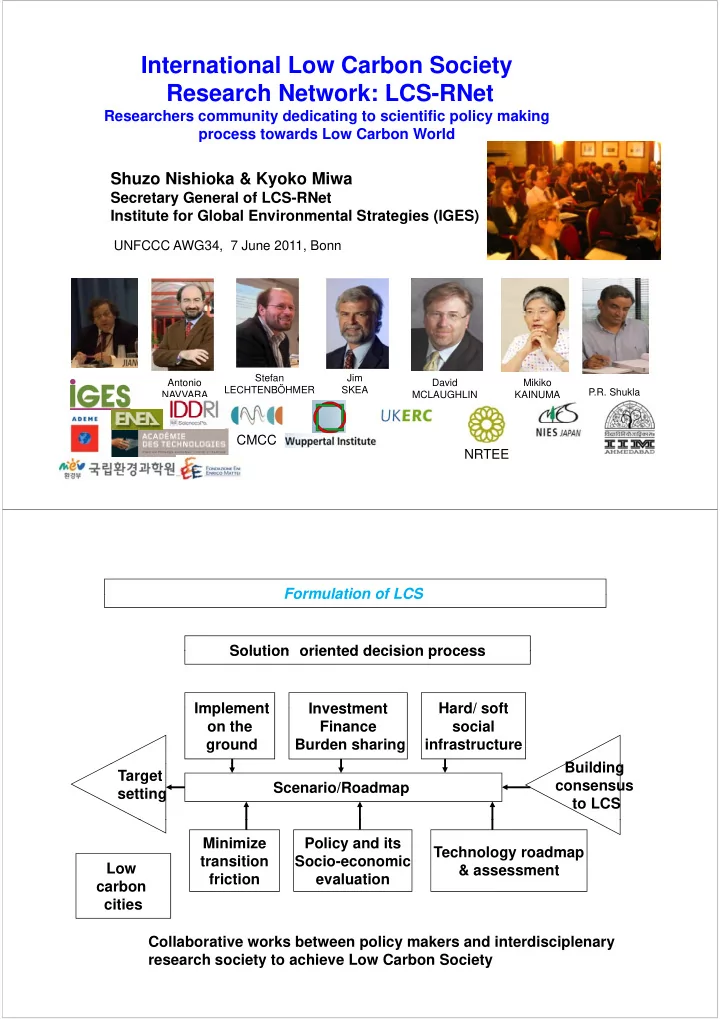
Formulation of LCS Solution oriented decision process Formulation of LCS Hard/ soft Implement Investment Solution oriented decision process Hard/ soft social infrastructure Implement

  • n the

ground Investment Finance Burden sharing B ildi Target setting Scenario/Roadmap Building consensus to LCS Minimize transition f i ti Technology roadmap & assessment Policy and its Socio-economic l ti Low friction evaluation carbon cities Collaborative works between policy makers and interdisciplenary research society to achieve Low Carbon Society

slide-2
SLIDE 2

LCS‐RNet(International Research Network for Low Carbon Societies)

  • Supported its foundation by G8 Environment Ministers Meeting

Supported its foundation by G8 Environment Ministers Meeting.

  • Research network to foster researches to realize low‐carbon societies.
  • 7 countries and 15 major research institutes (currently)

Ministry of Ecology, Energy, Sustainable Development d l

Input to Policy (G8/G20 UNFCCC IPCC)

Sustainable Development and the Sea Federal Environment Agency

CIRED ADEME IDDRI

Wuppertal Institute for Climate, En ironment and Energ

Department of Energy and Climate Change

Ministry of Environment & Forests

Academy of Technologies

France

Environment and Energy

Germany

UK Energy Research Centre

UK

Indian Institute of Management, Ahmedabad, etc.

India

LCS‐RNet

Co‐chairs+Secretariat 【IGES】

ENEA FEEM CMCC

Italy

National Institute for Environmental Studies

Japan

National Institute of Environmental Research

Korea

Ministry for the Environment, Land and Sea

Ministry of Environment

Ministry of the Environment

Japan

G20 G8

LCS LCS‐RNet RNet

l

|FY2008 |FY2009 |FY2010 現在 |FY2011 |FY2012 |FY2013

At present

Reacting to the paradigm‐shift from G8 to G20

G8EMM

France

(April)

G8

Huntsville

(25‐26 June)

G8EMM

Siracusa

(22‐24 April)

G8EMM

Kobe

(24‐26 May)

COP15

5 year plan 5 year plan

COP16

Intergovernmental Panel

  • n Climate Change

G20 G20 5

(7‐19 Dec)

1st in Bologna Foundation

1.

  • 1. Management

Management

  • f the Network
  • f the Network

2nd in Berlin 3rd in France

(29 Nov‐10 Dec)

  • n Climate Change

Annual Meeting

International Research Network for Low Carbon Societies

1st in Bologna

(12‐13 October)

‐ Synthesis Report

Journal Special Issue

2.

  • 2. Scientific Policy

Scientific Policy Recommendations Recommendations 2nd in Berlin

(20‐21 September)

‐ Synthesis Report ‐ Country Report ‐ Berlin Memorandum

3rd in France

(March?)

Special Issue

Development of LCS researches and finding, analyzing and

Fostering LCS researches to

and finding, analyzing and proposing important policy relevant issues

3.

  • 3. Development of

Development of LCS Researches LCS Researches

Contribution to LCS

researches to achieve LCS on time

Indonesia Yokohama Thailand Workshop,

4.

  • 4. Capacity Building

Capacity Building

  • f Developing
  • f Developing

Own research

  • Sus. consumption

Contribution to LCS strategies of government Competitive LCS policy and expansion to developing countries

Activity of Secretariat

Green growth

National policy

Indonesia

(16‐17 February 2010)

Yokohama

(15 March 2010)

Thailand

(November 2011)

India

policy dialogue

p g p g Countries Countries

5.

  • 5. Public Relations

Public Relations

Internship

Indonesia Thailand

Newsletter Database

p g

International Research Network for Low Carbon Societies

・・・

Webpage
slide-3
SLIDE 3

Activities and Publications

Stakeholder Dialogue:

Overcoming Barriers to Low‐ Carbon Societies

15 March 2010 Expert Meeting

Stakeholder Dialogue

  • n Low Carbon

15 March 2010 Yokohama, Japan

Societies

26‐27 June 2009 Hayama, Japan

1st Annual Meeting b

Annual Report:

Low Carbon Society Research

March 2010

12‐13 October 2009 Bologna, Italy

Series of policy-research dialogue workshops on Asian

Policy Dialogue:

Sustainable and Low‐Carbon Development in Indonesia and Asia

2nd Annual Meeting

  • Sept. 2010, Berlin, Germany

dialogue workshops on Asian Low Carbon Development Indonesia

16‐17 February 2010 Bogor, Indonesia 3rd Annual Meeting

  • Oct. 2011, Paris, France

Thailand, Cambodia, Vietnam, Malaysia

Major findings from Berlin Meeting ‐1

  • 1. Using the significant progress that has been made in

LCS research and policy design it is time to craft LCS research and policy design, it is time to craft measures for implementation.

  • 2. All stakeholders need to be made aware that short-term

costs are countered by longer-term benefits

  • 3. Inter-linkages among society’s components must be

understood in the effort to devise feasible and effective understood in the effort to devise feasible and effective policy

  • 4. Technologies and R&D alone cannot attain LCS
  • 5. Modeling implications and limitations must be correctly

understood

slide-4
SLIDE 4

Major findings from Berlin Meeting ‐2

  • 6. Multi-level governance in a multi-level world is necessary

for promoting LCS

  • 7. International cooperation is central to the LCS transition
  • 8. Mobilising private sector investment in a desirable

direction is a key to achieving LCS direction is a key to achieving LCS 9 Civil society participation is crucial to mobilizing

  • 9. Civil society participation is crucial to mobilizing

acceptance for LCS actions

  • 10. ‘Science in transition’ can forge inter-linkages among

issues, and more importantly, can be an agent of change

Cooperation with developing countries is key

  • As significant worldwide reduction is essential

Estimated future global CO2

25 25 CO2 emissions (carbon conversion 1 billion tons)

the U.S. Others

As significant worldwide reduction is essential

emissions

15 20 15 20

22.1% 31.8%

2004 global 10 15 開発途上国 10 15

Developing countries 18.1% 4 3%

global CO2 emissions 7.2 billion t-C

(26.5 billion t-CO2)

5 先進国 5

12.8% 6.0% 4.8% 4.3% China Japan I ndia

Developed countries

* 2050 50% reduction target

Sources: Kainuma et al., 2002:

20002010202020302040205020602070208020902100 20002010202020302040205020602070208020902100 year

EU 15 countries Russia Japan

Made by the Ministry of the Environment, Japan based on

p Kyoto Protocol framework for period subsequent to first commitment period (2013

  • nwards)

Climate Policy Assessment, Springer, p.64. y y , p Energy & Economics Statistics in Japan (2007 version)

・ An effective framework capable of promoting maximum efforts to reduce emissions by An effective framework capable of promoting maximum efforts to reduce emissions by non non-

  • signatory U.S. and exempt developing major emitter nations such as India and

signatory U.S. and exempt developing major emitter nations such as India and China is needed China is needed.

slide-5
SLIDE 5

Developed

Asian LCS scenario studies

capita Developed Countries Energy‐Intensive Lock‐ins in d l i ns per c developing countries mission With Significant Damage to d Developing GHG e Low Carbon Economic and Natural Systems p g Countries Leapfrog‐ Time World Leapfrog‐ development

D l t f A i LCS S i Development of Asia LCS Scenarios (1) Developing narratives for LCS scenarios (2) Quantifying future LCS visions (3) Developing robust roadmaps

  • Encouraging the framing of LC policy in

each Asian country

  • Assistance for international

(3) Developing robust roadmaps

Policy Packages for Asia LCS negotiations scientific basis

  • Networking among LCS research in

Asia

South Korea China India Indonesia Thailand Vietnam Cambodia Appendix I & II of CA and NAMA 30 % GHG reduction by 2020 (from BAU Voluntary lower CO2 emissions per unit of GDP Reduce the emissions intensity of its Voluntary reduce emissions by

  • and NAMA 2020 (from BAU

scenario) per unit of GDP by 40‐45% by 2020 (2005 level) intensity of its GDP by 20‐25% by 2020 (2005 level) emissions by 26% in 2020 (from BAU) or 41% if international international fund available NAMA Positive Positive, No international MRV Positive, MRV with the external fund Positive Positive Positive Positive MRV external fund Legislation Framework Act

  • n Low Carbon,

Green Growth (2009) 12th Five Year Plan National Action Plan for Climate Change (2008) National Action Plan Regional AP 11th National Development Plan National Strategic Developme nt Plan (2009) nt Plan Institution al support particularl y for LCS ◎ Led by the Presidential Committee on ○ × × × × × y for LCS Committee on Green Growth Policy/focu sed areas Cap‐and‐trade with targets Domestic Emission Trading for Energy and Carbon tax,, EE, transportation Star system for Sustainable peatland and land use Crown Standard for EE for cities Decentralisa tion and deconcentra for Energy and Environment non‐fossil fuels, forest coverage and stock Star system for EE PAT(Performanc e Achievement and Trade ) land use management EE, renewable, transportation EE for cities, deconcentra tion strategy and stock and Trade )

Coordination with other policies

○Combined foreign policy and resource security ○ ○ ○ ○

slide-6
SLIDE 6

Korea, Republic of China India Indonesia Thailand Vietnam Cambodia p Socio‐ economic consideratio n ○ Gradually yea ○Low Carbon Strategy for Inclusive Growth as ○ ○ ○ ○ Indian version

  • f green growth

Local level initiative Pilot City Programme Pilot City Programme Gaps amongst provinces Bankgok city g Gaps amongst provinces g p y programme Private sector ○ ○ ○ involvement Technology focus and consideratio Clean coal technology, nuclear, solar EE and solar, building Off‐grid energy self‐ sufficient Nuclear Off grid, decentraliz ed supply Decentrali zed supply system ns and solar heater, other renewables Potential of nuclear may be not so high system in rural area, forest fire pp y system y Approach Top‐down with Top‐down or Top‐down or Decentralized Top‐down or Top‐down Top‐down participatory approach combination combination NGOs play important roles administration system combination、 Sufficiency economy Traditional p p for Bottom‐up resource managemen t

Key Findings ‐ 1 ‐

Inventories can provide a strong basis for a scientific approach

  • Countries that develop reliable inventories could be in a good position for CDM.
  • As a next step, cooperation between researchers and policy makers is urgently

Inventories can provide a strong basis for a scientific approach

p, p p y g y required for research agenda setting.

  • Lack of reliable activity data is a barrier for developing LCS scenarios.
  • Major emission sources/target areas are;

Low carbon is not just about energy

  • Energy
  • Agriculture and Forestry

T t ti

  • Transportation

Both adaptation and mitigation are important

  • Adaptation is still given a priority in most countries
  • For the effective use of limited resources, coordination of adaptation and

mitigation policies is necessary. mitigation policies is necessary.

  • In urban areas, co-control of air pollution and GHGs is called for. Pollution control

measures can be a good entry point to mitigate GHGs.

slide-7
SLIDE 7

Key Findings ‐ 2 ‐

Localization of transferred technology is necessary

  • Technical know-how to support the localization of such technologies, as

well as infrastructure changes for LCS, are important.

Localization of transferred technology is necessary

  • Tradition of its political system (e g Indonesia)

Decentralization is a key for various reasons

  • Tradition of its political system (e.g. Indonesia)
  • For energy supply – it is a way to improve the access to electricity

promoting off-grid system using biofuels.

  • For strategic national development plan
  • Sound agriculture community is important for the national development

plan to become a food commodity supplier to neighboring countries (India, p y pp g g ( , Cambodia), as well as to avoid problems of urbanization in big cities by keeping people in the agriculture communities for some countries

  • Coordination of land use and energy policies and supporting institutional

Innovative governance is called for

arrangement is needed.

  • Inter-ministerial coordination is needed.

Key Findings ‐ 3 ‐

  • Sufficiency economy (Thailand) and “Mottainai” (Japan) as examples of

Traditional values to promote LCS

traditional wisdom for the sustainable utilization of natural resource

  • Mitigation in forestry sector: depend on the social system and local voluntary

actions.

Coordination is a key in many ways

  • Inter-ministerial coordination of LCS policy is necessary (i.e. land-use policies)
  • Cooperation between policy and research communities
  • Sub‐national level initiatives are important
  • Since agriculture, forests and natural resources are target areas for mitigation,

knowledge of local people for adaptation and natural resource management are important in designing mitigation.

p

z1

slide-8
SLIDE 8

スライド 14 z1 See previous comment on agriculture

zusman, 24/05/2011

Thank you for your attention!