LCS 11: Cognitive Science 1. Leader discusses response to group 2. - - PowerPoint PPT Presentation

lcs 11 cognitive science
SMART_READER_LITE
LIVE PREVIEW

LCS 11: Cognitive Science 1. Leader discusses response to group 2. - - PowerPoint PPT Presentation

Agenda Pomona College Group question 1.2 LCS 11: Cognitive Science 1. Leader discusses response to group 2. Group discussion with summary of points The mind 3. Class discussion Illusions Jesse A. Harris Preview for Eagleman 2011:


slide-1
SLIDE 1

Pomona College

LCS 11: Cognitive Science

The mind

Jesse A. Harris January 30, 2013

Jesse A. Harris: LCS 11: Cognitive Science, The mind 1

Agenda

֠ Group question 1.2

  • 1. Leader discusses response to group
  • 2. Group discussion with summary of points
  • 3. Class discussion

֠ Illusions ֠ Preview for Eagleman 2011: ch.5 and Fodor 1985. ֠ GQ 1.3

Jesse A. Harris: LCS 11: Cognitive Science, The mind 2

GQ 1.2

GQ 1.2

What do you think the difference is between a (i) reflex, (ii) bias, and (iii) strategy? Give concrete examples of each. How might each of these concepts be related to the concept of "Umwelt" (Eagleman, 2011, p.77) and to "instinct blindness" (Eagleman, 2011, p.88)?

Group leaders

Cole, Hana, Stephen, Juliana, Alex, Adele, Tatiana, Natasha, Thomas

Jesse A. Harris: LCS 11: Cognitive Science, The mind 3

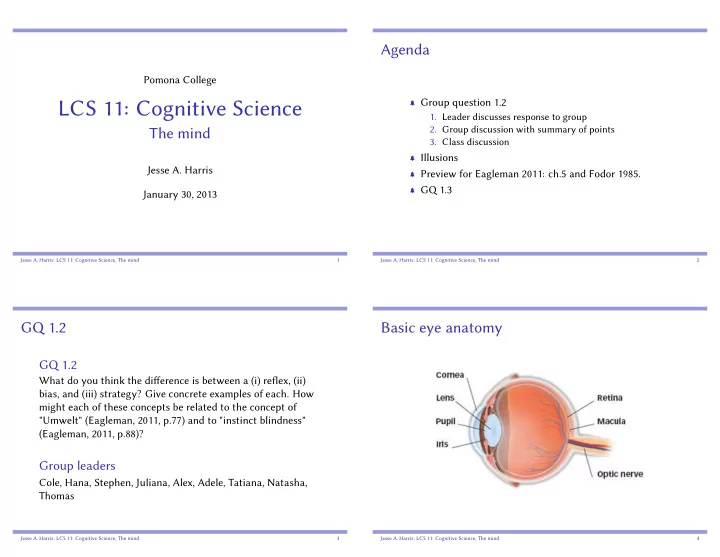
Basic eye anatomy

Jesse A. Harris: LCS 11: Cognitive Science, The mind 4

slide-2
SLIDE 2

The eye and the blindspot

Jesse A. Harris: LCS 11: Cognitive Science, The mind 5

Illusions

Types of illusion

Illusions can affect any one of our sensory modalities:

  • 1. Visual
  • 2. Auditory
  • 3. Taste
  • 4. Touch

Truth in illusion

What do systematic misinterpretations reveal about the cognitive system?

Jesse A. Harris: LCS 11: Cognitive Science, The mind 6

Perceptual illusions

◮ Observed by the Greeks (of course) ◮ Scientific study of illusions began with L. A. Necker (1832) ◮ Occur when brain attempts to interpret a 2 dimensional

representation in 3 dimensions and is misled by the visual input. We might define illusions as deviations from kitchen physics ...For both science and perception phenomena cannot speak for themselves. Phenomena have to be interpreted to have significance. Inferences are not directly from phenomena or data, but from interpretation. Richard Gregory (2009). Seeing through illusions

Jesse A. Harris: LCS 11: Cognitive Science, The mind 7

Müller Lyer illusion

Jesse A. Harris: LCS 11: Cognitive Science, The mind 8

slide-3
SLIDE 3

Müller Lyer illusion

Jesse A. Harris: LCS 11: Cognitive Science, The mind 9

Ebbinghaus circles

Jesse A. Harris: LCS 11: Cognitive Science, The mind 10

Kanizsa triangle

Jesse A. Harris: LCS 11: Cognitive Science, The mind 11

Necker cube

Jesse A. Harris: LCS 11: Cognitive Science, The mind 12

slide-4
SLIDE 4

Rubin vase

Jesse A. Harris: LCS 11: Cognitive Science, The mind 13

Blivet illusion

Jesse A. Harris: LCS 11: Cognitive Science, The mind 14

Penrose triangle

http://www.youtube.com/watch?v=Ffy1uDiu764 Jesse A. Harris: LCS 11: Cognitive Science, The mind 15

Is consciousness required?

Open question

What is the role of consciousness in perceptual illusions? What does the existence – and power – of illusions indicate about the relationship between consciousness and perception?

Jesse A. Harris: LCS 11: Cognitive Science, The mind 16

slide-5
SLIDE 5

Visual cues

◮ Not just a single representation ◮ Multiple representations depicting aspects of an image ◮ Early visual processing organized into various types of

cues, with multiple sources of information

  • 1. Color
  • 2. Luminance
  • 3. Texture
  • 4. Relative size
  • 5. Cues from motion
  • 6. Depth

Jesse A. Harris: LCS 11: Cognitive Science, The mind 17

Visual cues

◮ In some sense, all “pictures depicting depth are

paradoxical, for we see them as flat (which they really are) and in a kind of suggested depth which is not quite right” (Gregory 1968)

◮ Brain uses a host of visual cues to give pictures depth and

texture

◮ Conflicting cues can give rise to conflicting inferences,

resulting in an illusion.

Jesse A. Harris: LCS 11: Cognitive Science, The mind 18

Visual cues

http://www.youtube.com/watch?v=hCV2Ba5wrcs

Jesse A. Harris: LCS 11: Cognitive Science, The mind 19

Motion perception

◮ Brain evolved to see motion ◮ One defense against good camouflage ◮ Employs heuristics: brain favors a perception of the world

that is continuous

◮ Good evidence that neural pathway for detecting motion

is distinct from other visual pathways (more on that next time)

Jesse A. Harris: LCS 11: Cognitive Science, The mind 20

slide-6
SLIDE 6

Apparent motion

Jesse A. Harris: LCS 11: Cognitive Science, The mind 21

Gregory’s look-up model

“Perception seems, then, to be a matter of ‘looking-up’ stored information of objects, and how they behave in various

  • situations. Such systems have great advantages.” Gregory

1968, page 6

  • 1. Enhance speed of recognition
  • 2. Predictive
  • 3. Continue to function even without input
  • 4. Redundancy to cut down on signal-noise ratio

◮ Create and store partial models of the world ◮ Information is accessed when assessing new input ◮ Past experience guides present perception

Jesse A. Harris: LCS 11: Cognitive Science, The mind 22

Auditory visual illusions

McGurk effect

Perceptual blending of sounds due to competing information across auditory and visual modalities. McGurk Effect in action: http://www.youtube.com/watch?v=G-lN8vWm3m0 Bill, bill, bill, ... http://www.youtube.com/watch?v=KiuO_Z2_AD4

Jesse A. Harris: LCS 11: Cognitive Science, The mind 23

GQ 1.3 due Sunday, Feb 3, by 9PM

GQ 1.3

Take a simple action or mental process of your choosing and identify at least three distinct subprocesses that might be involved in performing that action or process. Which, if any, of those subprocesses might be called modular in Fodor’s (1985) sense, and why?

Group leaders

Sam, Audrey, Lea Lynn, Daniel, Joel, Noah, Jun, Sarah, Paul

Jesse A. Harris: LCS 11: Cognitive Science, The mind 24