Growth and Cell Reproduction The copier reproduces the pages, - - PDF document

growth and cell reproduction
SMART_READER_LITE
LIVE PREVIEW

Growth and Cell Reproduction The copier reproduces the pages, - - PDF document

7/22/2009 Growth is a characteristic of all living things. Your cells are like a photocopier: Growth and Cell Reproduction The copier reproduces the pages, making p g , g exact copies; and your Cells divide to increase their


slide-1
SLIDE 1

7/22/2009 1

Growth and Cell Reproduction

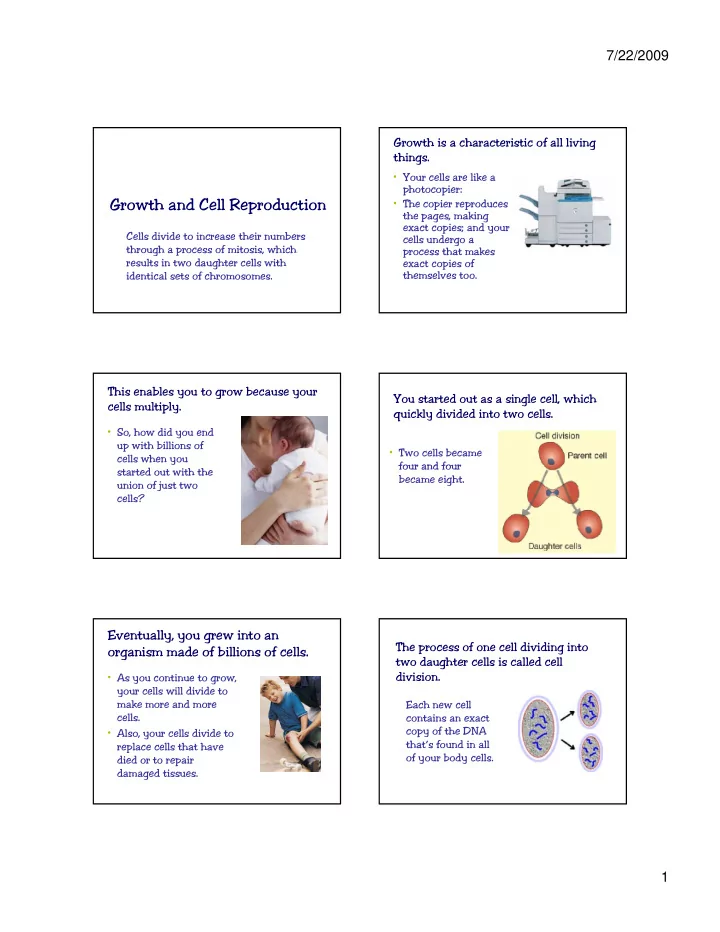
Cells divide to increase their numbers through a process of mitosis, which results in two daughter cells with identical sets of chromosomes.

Growth is a characteristic of all living things.

  • Your cells are like a

photocopier:

  • The copier reproduces

the pages, making p g , g exact copies; and your cells undergo a process that makes exact copies of themselves too.

This enables you to grow because your cells multiply.

  • So, how did you end

up with billions of cells when you started out with the union of just two cells?

You started out as a single cell, which quickly divided into two cells.

  • Two cells became

four and four four and four became eight.

Eventually, you grew into an

  • rganism made of billions of cells.
  • As you continue to grow,

your cells will divide to make more and more cells.

  • Also, your cells divide to

replace cells that have died or to repair damaged tissues.

The process of one cell dividing into two daughter cells is called cell division.

Each new cell contains an exact copy of the DNA that’s found in all

  • f your body cells.
slide-2
SLIDE 2

7/22/2009 2 So how do cells divide to make exact copies of themselves?

Well, there are two types of cells: prokaryotic and eukaryotic, and each of these types of cells has a unique way of dividing.

As you learned earlier, prokaryotic cells, like bacteria, do not have a nucleus.

  • Their DNA is found bunched up in the

cytoplasm.

  • Because of this, their cell division is simpler

Because of this, their cell division is simpler than the division of eukaryotic cells.

  • First the chromosomes are duplicated.

Then, the bacteria reproduce by merely splitting in two.

  • This process is

called binary fission. fission.

  • Each daughter

cell contains one copy of the DNA from the original cell.

Binary Fission Video Clip Eukaryotic cells are usually larger and more complex than prokaryotic cells, so their cell division is also more complex.

  • The DNA of a

eukaryotic cell is f d i h l found in the nucleus, which is organized into structures called chromosomes.

Chromosomes are made from protein and DNA in cells with a nucleus.

  • The proteins in a

chromosome help support its structure d f cti d the and function, and the genetic information of the cell is stored in the DNA.

  • Chromosomes organize

DNA into distinct units.

slide-3
SLIDE 3

7/22/2009 3

Cell Division Video Clip

Different organisms have different numbers of chromosomes.

  • Humans, for example, have 46

chromosomes, but chickens have 78.

A house fly has 12 chromosomes and a tomato plant has 24.

Do more chromosomes mean the organism is more complex?

However, you need to wait until just before the cell divides to see these individual chromosomes under a microscope.

visible