
SLIDE 1
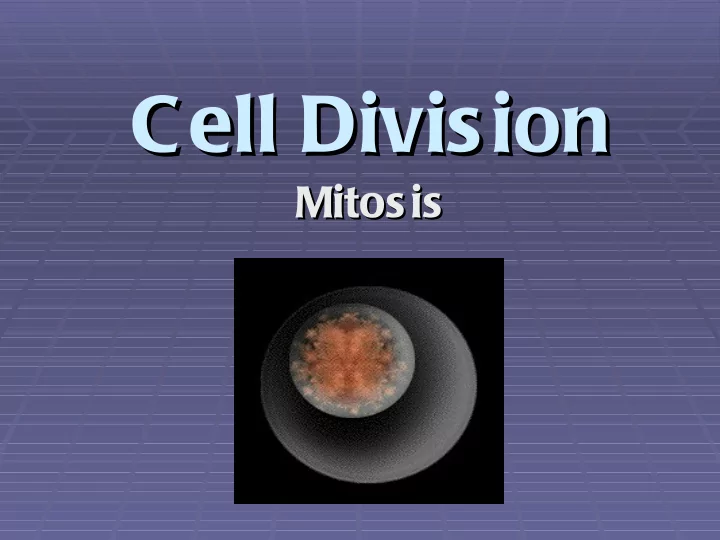
Cell Division Cell Division Mitosis Mitosis Reasons for Mitosis - - PowerPoint PPT Presentation
Cell Division Cell Division Mitosis Mitosis Reasons for Mitosis Reasons for Mitosis There are three main reasons There are three main reasons A. growth growth A. B. repair/healing repair/healing B. C. asexual reproduction asexual
There are three main reasons There are three main reasons
A.
growth B.
repair/healing C.
asexual reproduction
Some cells divide constantly: cells in the constantly: cells in the embryo, skin cells, gut embryo, skin cells, gut lining cells, etc. lining cells, etc.
Epithelial Cell Intestinal Cell 7 week old embryo
Other cells divide rarely or never. never.
Brain Cell – Nerve cell Spinal Cord Cell- Nerve cell Cardiac Cell (Heart Muscle)
2 kinds of cell division:
Sperm cells Human egg cell Pancreatic cells
Somatic cell – a body cell; a cell whose – a body cell; a cell whose genes will not be passed on to future genes will not be passed on to future generations. generations.
Germ cell - a cell that is destined to
become a gamete (egg or sperm); a cell become a gamete (egg or sperm); a cell whose genes can be passed on to whose genes can be passed on to future generations future generations
diploid (2N) – a cell with 2 chromosome – a cell with 2 chromosome sets in each of its cells; all body sets in each of its cells; all body (somatic) cells (somatic) cells
haploid (N) – a cell with 1 chromosome – a cell with 1 chromosome set in each of its cells; all gametes set in each of its cells; all gametes (sperm, eggs) (sperm, eggs)
dipl
l w il l g iv e r ise t
dipl
l A dipl
l w il l g iv e r ise t
dipl
l
hr
r ema ins t he sa me C hr
r ema ins t he sa me
he DN A r ema ins ident ica l l y t he sa me T he DN A r ema ins ident ica l l y t he sa me
ne cel l ( 2N ) g iv es r ise t
w
l s ( 2N ) O ne cel l ( 2N ) g iv es r ise t
w
l s ( 2N )
A typical cell goes through a process through a process
development, and development, and reproduction called reproduction called the cell cycle. the cell cycle.
Most of the cycle is called interphase. called interphase.
INTERPHASE
The longest phase in the phase in the cell cycle is cell cycle is interphase. interphase.
The 3 stages of interphase are interphase are called G called G 1
1, S,
, S, and G and G 2
2.
.
All living cells come from other living cells. cells.
During mitosis, the nucleus of the cell divides, forming two nuclei with divides, forming two nuclei with identical genetic information. identical genetic information.
Mitosis produces two genetically two genetically identical cells. identical cells.
Mitosis is referred to in the following to in the following stages: prophase, stages: prophase, metaphase, metaphase, anaphase, and anaphase, and telophase. telophase.
In prophase, the cell begins the process of division. division.
The chromosomes condense.
chromatin duplicated chromosom e
Nuclear envelope disappears.
Centrioles migrate to migrate to
the cell. the cell.
Asters and spindle fibers spindle fibers form. form.
Aster and the mitotic apparatus in an animal cell
Aster Sister chromatids Centromere Centriole Spindle fibers
The chromosomes chromosomes line up at the line up at the equator of the cell equator of the cell (metaphase plate), (metaphase plate), with the centrioles with the centrioles at opposite ends at opposite ends and the spindle and the spindle fibers attached to fibers attached to the centromeres. the centromeres.
Centriole Centriole Spindle fibers Metaphase plate
In anaphase, the centromeres divide. centromeres divide.
At this point, each chromosome goes chromosome goes from having 2 sister from having 2 sister chromatids to being chromatids to being 2 separate 2 separate chromosomes chromosomes
The spindle fibers contract and the contract and the chromosomes are chromosomes are pulled to opposite pulled to opposite poles. poles.
In telophase the nucleus actually nucleus actually divides. divides.
The chromosomes are at the poles of the cell. at the poles of the cell.
The nuclear envelope re-forms around the re-forms around the two sets of two sets of chromosomes. chromosomes.
The division of the cytoplasm. cytoplasm.
In animal cells, a Cleavage Furrow Cleavage Furrow forms and forms and separates Daughter separates Daughter Cells Cells
Cleavage furrow in a dividing frog cell.
In plant cells, a Cell Plate forms and separates forms and separates Daughter Cells. Daughter Cells.
Cell Plate forming
ANIMAL CELL
Centriole and aster present aster present
Daughter cells separated by separated by cleavage furrow cleavage furrow
PLANT CELL
No visible centriole or centriole or aster aster
Daughter cells separated by separated by cell plate cell plate
M it
a n y
me t he st a ges? M it
a n y
me t he st a ges?
1 2 3 4 5
M it
a n y
me t he st a ges? M it
a n y
me t he st a ges?
Prophase 2 3 4 5
M it
a n y
me t he st a ges? M it
a n y
me t he st a ges?
Prophase Metaphase 3 4 5
M it
a n y
me t he st a ges? M it
a n y
me t he st a ges?
Prophase Metaphase Anaphase 4 5
M it
a n y
me t he st a ges? M it
a n y
me t he st a ges?
Prophase Metaphase Anaphase Telophase 5
M it
a n y
me t he st a ges? M it
a n y
me t he st a ges?
Prophase Metaphase Anaphase Telophase Cytokinesis
ha ses of cel l cy cl e- IP M A T C P ha ses of cel l cy cl e- IP M A T C
Interphase Cytokinesis
Phases of cell cycle - IPMATC