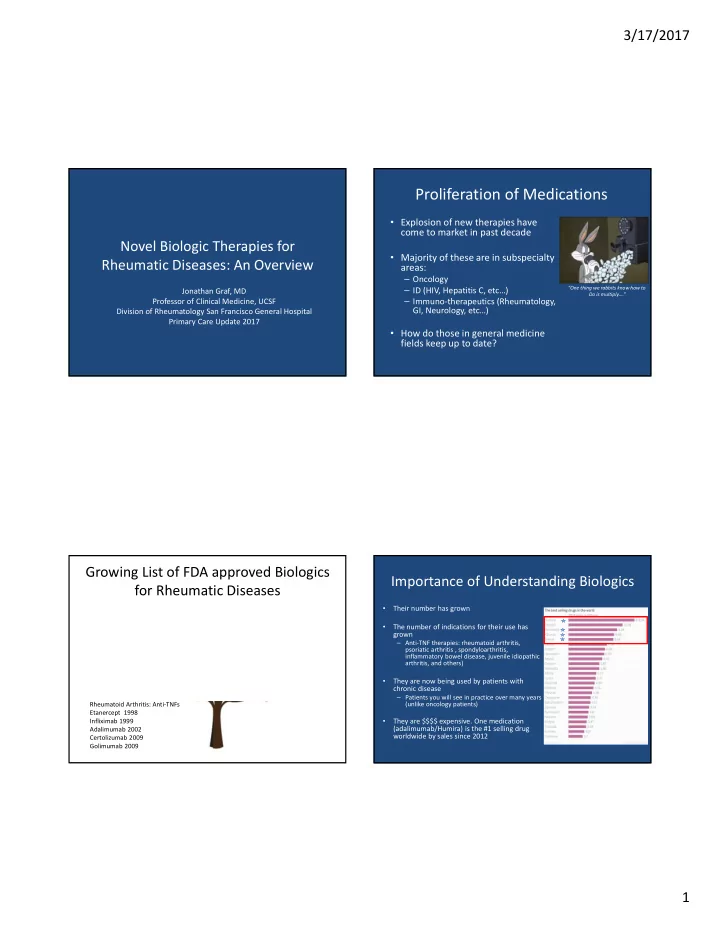
Proliferation of Medications Explosion of new therapies have come to - - PDF document

proliferation of medications
SMART_READER_LITE
LIVE PREVIEW

Proliferation of Medications Explosion of new therapies have come to - - PDF document

3/17/2017 Proliferation of Medications Explosion of new therapies have come to market in past decade Novel Biologic Therapies for Majority of these are in subspecialty Rheumatic Diseases: An Overview areas: Oncology One thing we


slide-1
SLIDE 1

3/17/2017 1 Novel Biologic Therapies for Rheumatic Diseases: An Overview

Jonathan Graf, MD Professor of Clinical Medicine, UCSF Division of Rheumatology San Francisco General Hospital Primary Care Update 2017

Proliferation of Medications

  • Explosion of new therapies have

come to market in past decade

  • Majority of these are in subspecialty

areas:

– Oncology – ID (HIV, Hepatitis C, etc…) – Immuno‐therapeutics (Rheumatology, GI, Neurology, etc…)

  • How do those in general medicine

fields keep up to date?

“One thing we rabbits know how to Do is multiply….”

Growing List of FDA approved Biologics for Rheumatic Diseases

SLE: Belimumab (anti‐BLyS) 2011 ANCA vasculitis: Rituximab 2012 Ank Spondylitis/Psoriasis/Psoriatic Arthritis: Secukinumab 2016 (anti IL17a) Psoriatic arthritis: Ustekinumab (anti IL‐12/23) 2013 Periodic fever syndromes : CAPS, muckle wells, NOMID Canakinumab (anti‐IL1) 2009 Rilonacept (IL‐1 TRAP) 2008 Rheumatoid Arthritis: Anti‐TNFs Etanercept 1998 Infliximab 1999 Adalimumab 2002 Certolizumab 2009 Golimumab 2009 RA: Abatacept (CTLA4 Ig) 2005 RA: Tocilizumab (anti‐IL6R) 2010 RA: Rituximab: depleting B cell Antibody 2006 RA: Anakinra: IL1‐RA 2001

Importance of Understanding Biologics

  • Their number has grown
  • The number of indications for their use has

grown

– Anti‐TNF therapies: rheumatoid arthritis, psoriatic arthritis , spondyloarthritis, inflammatory bowel disease, juvenile idiopathic arthritis, and others)

  • They are now being used by patients with

chronic disease

– Patients you will see in practice over many years (unlike oncology patients)

  • They are $$$$ expensive. One medication

(adalimumab/Humira) is the #1 selling drug worldwide by sales since 2012

slide-2
SLIDE 2

3/17/2017 2

Overview of Today’s Talk

  • Anti‐TNF therapy in detail

– Most commonly used in practice

  • When anti‐TNF therapy for RA fails

– Anti‐IL6 directed therapy (although there are other

  • ptions)

– Use this as example to show how indications are likely to increase beyond RA for biologics like this – Segue into discussion below:

  • New small molecule “biological response modifiers”
  • A lot of long‐worded medications that sound alike:

“imabs, umabs.” Don’t fret – discuss general principles

Biologic Therapies

  • What is meant by the term “Biologic Therapy”?
  • Double meaning:

– Large complex molecules (usually proteins or protein‐ based) that are synthesized by living cells – Target a gene or protein and modify biologic responses

  • Antibody‐antigen interactions
  • Cytokine‐receptor interactions (both ends)
  • Cell signaling proteins, inhibitors, or ligands

Conventional vs. biological medication comparison

Conventional medications

  • Small molecules
  • Usually simple chemical structure
  • Synthesized and purified from

simple chemical reaction in lab

  • Structures can be identified =

easily manufacture generic

Biological medications

  • Larger complex molecules
  • Larger complex macromolecules:

usually peptides/proteins

  • Encoded genetically, transcribed,

translated, and then post translationally modified by living cells

  • Often can be difficult to identify

full structure of complex molecules that biologically constructed modified by cells

Families of biological medications for rheumatic diseases

  • Anti‐cytokine therapies

– Block pro‐inflammatory cytokines from binding their receptors – Anti‐TNF, anti‐IL6, anti‐IL1, anti‐IL 12/23, anti‐IL 17

  • Cell‐oriented therapies

– Removal of or prevent activation and/or proliferation of cells implicated in disease – Rituximab (B‐cells), abatacept (T‐cells)

slide-3
SLIDE 3

3/17/2017 3

Anti‐cytokine therapies

  • Pro‐inflammatory cytokines bind

to receptors on cells and mediate inflammatory responses from those cells

  • Blockade of following cytokines

significantly ameliorates these diseases – TNFa: RA, Psoriatic arthritis (PsA), psoriasis, ankylosing spondylitis, juv. arthritis, IBD – IL 17: Psoriasis and PsA – IL 12/23: Psoriasis and PsA – IL 6: RA, ?giant cell arteritis – IL 1: periodic fevers (?gout) McInnes et al. JCI 2008

Biological therapy for rheumatoid arthritis

  • Approaching two decades of

experience with first class of biological medications (anti‐TNF medications)

  • Data have shown significant

benefits not only in treating disease‐associated symptoms

  • Significant prevention of joint

erosion, narrowing, and ultimately disability Benefits of adding an anti-TNF medication to conventional therapy with methotrexate

Klareskog et al. Lancet 2004. Tempo Trial

Biologic therapies for rheumatoid arthritis

  • Anti-Tnf medications (5 total)

– Etanercept (TNF decoy receptor fusion protein) – Infliximab, Adalimumab, certolizumab, golimumab (variations of anti-TNF antibodies or fragments)

  • B-cell depleting agents

– Rituximab

  • T-cell costimulation inhibitors (receptor-ligand )

– Abatacept

  • Inhibitors of IL-6 signaling

– Tocilizumab (anti Il-6 receptor antibody)

  • Il-1 Inhibitors (IL-1 cytokine receptor decoy)

– Anakinra

slide-4
SLIDE 4

3/17/2017 4

Biologic therapies for rheumatoid arthritis

  • Anti-Tnf medications (5 total)

– Etanercept (TNF decoy receptor fusion protein) – Infliximab, Adalimumab, certolizumab, golimumab (variations of anti-TNF antibodies or fragments)

  • B-cell depleting agents

– Rituximab

  • T-cell costimulation inhibitors (receptor-ligand )

– Abatacept

  • Inhibitors of IL-6 signaling

– Tocilizumab (anti Il-6 receptor antibody)

  • Il-1 Inhibitors (IL-1 cytokine receptor decoy)

– Anakinra

Tumor Necrosis Factor-a

  • Where does it come from?

– TNF genes located on chromosome 6 (MHC) – Primarily Macrophage and Monocyte derived – Some also produced in T Cells and Synoviocytes

Natural Biological Effects of TNF

McInnes et al. JCI 2008

TNF Effects: Good and the Bad

  • TNF‐alpha regulates biological

functions necessary for normal inflammatory, immune, and tumor surveillance responses.

– TNF‐alpha absolutely essential for granulomatous host defenses against intracellular bacteria (MTb, fungal infections, listeria) – Explains infection‐related toxicity profile of these medications

  • TNF‐a binds membrane‐

bound TNF receptors and mediates pro‐inflammatory processes implicated in inflammatory arthritis.

GOOD BAD

slide-5
SLIDE 5

3/17/2017 5

Anti-TNF Family

Anti‐Tnf medications

– Etanercept (TNF receptor fusion protein) – Infliximab (anti‐TNF antibody) – Adalimumab (anti‐TNF antibody) – Certolizumab pegol (anti‐TNF Fab‐PEG) – Golimumab (anti‐TNF antibody)

Anti‐TNF medications

Etanercept Most of other anti‐TNF monoclonal Abs

Practical issues to consider in patients on long term anti-TNFs: Pharmacokinetics...

  • Anti-TNF medications have long half lives
  • This is important for duration of the biologic effect
  • Also important in case someone develops a side effect
  • r infection while on one of these medicines

– Etanercept 4.25 days – Infliximab 8-12 days – Adalimumab 14 days

  • Many patients, especially those on IV therapy,

(infliximab, rituxan, etc…) may not mention to their MD that they are on therapy

Contraindications

  • History of latent tuberculosis unless/until they have

completed an adequate courses of prophylactic therapy (Duration up for debate)

  • Active acute or chronic infections (HCV exception)
  • Active or suspected malignancies.
  • Anti-TNFs are generally contraindicated in patients with

moderate or severe congestive heart failure (some have black box warning)

  • History of demyelinating disease
slide-6
SLIDE 6

3/17/2017 6

Initiating Anti-TNF Therapy

  • Asses Latent TB status at baseline

– PPD or interferon release assay – Follow up CXR if necessary (I recommend CXRs on all high risk patients)

  • Initiate treatment for LTBI if necessary (I recommend

holding therapy in high risk patients until they have completed a significant amount of their regimen)

  • Other intracellular organisms with latent infection:

– Consider coccidiomycosis and histoplasmosis in endemic regions before prescribing (should weigh into decision of risks/benefits)

  • Age appropriate cancer screening - good idea

Initiating and monitoring therapy

  • Screening for active infections by history in all

patients on active therapy

– Hepatitis B (will be discussed shortly)

  • If patients are being treated in our office, screen

for illness (history, temperature and blood pressure) before infusions or injections

– Counsel patients to do the same if being treated at home and hold doses if ill. If truly sick – seek MD attention

Anti-TNFs: Adverse Events

  • Most common: Injection site reactions

– Tend to wane over time and with use

  • Most serious: Increased risk of infections! (OR of

2.0 for serious infection in large meta analysis published in JAMA 2006)

– Most common URIs – Problematic: mTB and other intracellular organisms for which TNF is necessary for immune containment

  • Increased malignancy risk: Controversial
  • May worsen symptoms of congestive heart

failure.

Infliximab and TB

Keane et al. N Engl J Med. 2001 Oct 11;345(15):1098-104

56% Extra Pulmonary TB 24% Disseminated disease Patients don’t make granulomas (atypical appearance) Average onset 12 weeks after initiation (3‐4th dose)

slide-7
SLIDE 7

3/17/2017 7

Specifics: Hepatitis B

  • Patients with chronic hepatitis B infections are at

risk for re-activation and liver injury

  • Risk is highest for those who are hepatitis B

surface antigen positive and/or DNA positive

  • Risk is lowest for those who are surface antigen

negative and surface antibody positive

Hepatitis B Recommendations:

  • We screen all patients for HBV serologies
  • Follow LFTs in “carriers” who are Hep B Core

Ab+, even if also SAb+. Ensure viral load undetectable

  • Avoid anti-TNF therapy in patients who have

chronic active infection (Hep B Sag+) unless:

  • If use anti-TNFs in Hep B Sag+ patients:

– we initiate anti-Hep B therapy (RT inhibitors) – Follow Hep B DNA PCR for log changes in viral copies

Specifics: Vaccination

  • Yearly vaccination with influenza vaccine strongly

recommended

  • Vaccination with pneumococcal vaccines (PCV‐13

conjugate and pneumococcal 23‐polyvalent) strongly recommended per CDC schedule

  • Recommended NOT to receive live, attenuated vaccines

during therapy within two weeks of initiating therapy (ACR)

– Zoster vaccine is recommended at least 2 weeks prior to starting therapy (Age >50) – OK with modest level immune suppression (conventional DMARDs like MTX and prednisone doses <20 mg/day)

Specifics: Anti-TNFs and Malignancy

  • Large meta-analysis suggested an OR 3.3 for all

malignancies in patients using anti-TNF, especially “high doses.” (Bongartz et al., JAMA 2006)

  • Longitudinal analysis of 20,000 patients from the

National Databank of Rheumatic Diseases found no increased risk of lymphoma compared to general population or those with RA (Wolfe et al., A&R 2007)

  • Two studies published in 2011 (including large Danish

registry) corroborate lack of evidence linking cancer to anti-TNF therapy in adult RA patients

  • Possible evidence of increased risk of non-melanoma

skin cancer

slide-8
SLIDE 8

3/17/2017 8 When patients fail anti-TNF therapy…

  • Up to 30% of patients fail to respond or

lose response to anti-TNF therapy

  • Additional patients are intolerant or have

contraindication to anti-TNF therapy

  • There are now many other biologic

therapies available

When Patients fail anti-TNF therapy:

B‐cell depleting agents

Rituximab

T‐cell costimulation inhibitors (receptor‐ligand )

Abatacept

Inhibitors of Il‐6 signaling

Tocilizumab (anti Il‐6 receptor antibody)

Il‐1 Inhibitors (Il‐1 cytokine receptor decoy)

Anakinra

When Patients fail anti-TNF therapy:

B‐cell depleting agents

Rituximab

T‐cell costimulation inhibitors (receptor‐ligand )

Abatacept

Inhibitors of Il‐6 signaling

Tocilizumab (anti Il‐6 receptor antibody)

Il‐1 Inhibitors (Il‐1 cytokine receptor decoy)

Anakinra

Interleukin‐6 Biology

  • Cytokine with pleiotropic effects
  • Secreted by activated T‐cells and macrophages
  • Triggers acute phase inflammatory response

– Fever, acute phase proteins, host defense against pathogens, tumor surveillance

  • Basal IL‐6 secretion also required for normal homeostatic

functions

– hamatopoesis – regenerative processes (liver) – neural development

slide-9
SLIDE 9

3/17/2017 9

IL‐6 is an important cytokine

Measuring the Acute Phase Response Directly

IL‐6 Signaling

  • Most cells do NOT express an IL6 receptor
  • Rather, the IL6 receptor is secreted and

soluble

  • Unlike soluble TNF receptor (of which

etanercept is based), sIL6‐R is NOT an antagonist/anti‐inflammatory; it potentiates the iL6 signal

How IL6 transmits its signal

slide-10
SLIDE 10

3/17/2017 10

Tocilizumab

  • Antibody that binds to the iL6 receptor and

prevents IL6/IL6R complex from forming

Tocilizumab very effective in treating RA

Genovese et al. Arth Rheum 2008

Blocking IL6: predictable biology of inhibiting the acute phase response

Genovese et al. Arth Rheum 2008

Tocilizumab: Predictable (and not so predictable side effects)

  • 34% of patients had significant drop in neutrophil counts
  • Significantly higher percentage of patients on tocilizumab

has transaminase elevations

  • 23% patients on tocilizumab vs. 4% controls had fasting

total cholesterol >240 (increases in LDL and HDL)

  • Infections more common in tocilizumab vs. placebo
  • Unusual side effect: intestinal perforations have led to

caution with use in patients susceptible to diverticulitis

slide-11
SLIDE 11

3/17/2017 11

7 patients with refractory large vessel vasculitis (including GCA, TA) despite trials of other corticosteroid sparing agents All patients responded after 8‐12 weeks

  • f therapy and remained in clinical

remission on therapy All patients tapered their prednsone dose from mean 20 mg/day to <6 mg/day One patient died of preoperative MI and on autopsy was found to have

  • ngoing vasculitis despite being “in

clinical remission”

Cytokine Signaling through Kinases

Cytokine:

  • eg. TNF/IL6

Kinases

Transcription Biologic Effect: Proliferation Activation Cytokine production Current Biologic Therapies

Oral Small Molecule Inhibitors

  • Not proteins but are small molecules
  • Taken orally and can act intracellularly
  • “Biologic‐like” effects by blocking downstream

events initiated by cytokine‐receptor engagement

  • Emerging term: “Biologic response modifiers”

– Not organic, complex macromolecules but have similar effects to biological molecules

Cytokine Signaling through Kinases

Cytokine:

  • eg. TNF/IL6

Kinases

Current Biologic Therapies New Kinase Inhibitors

slide-12
SLIDE 12

3/17/2017 12 IL‐6 and other cytokines signal through JAK upon binding their receptors

Lee EB et al. N Engl J Med 2014;370:2377‐2386.

  • 40% of MTX naïve

patients with active RA achieved a 70% response on Tofacitinib 10 mg vs. 10% on MTX.

  • Predictable adverse

events similar to anti‐ iL6 therapy

– Liver, neutropenia, lipids, infections, etc. – Caution that JAK signaling more widespread than for IL6 alone

Pipeline of Oral Small Molecule Inhibitors

  • Tofacitinib (JAK 1/3 kinase inhibitor)

– Rheumatoid Arthritis (FDA approved 2012; Failed twice to get approval in Europe)

  • Apremilast (Phosphodiesterase 4 inhibitor)

– Psoriatic Arthritis (FDA approved 2014)

  • In development

– Syk kinase inhibitors – CSF1‐receptor (c‐FMS) inhibitors

Summary

  • Biological medications and non‐biological

therapies with biologic‐like effects are increasingly used to treat a wide‐variety of chronic diseases (RA, psoriasis, IBD, MS, etc…)

  • Anti‐Cytokine therapies are most prevalent
  • Primary care providers should be aware of how to

follow patients on these medicines

slide-13
SLIDE 13

3/17/2017 13

Multiplication! MOC Question

  • You are caring for a 52 YO female with a history of RA and

progressive interstitial lung disease for which she is currently receiving treatment with methotrexate 20 mg/week and prednisone 30 mg/day. Her rheumatologist would like to switch her from methotrexate to an anti‐TNF therapy in a few weeks and is requesting that you make sure her vaccinations are up to date. All of the following would be acceptable EXCEPT:

A. Injectable influenza vaccine B. Herpes zoster vaccine C. PCV‐13 conjugated pneumococcal vaccination D. Pneumococcal 23‐valent polysaccharide vaccine

MOC Question

  • You are caring for a 52 YO female with a history of RA and

progressive interstitial lung disease for which she is currently receiving treatment with methotrexate 20 mg/week and prednisone 30 mg/day. Her rheumatologist would like to switch her from methotrexate to an anti‐TNF therapy in a few weeks and is requesting that you make sure her vaccinations are up to date. All of the following would be acceptable EXCEPT:

A. Injectable influenza vaccine B. Herpes zoster vaccine C. PCV‐13 conjugated pneumococcal vaccination D. Pneumococcal 23‐valent polysaccharide vaccine

MOC Question Explanation

Of the four choices listed, only the herpes zoster vaccine is a live, attenuated vaccine. It also contains a high inoculum of virus and is therefore not recommended for patients who are heavily immunosuppressed, including but not limited to, patients receiving biologicals such as anti‐TNF medications and those on higher doses of prednisone >20 mg/day as in this patient with ILD. It is generally recommended that other patients over the age of 50 with rheumatic diseases receive the zoster vaccine, including those patients receiving DMARDS such as methotrexate at standard doses to treat RA.