VHL and clear cell Renal Cell Carcinoma Gene expression profiles in - - PowerPoint PPT Presentation

vhl and clear cell renal cell carcinoma
SMART_READER_LITE
LIVE PREVIEW

VHL and clear cell Renal Cell Carcinoma Gene expression profiles in - - PowerPoint PPT Presentation

11/7/2014 VHL and clear cell Renal Cell Carcinoma Gene expression profiles in renal cell VHL syndrome hallmark cancer: carcinoma Clear cell renal cell carcinoma (ccRCC) October 23, 2014 VHL mutations also a hallmark of sporadic ccRCC


slide-1
SLIDE 1

11/7/2014 1

October 23, 2014

Title

Gene expression profiles in renal cell carcinoma

  • W. Kimryn Rathmell, MD, PhD

VHL and clear cell Renal Cell Carcinoma

  • VHL syndrome hallmark cancer:

– Clear cell renal cell carcinoma (ccRCC)

  • VHL mutations also a hallmark of sporadic ccRCC
  • VHL mutationHIF stabilization and gene

expression changes associated with the hypoxia response.

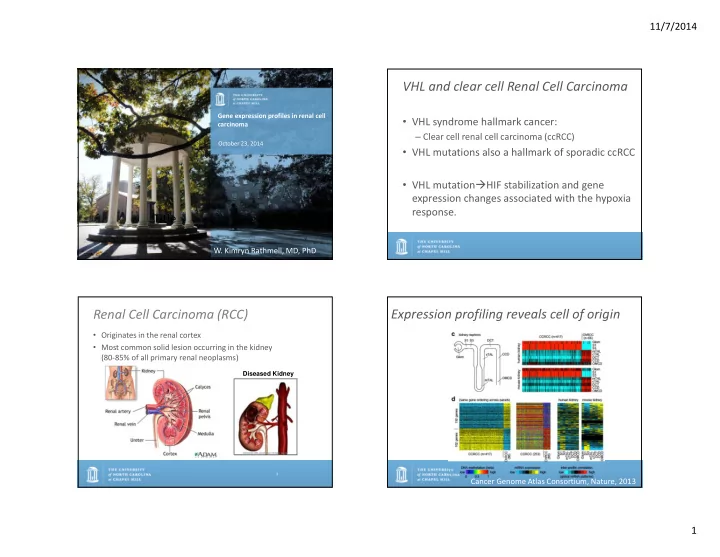
Renal Cell Carcinoma (RCC)

  • Originates in the renal cortex
  • Most common solid lesion occurring in the kidney

(80‐85% of all primary renal neoplasms)

3

Diseased Kidney

Expression profiling reveals cell of origin

Cancer Genome Atlas Consortium, Nature, 2013

slide-2
SLIDE 2

11/7/2014 2

VHL/HIF Regulatory Pathway

HIF2α HIF2α HIFβ HIF1α HIF1α

HIF1α

HIFβ VEGF PDGF CCD1 GLUT1 HIF2α PDK LDHA FLT1 TGFα OCT4 Glycolysis BNIP3 Apoptosis Angiogenesis Invasion Metastasis MMP2 CXCR4 De- differentiation Proliferation

Outline

  • Gene expression profiles in clear cell renal cell

carcinomas.

  • Validating a prognostic signature in RCC.
  • Exploring gene expression profiles in VHL

syndrome RCC tumors.

Sporadic VHL mutant tumors express HIF1 and HIF2, or HIF2 alone.

Gordan et al, Cancer Cell, 2008

Gene expression patterns show HIF‐specific variability

  • HIF1 drives glycolytic genes,

mTOR pathway

  • HIF2 drives genes involved in

cell cycle and DNA damage.

  • Overlap in angiogenesis and

motility targets.

Gordan et al, Cancer Cell, 2008

slide-3
SLIDE 3

11/7/2014 3

Using gene expression to identify tumor subgroups. ccA and ccB

Brannon, et al, Genes and Cancer, 2010

K=3, K=4 still fall into two groups

Brannon, et al, Genes and Cancer, 2010

ccA (classical angiogenic), ccB (bad)

Brannon, et al, Genes and Cancer, 2010

Validation in a historical dataset

Brannon, et al, Genes and Cancer, 2010

slide-4
SLIDE 4

11/7/2014 4

Extent of Disease at Diagnosis

  • Most cancers of the kidney and renal pelvis are

diagnosed when the disease is still localized to the primary site

13

National Cancer Institute. SEER Stat Fact Sheets. Available at: http://seer.cancer.gov/statfacts/html/kidrp.html. Accessed August 28, 2008.

Loco-regional Spread 19% Localized Disease 56% Metastatic Spread 20% Unknown 5%

Determining Prognosis: Anatomic Extent of Disease

  • Most consistent factor used to determine RCC prognosis

14

Reprinted with permission from Tsui KH, et al. J Urol. 2000;163:1090-1095.

5-year Cancer-specific Survival Based on TNM Stage

TNM Stage 5-year Cancer- specific Survival Stage I 91 ± 2.5% Stage II 74 ± 6.9% Stage III 67 ± 6.1% Stage IV 32 ± 3.2%

12 24 36 48 60 72 84 96 108 120 132 1.00 .75 .50 .25 Log Rank P Value<.001 Stage IV (N=318) Stage III (N=83) Stage II (N=57) Stage I (N=185) Months of Postsurgery Probability of Survival

ccA/ccB predicts for cancer specific and

  • verall survival outcomes

Brannon, et al, Genes and Cancer, 2010

Validation dataset reveals a small distinct tumor set

Brannon, et al, Eur Urol, 2012

slide-5
SLIDE 5

11/7/2014 5

Cluster 3 are highly divergent from ccA and ccB in metabolic genes.

Brannon, et al, Eur Urol, 2012

VHL mutants in both ccA and ccB

Brannon, et al, Eur Urol, 2012

Developing a clinic tool: ClearCode34

LAD and ConsensusCluster analysis Set aside arrays with non-concordant assignments 43 ccA arrays (42 tumors, 1 replicate) 72 arrays (microarray standard set) (69 tumors, 3 replicates) 29 ccB arrays (27 tumors, 2 replicates) Prediction Analysis for Microarrays (PAM) 95 clear cell tumors Predictive biomarkers: ClearCode34

Brooks, et al, Eur Urol, 2014

Prognostic value of ClearCode34 evaluated in TCGA

20 40 60 80 100 .0 .2 .4 .6 .8 1 .0 Time (months) 20 40 60 80 100 .0 .2 .4 .6 .8 1 .0 Time (months)

0 20 40 60 80 100

ccA ccB (n=205) (n=175)

  • No. of events

50 75 Median RFS, months 91 53 HR, 2.3; 95% CI, 1.6 to 3.3; P=4.3e-06

0.0 0.2 0.4 0.6 0.8 1.0 ccA ccB 0 20 40 60 80 100 0.0 0.2 0.4 0.6 0.8 1.0 Cancer-Specific Survival (probability) ccA ccB Time (months) Time (months) Recurrence-free Survival (probability)

ccA ccB (n=205) (n=175)

  • No. of events

14 29 Median CSS, months

  • HR, 2.9; 95% CI, 1.6 to 5.6; P=0.0005

Brooks, et al, Eur Urol, 2014

slide-6
SLIDE 6

11/7/2014 6

Prognostic value of ClearCode34 validated in UNC cohort

50 100 150 200 .0 .2 .4 .6 .8 1 .0 Time (months) 50 100 150 200 .0 .2 .4 .6 .8 1 .0 Time (months)

Cancer-Specific Survival (probability) 0.0 0.2 0.4 0.6 0.8 1.0 Time (months) 0 50 100 150 200

ccA ccB ccA ccB (n=69) (n=88)

  • No. of events

7 25 Median CSS, months

  • 151

HR, 3.0; 95% CI, 1.3 to 7.0; P=.005

Recurrence-Free Survival (probability) 0.0 0.2 0.4 0.6 0.8 1.0

ccA ccB ccA ccB (n=69) (n=88)

  • No. of events

26 59 Median RFS, months 88 52 HR, 2.1; 95% CI, 1.3 to 3.4; P=.001

0 50 100 150 200 Time (months)

Brooks, et al, Eur Urol, 2014

Prognostic value of ClearCode34 validated in TCGA

Abbreviation: HR, hazard ratio Subtype ccA was used as reference in univariate and multivariate analysis. $ Stage I was used as reference in univariate and multivariate analysis. Stage was encoded as an ordinal variable with three levels. || Grade 1 and 2 were combined and used as reference in univariate and multivariate

  • analysis. Grade was encoded as an ordinal variable with three levels.

Brooks, et al, Eur Urol, 2014

Integrated prognostic models can evaluate risk outcomes

Group Risk Score Low 0-0.5 Intermediate 0.5-1.5 High >1.5

50 100 150 200 .0 .2 .4 .6 .8 1 .0 Time (months)

Recurrence-free Survival (probability) 0.0 0.2 0.4 0.6 0.8 1.0 0 50 100 150 200 Time (months)

Log-rank P=3.04e-09 Low Risk (N=98) Intermediate Risk (N=140) High Risk (N=28)

50 100 150 200 .0 .2 .4 .6 .8 1 .0 Time (months)

Log-rank P=2.03e-08 Low Risk Intermediate Risk High Risk

0.0 0.2 0.4 0.6 0.8 1.0 Time (months) Cancer-Specific Survival (probability) 0 50 100 150 200

Brooks, et al, Eur Urol, 2014

RCC Algorithms for cancer-specific survival

UCLA Integrated Staging System (UISS)
slide-7
SLIDE 7

11/7/2014 7

ClearCode34 Model outperforms established algorithms

UISS ClearCode34 Model C - in d e x 0 .5 0 0 .5 5 0 .6 0 0 . 6 5

UISS ClearCode34 Model

.50 .55 .60 .65 C-index

CC34Model->UISS C h a n g e in C h i-s q u a r e d S t a tis tic 2 4 6 8 1 0

0 2 4 6 8 10 Change in chi-squared statistic

Model->UI UI->Model

7.3 1.9 2.5 6.7*

*

CC34Model->SSIGN C h a n g e in C h i- s q u a r e d S t a t is t ic 5 1 0 1 5 2 0 2 5 3 0 3 5 SSIGN ClearCode34 Model C - in d e x 0 . 5 0 0 . 5 5 0 . 6 0 0 . 6 5 0 .7 0

SSIGN ClearCode34 Model

.50 .55 .60 .65 .70 C-index 0 5 10 15 20 25 30 35 Change in chi-squared statistic 26.9 3.2 15.9 14.2*

*

Model->SS SS->Model

* Brooks, et al, Eur Urol, 2014

ClearCode34 Summary

  • ClearCode34 can accurately classify ccRCC

tumors

  • Prognostic value of ccA/ccB classification validated

in a TCGA and UNC cohort

  • Integrated model for recurrence-free and cancer-

specific survival constructed using ccRCC subtypes and traditional clinical variables stage and grade.

  • This classifier adds value to predicting cancer-

specific survival above and beyond established algorithms.

How do we know this is meaningful for VHL patients?

*VHL disease tumors and sporadic ccRCCs (the majority VHL mutated) are not distinguishable by gene expression. TCGA includes 14 tumors from VHL patients:

2‐class comparison reveals NO significantly different upregulated genes, 209 significantly downregulated.

VHL cases in the TCGA‐A mixture of ccA and ccB

TCGA Sample ID ClearCode34 Status Grade Size (cm) T Stage N Stage M StatusStage KIRC TCGA‐A3‐xxxx ccA G2 3 T1a NX M0 Stage I KIRC TCGA‐A3‐xxxx ccA G3 4.9 T1b N0 M0 Stage I KIRC TCGA‐A3‐xxxx ccB G2 4 T1a N0 M0 Stage I KIRC TCGA‐AK‐xxxx G2 5.5 T1 N0 M0 Stage I KIRC TCGA‐AK‐xxxx ccA G2 12 T3b N0 M0 Stage III KIRC TCGA‐AK‐xxxx ccA G2 7.5 T2 N0 M0 Stage II KIRC TCGA‐AK‐xxxx G3 6.5 T3b N1 M0 Stage III KIRC TCGA‐AK‐xxxx ccB G3 11 T2 NX M0 Stage II KIRC TCGA‐AK‐xxxx ccA G2 7 T1b NX M0 Stage I KIRC TCGA‐AK‐xxxx G2 9 T2 N0 M1 Stage IV KIRC TCGA‐AK‐xxxx G2 6 T1b NX M0 Stage I KIRC TCGA‐AK‐xxxx ccB G3 5.5 T3a NX M0 Stage III KIRC TCGA‐AK‐xxxx ccA G2 4 T1a NX M0 Stage I KIRC TCGA‐AK‐xxxx ccA G3 9 T2 N0 M0 Stage II

slide-8
SLIDE 8

11/7/2014 8

Summary

  • The hypoxia gene expression signature

dominates VHL mutated RCC, but many other pathways emerge.

  • The expression profile matches ccRCC to the

early proximal tubule.

  • Tumor expression profiles can reveal relevant

biology and aid in disease prognosis .

Acknowledgments

Rathmell Lab Kate Hacker, PhD Alex Arreola, PhD Samira Brooks Zufan Debebe, PhD Sneha Sundaram, PhD Catherine Fahey Adam Sendor Rathmell Lab Past Members Rose Brannon, PhD Oishee Sen Shufen Chen, MD, PhD Lance Cowey, MD Caroline Martz Lee, MD, PhD Tricia Wright, PhD Neal Rasmussen, PhD Translational Pathology Laboratory Genomics Core, Tissue Procurement Facility Rutgers Gyan Bhanot, PhD Anupama Reddy, PhD Joel Parker, PhD UNC Biomedical Research Imaging Center Weili Lin, PhD Amir Khandani, MD Julia Fielding, MD The Cancer Genome Atlas Particularly: Chad Creighton, Marston Linehan, Richard Gibbs, Kenna Shaw Clinical TCGA Partiularly: James Hsieh, Ari Hakimi, Toni Chouieri Funding: AACR INNOVATOR Award, NIH (TCGA), NIH (K24), V Foundation for Cancer Research