5/25/2017 EPITHELIAL KIDNEY TUMORS: RENAL CELL CARCINOMA - - PowerPoint PPT Presentation

5 25 2017
SMART_READER_LITE
LIVE PREVIEW

5/25/2017 EPITHELIAL KIDNEY TUMORS: RENAL CELL CARCINOMA - - PowerPoint PPT Presentation

5/25/2017 EPITHELIAL KIDNEY TUMORS: RENAL CELL CARCINOMA EPIDEMIOLOGY (2016) NEW ENTITIES AND PROBLEM DIAGNOSES Kidney & renal pelvis 9,240 3% Kidney& renal pelvis 5,000 2% Siegel et al. CaA Cancer J Clin 66:7-30,


slide-1
SLIDE 1

5/25/2017 1

David Grignon MD, Indiana University, Indianapolis, IN

EPITHELIAL KIDNEY TUMORS: NEW ENTITIES AND PROBLEM DIAGNOSES

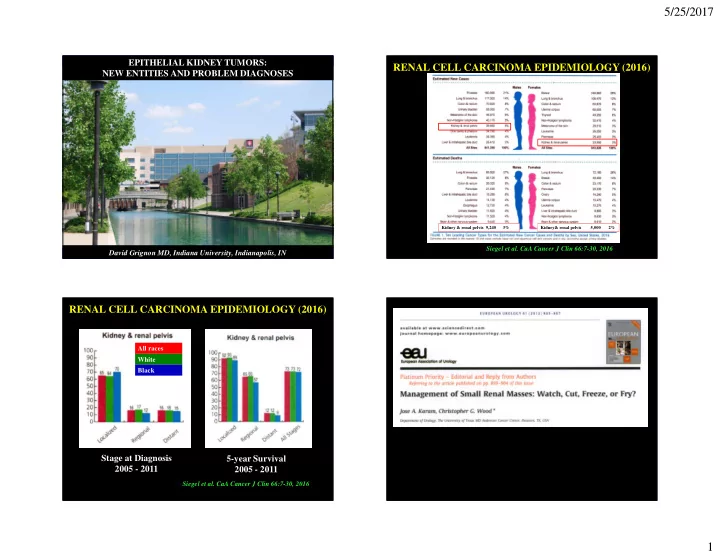
RENAL CELL CARCINOMA EPIDEMIOLOGY (2016)

Siegel et al. CaA Cancer J Clin 66:7-30, 2016

Kidney& renal pelvis 5,000 2% Kidney & renal pelvis 9,240 3%

RENAL CELL CARCINOMA EPIDEMIOLOGY (2016)

Siegel et al. CaA Cancer J Clin 66:7-30, 2016

Stage at Diagnosis 2005 - 2011 5-year Survival 2005 - 2011

All races White Black

slide-2
SLIDE 2

5/25/2017 2

RENAL CELL CARCINOMA ACTIVE SURVEILLANCE

Favorable

  • Clear, NG 1
  • Papillary, type 1, NG 1
  • Chromophobe

Intermediate

  • Clear, NG 2
  • Papillary, type 1, NG 2
  • Papillary, NOS
  • Oncocytic neoplasm, NOS

Unfavorable

  • Clear, NG 3 & 4
  • Papillary, type 1, NG 3 & 4
  • Papillary type 2
  • Sarcomatoid

Halverson, et al. J Urol 189:441-446, 2013

NEEDLE BIOPSY DIAGNOSIS

Clear cell RCC Papillary RCC

NEEDLE BIOPSY DIAGNOSIS

Mucinous tubular and spindle cell RCC Medullary RCC

NEEDLE BIOPSY DIAGNOSIS

Metanephric adenoma Trabecular angiomyolipoma

slide-3
SLIDE 3

5/25/2017 3

WHO 2016 CLASSIFICATION EPITHELIAL TUMORS

BENIGN Papillary adenoma Metanephric adenoma Metanephric adenofibroma Oncocytoma

Adenoma

WHO 2016 CLASSIFICATION EPITHELIAL TUMORS

MALIGNANT Clear cell RCC Multilocular cystic renal neoplasm of low malignant potential Papillary RCC Chromophobe RCC Collecting duct carcinoma Medullary carcinoma

Chromophobe RCC

WHO 2016 CLASSIFICATION EPITHELIAL TUMORS

MALIGNANT MiT family translocation carcinomas Xp11 and t(6;11) Carcinoma associated with neuroblastoma Mucinous tubular and spindle cell ca Tubulocystic RCC Acquired cystic disease associated RCC

Acquired cystic disease associated RCC

WHO 2016 CLASSIFICATION EPITHELIAL TUMORS

MALIGNANT

Clear cell papillary RCC HLRCC syndrome associated RCC SDH deficiency associated RCC Unclassified RCC

Clear cell papillary RCC

slide-4
SLIDE 4

5/25/2017 4

WHO 2016 CLASSIFICATION

Tumors Not Ready to be Added

  • Specific hereditary types of RCC

– Birtt-Hogg-Dube Syndrome

  • Oncocytic papillary RCC*
  • So-called “hybrid” oncocytoma/chromophobe

RCC**

  • ALK-translocation associated
  • Thyroid-like follicular carcinoma
  • Others

* left in Type 2 papillary RCC ** include in unclassified RCC category

Kidney tumors with pink cells

DIFFERENTIAL DIAGNOSIS

ONCOCYTOMA CHROMOPHOBE RCC CLEAR CELL RCC UNCLASSIFIED RCC PAPILLARY RCC COLLECTING DUCT CA TRANSLOCATION CARCINOMAS SDH ASSOCIATED RCC EPITHELIOID ANGIOMYOLIPOMA

RENAL ONCOCYTOMA

5% of kidney tumors in adults; wide age range; more common in females (2-3:1); majority are asymptomatic; variable cytogenetics: -1 and –Y most often reported

slide-5
SLIDE 5

5/25/2017 5

RENAL ONCOCYTOMA RENAL ONCOCYTOMA

CYSTIC CHANGE PAPILLARY ARCHITECTURE

slide-6
SLIDE 6

5/25/2017 6

NUCLEAR PLEOMORPHISM CLEAR CELL CHANGE PERINEPHRIC FAT INVASION

RENAL VEIN INVASION

slide-7
SLIDE 7

5/25/2017 7 ENTRAPPED TUBULES

CK7

HALE’S COLLOIDAL IRON

ONCOCYTOMA – SPECIAL STUDIES

CK7 Vimentin CD117 Hale colloidal iron

ONCOCYTOMA – SPECIAL STUDIES

CK7 Vimentin CD117 Hale colloidal iron

slide-8
SLIDE 8

5/25/2017 8

ONCOCYTOMA - IHC

CK7 VIM

RENAL ONCOCYTOMA

Cytokeratin 7 ONCOCYTOMA – NEEDLE BIOPSY: OUR CRITERIA

Cytokeratin 7 Hale’s colloidal iron Vimentin Typical morphology

ONCOCYTOMA - LIKE

Vimentin CD10

slide-9
SLIDE 9

5/25/2017 9

ONCOCYTOMA - LIKE

CK7 CD117 CD10

CLEAR CELL RENAL CELL CARCINOMA

CA IX CD10 CK7

PAPILLARY RENAL CELL CARCINOMA

CK7 AMACR/p504s

CHROMOPHOBE CARCINOMA

5% of kidney tumors, adults, M=F, excellent prognosis (>90% survival); distinctive cytogenetic profile with -1, -2, -6, -13, -17, -21

slide-10
SLIDE 10

5/25/2017 10

CHROMOPHOBE CARCINOMA

CHROMOPHOBE CARCINOMA

CHROMOPHOBE CARCINOMA

CHROMOPHOBE CARCINOMA

slide-11
SLIDE 11

5/25/2017 11

CHROMOPHOBE CARCINOMA

HALE’S COLLOIDAL IRON CHROMOPHOBE CARCINOMA IMMUNOHISTOCHEMISTRY

CK7 VIMENTIN CD10

CHROMOPHOBE CARCINOMA

CK7 Vimentin CD10 Hale’s

slide-12
SLIDE 12

5/25/2017 12

“HYBRID” TUMORS

  • RENAL ONCOCYTOSIS

– Bilateral, multiple tumors – Oncocytoma, chromophobe RCC and hybrid tumors

  • BIRT HOGG DUBE SYNDROME

– Skin tumors (trichofolliculomas, achrocordons), multiple renal tumors and pneumothoraces – Oncocytoma, chromophobe and clear cell RCC, and hybrid tumors – Autosomal dominant, 17p11.2 (folliculin)

  • DE NOVO

– 4/425 cases in recent series

RENAL ONCOCYTOSIS RENAL ONCOCYTOSIS

RENAL TUMOR OF ONCOCYTOSIS

Hale’s colloidal iron

slide-13
SLIDE 13

5/25/2017 13 BIRT HOGG DUBE SYNDROME

BIRT HOGG DUBE SYNDROME

Left - tumor #1 Left – tumor #2 Right - tumor #3 27 year old female with multiple, bilateral kidney tumors

ACQUIRED CYSTIC KIDNEY DISEASE

  • Examined 66 kidneys from 52 patients
  • Identified a variety of tumor types:

– ACD associated carcinoma 33% – Clear cell papillary carcinoma 21% – Papillary carcinoma 16% – Chromophobe carcinoma 16% – Clear cell carcinoma 14%

  • Considered the first two potentially

unique tumor types

Tickoo et al, Am J Surg Pathol 30:141, 2006

ACQUIRED CYSTIC DISEASE ASSOCIATED RENAL CELL CARCINOMA

  • To date have occurred exclusively in

patients with acquired cystic disease

  • Increase in frequency with increased

length of time on dialysis

  • Occur at any age
  • No specific genetic mutations recognized
  • Limited prognostic information but

metastases reported in 8% to 22^ of patients

slide-14
SLIDE 14

5/25/2017 14

AcqCKD ASSOCIATED CARCINOMA AcqCKD ASSOCIATED CARCINOMA AcqCKD ASSOCIATED CARCINOMA

Calcium oxalate crystals

AcqCKD ASSOCIATED CARCINOMA

Calcium oxalate crystals

slide-15
SLIDE 15

5/25/2017 15

AcqCKD ASSOCIATED CARCINOMA

CLEAR CELL PAPILLARY RCC

  • 3 – 4% of resected kidney tumors
  • Wide age range; slight male

predominance

  • 95% T1a (< 4 cm)
  • Not genetically related to clear cell or

papillary RCC

  • Distinctive IHC profile
  • Excellent prognosis

CLEAR CELL PAPILLARY RCC CLEAR CELL PAPILLARY RCC

slide-16
SLIDE 16

5/25/2017 16

CLEAR CELL PAPILLARY RCC

Clear cell Papillary RCC Clear cell Papillary RCC

CLEAR CELL PAPILLARY RCC

slide-17
SLIDE 17

5/25/2017 17

CLEAR CELL PAPILLARY RCC

CLEAR CELL PAPILLARY RCC

CK7 AMACR CD10 CAIX

CLEAR CELL PAPILLARY RCC

CA IX CD 10 CK 7

slide-18
SLIDE 18

5/25/2017 18

CLEAR CELL PAPILLARY RCC

CA IX CK7

EPITHELIAL KIDNEY TUMORS CLASSIFICATION

Cancer Genet Cytogen 21:165, 1986

EPITHELIAL KIDNEY TUMORS CLASSIFICATION

X:1 TRANSLOCATION ASSOCIATED CARCINOMA: FREQUENCY BY AGE

0.0 10.0 20.0 30.0 40.0 50.0 60.0 70.0 80.0 0 - 10 11 - 20 21 - 30 31 - 40 > 40

Klatte et al. Am J Clin Pathol 137:761, 2012

slide-19
SLIDE 19

5/25/2017 19

TRANSLOCATION ASSOCIATED CARCINOMA X:1 TRANSLOCATION CARCINOMA

X:1 TRANSLOCATION ASSOCIATED CARCINOMAS

TRANSLOCATION ASSOCIATED CARCINOMA

TFE3

slide-20
SLIDE 20

5/25/2017 20

TFE3

X:1 TRANSLOCATION CARCINOMA X:1 TRANSLOCATION CARCINOMA

Type IV collagen Cathepsin K TFE3

X:1 TRANSLOCATION RCC

slide-21
SLIDE 21

5/25/2017 21 X:1 TRANSLOCATION RCC

CK AE1/AE3 TFE3 X:1 TRANSLOCATION CARCINOMA TFE3 CK AE1/AE3

  • Because of limited number of published cases

prognostic features are unclear

Xp11TRANSLOCATION ASSOCIATED CARCINOMAS

Prolonged survival in young patients with recurrence/metastases (4/8 with Xp11 translocation RCC)

Komai et al, Urology 77:842, 2011

54 cases median age 36 50 TFE3 4 TFEB

Malouf et al, J Urol 185:24, 2011

6:11 TRANSLOCATION CARCINOMA

Type IV collagen

slide-22
SLIDE 22

5/25/2017 22

6:11 TRANSLOCATION CARCINOMA

Cathepsin K Melan A HMB45 PAX 8

Translocation associated renal cell carcinoma is in the differential diagnosis of ALL unclassifiable renal cell carcinomas

SDH ASSOCIATED RCC

  • Patients with mutation of SDHB >>

SDHC (rarely SDHA or SDHD)

  • Paraganglioma and GIST
  • Wide age range (14 – 76 yrs; median 35)
  • Multifocal and/or bilateral in 30%
  • Eosinophilic cells in nests and tubules;

cytoplasmic inclusions; entrapped tubules; mast cells

  • Most low grade but metastases develop in

about 10% of patients

Gill et al. Am J Surg Pathol 38:1588, 2014 Williamson et al. Mod Pathol 28:80, 2015

slide-23
SLIDE 23

5/25/2017 23

SDH ASSOCIATED RENAL CELL CARCINOMA SDH ASSOCIATED RENAL CELL CARCINOMA

CK AE1/AE3 SDHB

HLRCC SYNDROME

  • Patients with mutation of fumarate

hydratase gene (1q42.3-q43)

  • Cutaneous and uterine leiomyomas
  • Wide age range (17 – 87 years)
  • More common in females
  • Complex solid and papillary histology

with macro orangophilic nucleoli and perinucleolar halo

  • Aggressive tumors with up to 50% with

metastasis at diagnosis

Merino et al. Am J Surg Pathol 31:1578, 2007 Grubb et al. J Urol 177:2074, 2007

HLRCC SYNDROME ASSOCIATED RCC

slide-24
SLIDE 24

5/25/2017 24

HLRCC SYNDROME ASSOCIATED RCC

THYROID-LIKE FOLLICULAR CARCINOMA OF THE KIDNEY

ONCOCYTIC PAPILLARY RCC

UNCLASSIFIED RENAL CELL CARCINOMA

slide-25
SLIDE 25

5/25/2017 25

Indianapolis, IN