Comprehensive Molecular Characterization Papillary Renal Cell - - PowerPoint PPT Presentation
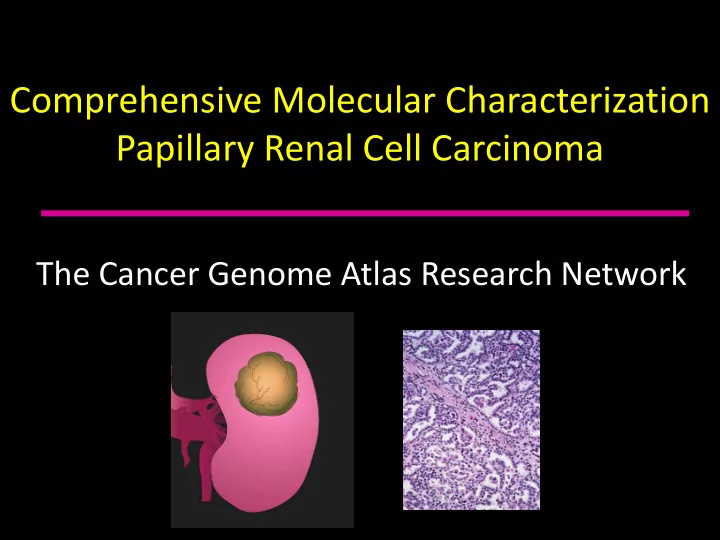
Comprehensive Molecular Characterization Papillary Renal Cell Carcinoma The Cancer Genome Atlas Research Network Renal Cell Carcinoma Clear Cell Papillary Type 1 Chromophobe Hybrid Oncocytoma Papillary Type 2 TFE3 Angiomyolipoma
Renal Cell Carcinoma
Clear Cell Papillary Type 1 Papillary Type 2 Chromophobe Oncocytoma Angiomyolipoma TFE3 Oncocytic Clear/Chromophobe Hybrid
Renal Cell Carcinoma
Clear Cell Papillary Chromophobe Oncocytoma 75% 15% 5% 3%
Papillary Renal Cell Carcinoma
Type 1 Papillary Type 2 Papillary
Hereditary Papillary Renal Carcinoma Type 1 Papillary Renal Carcinoma
Type 1 Papillary RCC
HPRC: MET Mutations
codon 1149 (exon 17) codons 1206, 1213 (exon 18) codons 1238, 1246, 1248, 1268 (exon 19)
β α
codon 1112, 1110, 1124 (exon 16)
β α
codon 1149 (exon 17) codons 1206, 1213 (exon 18) codons 1238, 1246, 1248, 1268 (exon 19) codon 1112, 1110, 1124 (exon 16)
Type 2 Papillary RCC is Heterogeneous
Hereditary Leiomyomatosis Renal Cell Carcinoma (HLRCC)
Type 2 Papillary RCC
Fumarate Hydratase (FH): HLRCC Gene
OAA Citrate Isocitrate α-Ketoglutarate Succinyl-CoA Succinate Fumarate L-Malate
Acetyl-CoA CO2 MDH succinate succinate thiokinase α-KGDH H2O aconitase IDH citrate synthase
FH catalyzes the conversion
- f fumarate
to malate Tomlinson, et al. Nature Genetics:30 2002
fumarate hydratase fumarate hydratase dehydrogenase
KIRP Analysis
Analysis Type Method of Analysis Samples Analysed Copy Number Analysis SNP6.0 Arrays 161 PRCC Samples 161 Normals Somatic Mutation Analysis Exome Sequencing 157 PRCC Samples 157 Normals Methylation Analysis Illumina BeadChip Assays 161 PRCC Samples 45 Normals mRNA Expression Analysis RNA-Seq 161 PRCC Samples 30 Normals miRNA Expression Analysis RNA-Seq 161 PRCC Samples 32 Normals Protein Expression Analysis Reverse phase protein array (RPPA) 125 PRCC Samples
TCGA-BQ-5886 Unclassified PRCC N=26 TCGA-BQ-5878 Type 2 PRCC N=60 TCGA-A4-7732 Type 1 PRCC N=75
Pathology Analysis: N=161
Chromosomal Copy Number Analysis
- Chromosomal level copy number analysis produced three distinct clusters
- 1. Relative genomic stability
- 2. Multiple chromosomal gain, notably chromosome 7
- 3. Multiple deletions; including chromosome 9
- Cluster 2 predominantly Type 1 PRCC
- Cluster 1 and 3 predominantly Type 2 PRCC
Cluster 2
Common amplification of chromosome 7. Additional amplifications of chromosomes 3, 12, 16 & 17.
Cluster 1
Genome Stable Small numbers of gains/losses
Cluster 3
Genome Unstable Numerous deletions, including chromosome 9.
Chromosomal Copy Number Analysis
100% 80% 60% 40% 0% 20% Survival Rate Time (days)
5000 4000 3000 2000 1000
Cluster 3 Cluster 2 Cluster 1
6000
- Chromosomal level copy number analysis produced three distinct clusters
- 1. Relative genomic stability
- 2. Multiple chromosomal gain, notably chromosome 7
- 3. Multiple deletions; including chromosome 9
Somatic Exome Mutation Analysis
- Mutation analysis was
performed using the MutSig 2.0CV with q-values <0.1
- In addition, analysis was
performed to evaluate genes identified in PanCan21.
- Chromatin remodeling/modifier genes mutated in clear cell RCC were also mutated in PRCC
- Associated with Type 2 PRCC
Pathway Mutation Analysis
- Several of the genes associated with PRCC exist as components of pathways or complexes,
such as the Hippo pathway and several chromatin modifier pathways.
- Mutations of pathway genes were found in both Type 1 and Type 2 PRCC
- SWI/SNF complex (20% and 27% respectively)
- Chromatin modifier pathways (35% and 38% respectively)
- Hippo signaling pathway (3% and 10% respectively)
Type 1 PRCC Specific Alteration - MET
MET
- Most of the MET mutations
were in the tyrosine kinase domain, and were found predominately in the Type 1 PRCC.
- 14 MET mutations were
somatic; 3 were germline.
Type 1 PRCC Specific Alteration - MET
MET
- A specific MET splice variant was
identified in 8 samples, resulting in the loss of the first two exons and gain of a novel exon.
Type 1 PRCC Specific Alteration - MET
Type 2 PRCC Specific Alterations - CDKN2A
- GISTIC analysis revealed a
deleted region of chromosome 9p containing the CDKN2A (p16) gene.
Type 2 PRCC Specific Alterations - CDKN2A
- CDKN2A promoter hypermethylation was
identified in 10 tumors.
- Each correlated with low expression.
Type 2 PRCC Specific Alterations - CDKN2A
- CDKN2A gene alterations were found
in 21 tumors
- 15 (71%) were Type 2 PRCC
Type 2 PRCC Specific Alterations - CDKN2A
- Patients with CDKN2A alterations had poorer overall survival.
TFE3/TFEB Fusion PRCC
- TFE3/TFEB gene fusions were identified in 12% of Type 2 PRCC tumors, including
patients in their 7th and 8th decade.
- The TFE3 fusions included 4 with known fusion partners (PRCC and SFPQ) and 2
with novel fusion partners, RBM10 and DVL2.
- The two TFEB fusions both involved novel fusion partners, COL21A1 and CADM2.
Methylation Analysis
- Assessment of the global
methylation patterns separated samples into 3 clusters
- One of which demonstrated
the CpG Island Methylator Phenotype (CIMP).
- Eight of 9 CIMP PRCC
samples were Type 2 PRCC.
- CIMP phenotype strongly
associated with somatic and germline FH mutation, low FH expression
CIMP PRCC Phenotype
Early Onset Low Survival
Glycolysis and Fatty Acid Synthesis AMPK and Krebs Cycle
CIMP PRCC Phenotype
Increased Glycolysis, Fatty Acid Synthesis Decreased TCA Cycle, Decreased AMPK
CIMP PRCC Phenotype
Cluster of Cluster Analysis (COCA)
CIMP C1 C2b
COCA Clusters
Cluster of Cluster Analysis (COCA)
The NRF2 Pathway in Papillary Cancer
KIRP Conclusions
- 1. Type 1 PRCC and Type 2 PRCC are genomically
distinctly different tumors with differing clinical
- utcomes.
- 2. Type 1 PRCC tumors are associated with MET
mutations, MET splice variants and gain of chromosome 7.
- 3. Type 2 PRCC is made up of at least 3 distinct
subtypes with differing survival.
- 4. CDKN2A alterations are associated with Type 2
PRCC and poor survival.
KIRP Conclusions
- 5. TFE3 and TFEB gene fusions are found in 12% of
Type 2 PRCC and can be found in older patients.
- 6. CIMP Type 2 PRCC tumors are early onset, poor
survival tumors characterized by a metabolic shift to aerobic glycolysis and decreased oxidative phosphorylation.
- 7. The NRF2 pathway is up-regulated in Type 2
PRCC and is associated with high stage, low survival disease.
Comprehensive Molecular Characterization Papillary Renal Cell Carcinoma
The Cancer Genome Atlas Research Network
Comparative Copy Number Analysis
- KIRC: 3p loss
- KICH: multiple deletions
- KIRP: chromosome 7 increase
Type 2 PRCC Specific Alterations - CDKN2A
- Comparative analysis of tumors with & without CDKN2A alteration
demonstrated significantly increased levels of pRB & cell cycle related genes.