Pulmonary arterio-venous fistulas Pulmonary arterio-venous fistulas - - PowerPoint PPT Presentation

pulmonary arterio venous fistulas pulmonary arterio
SMART_READER_LITE
LIVE PREVIEW

Pulmonary arterio-venous fistulas Pulmonary arterio-venous fistulas - - PowerPoint PPT Presentation

6/22/2013 Pulmonary arterio-venous fistulas Pulmonary arterio-venous fistulas No conflicts of interest to declare Julien I.E.Hoffman Department of Pediatrics UCSF Pulmonary angiogram Typical patient presentation KB was cyanotic at


slide-1
SLIDE 1

6/22/2013 1

Pulmonary arterio-venous fistulas

Julien I.E.Hoffman Department of Pediatrics UCSF

Pulmonary arterio-venous fistulas

  • No conflicts of interest to declare

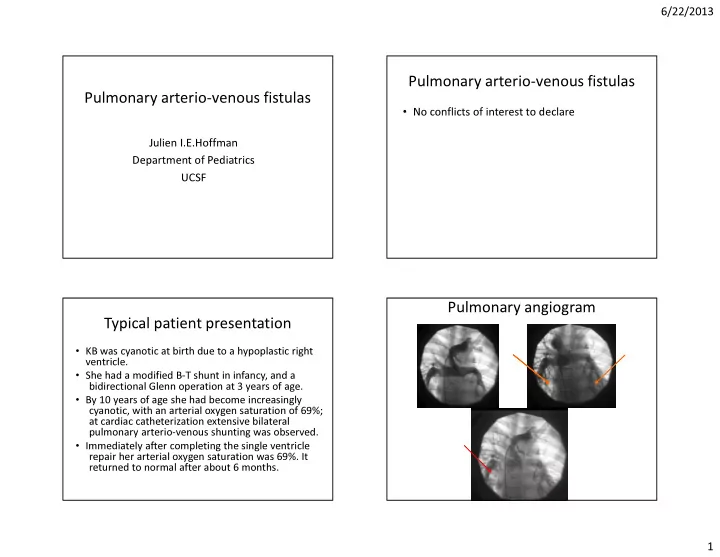
Typical patient presentation

  • KB was cyanotic at birth due to a hypoplastic right

ventricle.

  • She had a modified B-T shunt in infancy, and a

bidirectional Glenn operation at 3 years of age.

  • By 10 years of age she had become increasingly

cyanotic, with an arterial oxygen saturation of 69%; at cardiac catheterization extensive bilateral pulmonary arterio-venous shunting was observed.

  • Immediately after completing the single ventricle

repair her arterial oxygen saturation was 69%. It returned to normal after about 6 months.

Pulmonary angiogram

slide-2
SLIDE 2

6/22/2013 2

Injection of agitated saline into LPA

Before After

Detecting anatomic intra-pulmonary shunts

  • 1. IV/PA injection of radio-labeled macro-aggregated

albumin (99mTCMAAA). Very sensitive, but results vary with particle

  • size. Quantifiable.
  • 2. Contrast echocardiography. Sensitive, cannot quantify exactly
  • 3. Pulmonary angiography:

Blush due to increased number of tiny vessels May show details of fistulae. Much less sensitive than first two methods

  • 4. Measure AaD while breathing 100% oxygen

Normal venous admixture

  • Contrast echocardiography

– Usually none at rest, may appear with exercise

  • Respiratory gas techniques

– Shunt of 3-5% of cardiac output with heavy exercise

  • Radiolabeled microspheres

– <6% of cardiac output Diseases with abnormal venous admixture

  • After Glenn, Kawashima, or Fontan operations

– More with Kawashima, but may be absent

  • Rarely in congenital cardiovascular diseases without surgery
  • Isolated pulmonary arterio-venous fistulas, especially with

hereditary hemorrhagic telangiectasia (Osler-Weber-Rendu syndrome)

  • Liver disease (hepato-pulmonary syndrome)
  • Are there any common factors?
slide-3
SLIDE 3

6/22/2013 3

Post-surgical pulmonary arterio-venous fistulas

  • Occur in >50% of subjects after Glenn or Kawashima operations
  • Incidence increases with time
  • In original Glenn, fistulas only on side of operation
  • In bidirectional Glenn or Kwashima operations fistulas are bilateral
  • Fistulas usually disappear after completing the

Fontan operation

Possible mechanisms

  • Decrease or absence of inferior vena caval return to

lungs, depending on lesion and operation

  • Decreased pulsatility-unlikely because fistulas usually

disappear after completing the Fontan

  • In Kawashima operation only hepatic venous return

does not go directly to the lungs.Therefore likely that exclusion of hepatic venous drainage is responsible

CHD without surgery

  • 1. Pulmonary arterio-venous fistulas rare

in CHD

  • 2. Occasionally with left atrial isomerism
  • 3. Isolated drainage of IVC or hepatic

veins to left atrium

Hepatic factors in pulmonary arterio- venous fistulas

  • Pulmonary arterio-venous fistulas are often

associated with failure of hepatic vein blood to perfuse lungs in first circulation

  • These fistulas usually disappear when hepatic

venous blood is re-routed to lung, including Fontan patient with hepatic blood flow directed almost exclusively to one lung

  • Suggests a deficiency of a short-lived anti- angiogenic

factor or an excess of a short-lived angiogenic factor

slide-4
SLIDE 4

6/22/2013 4

Putative hepatic factor

Isolated pulmonary arterio-venous fistulas

  • Uncommon to present in childhood
  • Sometimes plexiform lesions
  • Sometimes large aneurysms
  • Usually associated with Hereditary

Hemorrhagic Telangiectasia (HHT)

Importance of HHT

Natural equilibria in body:

  • 1. Many cells and molecules undergo replacement after

characteristic times -120 days for red blood cells, 5 days for myosin. Control systems regulate the balance between formation and destruction

  • 2. Equilibrium may be static until disturbed

e.g blood pro- and anti-coagulant activity One of these may be true for lung blood vessels, with balanced angiogenesis and anti-angiogenesis related to endoglin and ALK1.

Lessons from HHT

slide-5
SLIDE 5

6/22/2013 5

Hepato-pulmonary syndrome

  • Defined as “an arterial oxygenation defect induced by

intrapulmonary vascular dilatations (IPVD) associated with hepatic disease”

  • Occurs in any liver disease, mainly cirrhosis (in 15-30%)
  • Pathology characterized by hugely dilated capillaries as well as

pulmonary arterio-venous fistulas. Cyanosis due to diffusion defect as well as Va/Q mismatch and fistulas

  • Lung contains CD68(+) macrophages that produce VEGF and PDGF

?

  • Are mechanisms of Glenn and Kawashima

pulmonary arterio-venous fistulas similar to those for hepato- pulmonary syndrome?

  • Is diseased liver producing excess angiogenic factor
  • r decreased anti-angiogenic factor?

Possible factors

  • VEGF and endoglin produced by many cells and tissues
  • VEGF increased in cyanotic heart disease
  • Angiopoietin-1 widely produced by pericytes and

smooth muscle cells, angiopoietin-2 inendothelial cells

  • Angiostatin is produced from plasminogen in the liver,

but half-life is 15 min

  • Endostatin is produced from soluble collagen XVIII

from liver, but has long half-life. Cannot be dismissed because of recent finding that endostatin decreases and collagen XVIII increases after Glenn operation

Angiotensin

slide-6
SLIDE 6

6/22/2013 6

Angiogenesis 1 Angiogenesis 2 Angiogenesis 3 Angiogenesis 4

slide-7
SLIDE 7

6/22/2013 7

Angiogenesis 5-7 Conclusions

  • Hepatic factor affected by first pass circulation in the

lungs

– Excess of antiogenic factor(s) – Deficit of anti-angiogenic factor(s)

  • With multiplicity of factors involved in angiogenesis, it

would not be surprising to find more than one factor involved

  • Whether the involved factor produces pulmonary

arterio-venous fistulas may depend on concentrations

  • f other involved factors

THE END

Venous admixture

  • 1. Produces an Alveolar-arterial gradient (AaD) of oxygen tension
  • 2. Normal AaD 5-15 mm Hg; more in neonates
  • 3. Usually <5% of cardiac output
  • 4. Causes of increased AaD:
  • a. Va/Q mismatch-abolished by breathing 100% oxygen
  • b. Diffusion limitation-does not occur normally
  • c. Lesions excluding air from alveoli-collapse, fluid, cells
  • d. Anatomic connections that by-pass alveoli

Post-alveolar connections Bronchial veins Thebesian veins Pre-alveolar connections-pulmonary arterio-venous fistulas

slide-8
SLIDE 8

6/22/2013 8

Basic diagram of venous admixture Non-functional alveolus Pathology of fistulas

  • Inadequately described
  • Usually irregular thin walled vessels, especially

subpleurally

  • NB. In hepato-pulmonary syndrome

– the pulmonary capillaries are very dilated, unlike

  • ther diseases mentioned here

– There are CD68+ macrophages that release angiogenic factors