Chronic Iliocaval Venous Occlusive Disease David Rigberg, M.D. - - PowerPoint PPT Presentation

chronic iliocaval venous occlusive disease
SMART_READER_LITE
LIVE PREVIEW

Chronic Iliocaval Venous Occlusive Disease David Rigberg, M.D. - - PowerPoint PPT Presentation

none Chronic Iliocaval Venous Occlusive Disease David Rigberg, M.D. Clinical Professor of Surgery Division of Vascular Surgery University of California Los Angeles Chronic Venous Occlusive Disease Chronic Venous Occlusive Disease Venous

slide-1
SLIDE 1

1

Chronic Iliocaval Venous Occlusive Disease

David Rigberg, M.D.

Clinical Professor of Surgery Division of Vascular Surgery University of California Los Angeles

none

Chronic Venous Occlusive Disease

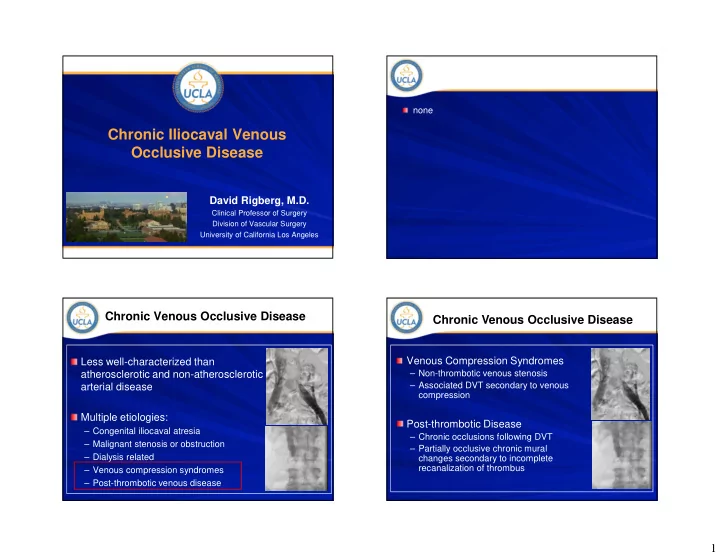
Less well-characterized than atherosclerotic and non-atherosclerotic arterial disease Multiple etiologies:

– Congenital iliocaval atresia – Malignant stenosis or obstruction – Dialysis related – Venous compression syndromes – Post-thrombotic venous disease

Venous Compression Syndromes

– Non-thrombotic venous stenosis – Associated DVT secondary to venous compression

Post-thrombotic Disease

– Chronic occlusions following DVT – Partially occlusive chronic mural changes secondary to incomplete recanalization of thrombus

Chronic Venous Occlusive Disease

slide-2
SLIDE 2

2 Venous Compression Syndromes

  • May-Thurner Syndrome

– Left CIV compression by right CIA – Compression/webs in symptomatic pts (under-recognized)

  • External Iliac compression
  • Compression of right or left EIV by

crossing hypogastric arteries

  • Extrinsic Compression
  • Malignancy
  • Fibroids and benign lesions

Wilengberg T, LINC 2014

Clinical Spectrum

Nuisance Leg Swelling Debilitating edema Skin changes Venous ulceration

Interventional Management of Venous Occlusive Disease

Options for Percutaneous Intervention : Chronic Venous Occlusions / Stenoses

RCIA LCIA LCIV Compression

– Venography with Intravascular Ultrasound – Venous angioplasty and stenting

slide-3
SLIDE 3

3

16 x 90 Wallstent

slide-4
SLIDE 4

4

slide-5
SLIDE 5

5

14 x 40 Atlas Balloon

slide-6
SLIDE 6

6

Post Stent IVUS Immediate, 3, 6, 12 months and annually…

slide-7
SLIDE 7

7

  • Popliteal / femoral + IJ approach
  • Diagnostic venography
  • IVUS in all patients without chronic total occlusions
  • Patients without known DVT
  • Angioplasty and stenting alone
  • Dual antiplatelet Rx
  • Patients with acute DVT
  • CD-thrombolysis / perc mech thrombectomy
  • Angioplasty and stenting of underlying lesions
  • Lovenox/Coumadin and dual antiplatelet Rx

Procedural Details

  • Careful sizing with IVUS
  • Stents
  • Stainless steel stents (IVC, CIV) – Wallstent, Visipro
  • Self-expanding nitinol (EIV, CFV) - Protege
  • Diameters: 14-22mm, IVUS-based sizing
  • Anticoagulation
  • Intraoperative ACT at >250 sec
  • Post-op anti-platelet therapy
  • ASA 325mg, Plavix 75mg
  • Post-op anti-coagulation
  • Lovenox/Coumadin (DVT, hypercoaguable states)

Procedural Details Deep Venous Thrombosis

Incidence : up to 100,000 cases/yr (inpatient samples) < 50% complete clot lysis with anticoagulation alone 30-50% long-term risk of leg swelling and PTS Up to 15% long-term risk of venous ulcers

Deep Vein Thrombosis Late Sequelae

Venous Reflux Venous Occlusions Venous Hypertension

Pain & Venous Claudication Lipodermato- sclerosis Venous ulcers

slide-8
SLIDE 8

8 May-Thurner with DVT May-Thurner with DVT Chronic Iliocaval Occlusion Chronic Iliocaval Occlusion

slide-9
SLIDE 9

9 Results in the Literature

Symptom Relief Swelling Relief Freedom from Ulcer Recurrence 528 Limbs, all with deep system reflux 69% with associated superficial or perforator vein reflux Only treatment was stenting of IVUS-determined iliac lesions 37% non-thrombotic 54% post-thrombotic 9% combined

Results in the Literature

16 studies with 2,373 T and 2,586 NT pts “Quality of evidence is currently weak” “promising and safe” “low risk” Many issues unanswered

Unanswered Questions & Future Directions

  • Stenting across the Inguinal Ligament
  • Evolution of Optimal Stent Design

Surgical Management of Venous Occlusive Disease

slide-10
SLIDE 10

10

HIP STRAIGHT HIP FLEX 90°

Stenting across Inguinal Ligament

HIP STRAIGHT HIP FLEX 90°

Stenting across Inguinal Ligament

Stent fractures and restenosis is not the

same in the CFV as it is in the CFA

Stenting across the inguinal ligament is

less of a concern than leaving untreated stenotic disease

54month Secondary Patency Non-thrombotic pts = 100% Thrombotic pts = 84%

Stenting across Inguinal Ligament Venous Stent Design

  • 12-18mm Diameter
  • 60-150mm length
  • 10Fr
  • Laser-cut Nitinol
  • 14-16mm Diameter
  • 60-140mm length
  • 7Fr
  • Laser-cut Nitinol

Sinus-Venous (Optimed) Zilver Vena (Cook)

slide-11
SLIDE 11

11 Venous Stent Design

  • 12-18mm Diameter
  • 60-150mm length
  • 10Fr
  • Laser-cut Nitinol
  • 14-24mm Diameter
  • 60-120mm length
  • 10Fr
  • Braided stainless steel

Vici Venous (Veniti) Wallstent (Boston Scientific)

Venous Stent Design

Loss of radial force at ends

  • High crush resistance
  • Uniform crush resistence
  • Low Profile
  • Conformability
  • Wide range of diameters
  • Large diameters

Ideal Venous Stent Properties

Conclusions

  • Is a safe and effective treatment modality
  • Is associated with excellent primary and

secondary patency rates

  • Can reduce the life-long symptoms of DVT

and venous occlusive disease, and can contribute to venous ulcer healing

Venous angioplasty and stenting : Conclusions

  • Patients with May-Thurner Syndrome

Leg swelling and venous claudication / DVT Complete resolution of symptoms in most patients

  • Patients with post-thrombotic iliocaval occlusions

History of prior DVT and IVC filter placement Technically challenging, lower success rates Dramatic symptom improvement when successful

slide-12
SLIDE 12

12 Technique and Lessons Learned

  • Use of intravascular ultrasound

Essential for stent sizing and positioning Post-stent assessment for residual stenosis or wall

apposition

  • Aggressive anticoagulation

Glycosaminoglycan (Arixtra) for 4-6 weeks in

Thrombotic MT patients postop (before transition to Coumadin)

Full antiplatelet therapy in Non-thrombotic MT

patients

  • Correct all underlying venous lesions

Extend stent into IVC Extend with nitinol stents into CFV if needed Aggressive lysis to improve inflow (from femoral

vein / PFV)

UCLA Ronald Reagan Medical Center ULCA Division of Vascular Surgery David Geffen School of Medicine at UCLA

Thank You