Disclosures Central and Peripheral Venous Access I have nothing - - PDF document

disclosures
SMART_READER_LITE
LIVE PREVIEW

Disclosures Central and Peripheral Venous Access I have nothing - - PDF document

3/22/2016 Disclosures Central and Peripheral Venous Access I have nothing to disclose Gavin Budhram, MD Department of Emergency Medicine Baystate Medical Center Central Venous Access Central Venous Access Why Use Internal Jugular


slide-1
SLIDE 1

3/22/2016 1

Central and Peripheral Venous Access

Gavin Budhram, MD Department of Emergency Medicine Baystate Medical Center

Disclosures

  • I have nothing to disclose

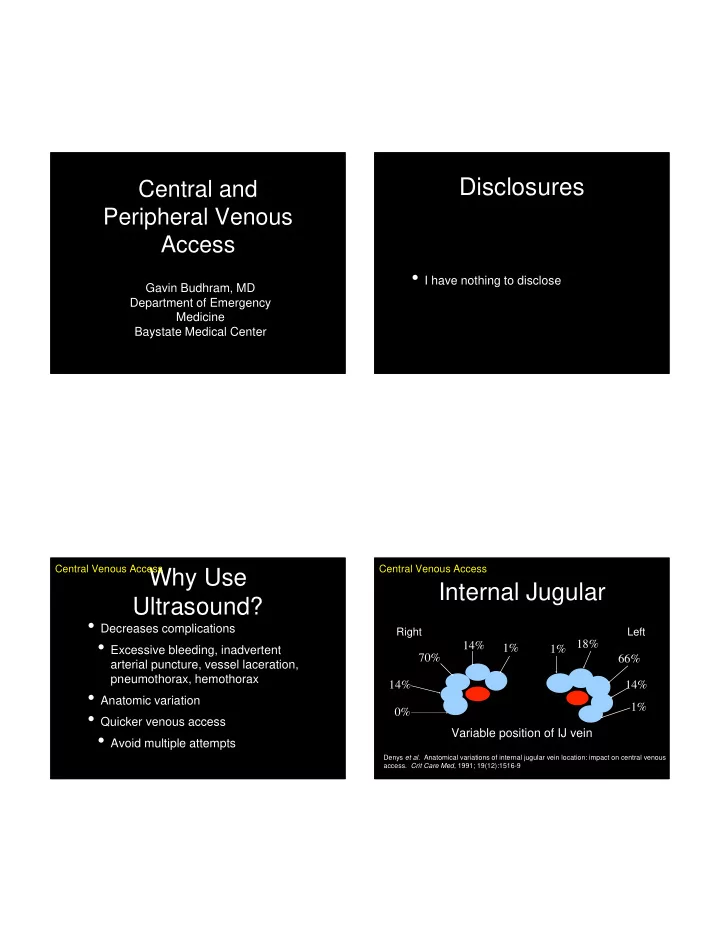
Why Use Ultrasound?

  • Decreases complications
  • Excessive bleeding, inadvertent

arterial puncture, vessel laceration, pneumothorax, hemothorax

  • Anatomic variation
  • Quicker venous access
  • Avoid multiple attempts

Central Venous Access Right Left

1% 1% 14% 18% 70% 66% 14% 0% 14% 1% Variable position of IJ vein

Denys et al. Anatomical variations of internal jugular vein location: impact on central venous

  • access. Crit Care Med, 1991; 19(12):1516-9

Internal Jugular

Central Venous Access

slide-2
SLIDE 2

3/22/2016 2

  • 982 US

guided

  • 302 landmark

based

US Landmark Success 100% 88.1% First Attempt 78% 38% Skin to vein 10 secs 44 secs Carotid puncture 1.7% 8.3%

Why Use Ultrasound?

Denys et al. Ultrasound-assisted cannulation of the internal jugular vein. A prospective comparison to the external landmark-guided technique. Circulation, 1993; 87(5):1557-62.

Central Venous Access

Technical Considerations

Vascular Probe

  • Linear array probe
  • high frequency (4-10 MHz)
  • very detailed images of superficial

structures

Technical Considerations

Two-Operator Technique

  • One person holds the ultrasound probe
  • Other person places cannulates vessel
  • Allows use of both hands for manipulating syringe
  • Often preferred when first learning technique

Technical Considerations

slide-3
SLIDE 3

3/22/2016 3

One-Operator Technique

  • Single operator

controls probe and needle

  • Allows greater

precision

  • Often preferred by

advanced practitioners Technical Considerations

Approach

  • Static approach
  • Ultrasound used to confirm anatomy

and mark position of vessel

  • Dynamic approach
  • Operator actually watches the needle

enter the vessel in real-time

Technical Considerations

Infection Precautions

  • Central Venous Access
  • Utilize sterile procedures
  • Sterile gloves and probe covers
  • Peripheral Venous Access
  • Clean skin and transducer
  • Similar to standard IV placement

Technical Considerations

  • Many commercially

available probe covers

  • Standard gel (inside)
  • Avoid air bubbles
  • Sterile gel (outside)

Sterile Probe Covers

Technical Considerations

slide-4
SLIDE 4

3/22/2016 4

Central Venous Access Artery vs Vein

  • Shape
  • Compression
  • Color Flow

Central Venous Access

Artery vs Vein

  • Shape
  • arteries: circular
  • veins: angular
  • Compression

Central Venous Access

Artery vs Vein

  • Color Flow

Central Venous Access

slide-5
SLIDE 5

3/22/2016 5

Artery vs Vein

  • Color Flow

veins may be pulsatile red vs blue

Central Venous Access

Transverse Approach

A V place the probe so that the vein is in the middle

  • f the screen

Central Venous Access

Transverse Approach

The needle is aimed for the middle of the probe

Central Venous Access

Transverse Approach

  • needle not directly

seen

  • localized by

artifacts:

  • shadowing
  • reverberation

Central Venous Access

slide-6
SLIDE 6

3/22/2016 6

Transverse Approach

Central Venous Access

Transverse Approach

Risk of Overshoot: Needle still appears to be in vessel

Central Venous Access

Longitudinal Approach

Central Venous Access

Longitudinal Approach

Central Venous Access

slide-7
SLIDE 7

3/22/2016 7

Transverse vs Longitudinal

Transverse

  • Easier to learn
  • See other

anatomy

  • Risk overshoot
  • ‘Ring-down’

artifact Longitudinal

  • Safer (no
  • vershoot)
  • Depth and slope
  • Harder to learn

Central Venous Access

Anatomic Sites

  • Central
  • Internal jugular
  • Femoral
  • Subclavian (distal) - Advanced
  • Supraclavicular (IJ/SC confluence) - Advanced

Central Venous Access

Internal Jugular

internal jugular vein common carotid artery subclavian vein external jugular vein Central Venous Access

Internal Jugular

Transverse Approach

Central Venous Access

slide-8
SLIDE 8

3/22/2016 8

internal jugular carotid

Internal Jugular

Longitudinal Approach

Central Venous Access

Internal Jugular

Longitudinal Approach

Central Venous Access

Femoral

common femoral artery superficial femoral artery deep femoral artery common femoral vein saphenous vein superficial femoral vein deep femoral vein (not pictured)

Central Venous Access

Femoral

  • In a study of femoral anatomy in 50 adult

patients:

  • At 4cm from the inguinal ligament:
  • all subjects have at least 50% overlap of

femoral artery over vein

  • 50% of patients had COMPLETE overlap

Hughes P et al. Ultrasonography of the femoral vessels in the groin: implications for vascular access. Anaesthesia 2000, Dec; 55(12): 1198-202.

Central Venous Access

slide-9
SLIDE 9

3/22/2016 9

Femoral

compression used to differentiate arteries and veins color may be used but is not always reliable Central Venous Access

Subclavian

Transverse Orientation

Central Venous Access

Subclavian

Longitudinal Orientation

Central Venous Access

Subclavian

Transverse Orientation

Central Venous Access

slide-10
SLIDE 10

3/22/2016 10

Supraclavicular

Central Venous Access

Supraclavicular

confluence of IJ and subclavian

Central Venous Access

Peripheral Venous Access

  • Difficult IV access
  • Dialysis patients, IV drug users,
  • besity
  • Central access not needed
  • Avoid multiple attempts
  • Increase patient satisfaction

Why Use Ultrasound?

Peripheral Venous Access

slide-11
SLIDE 11

3/22/2016 11

Preparation

  • Similar to standard preparation for IV

access

  • Clean skin and transducer
  • Have all materials readily accessible
  • Placement of ultrasound machine
  • Get comfortable!

Peripheral Venous Access

Catheter Length

  • In general, longer

catheters are needed for ultrasound-guided IV’s

  • Deeper vessels

usually cannulated

standard 1 1/4” (32mm) 1 3/4” (45mm) 2 1/2” (64mm)

Peripheral Venous Access

Catheter Length

  • Standard catheters

are 1 inch (32mm).

  • To cannulate a vein

7mm deep at a 45 degree angle “uses up” 10mm 7mm 10mm

Peripheral Venous Access

Catheter Length

  • However at the

shallower angle needed (22 degrees), 16mm are “used up” to reach the vein

  • Only leaves 1/2 inch in

the vein

  • ED should stock 1.5-2

inch catheters

  • sto

7mm 16mm

Peripheral Venous Access

slide-12
SLIDE 12

3/22/2016 12

Anatomy

Superficial Upper Arm Veins

cephalic vein antecubital vein basilic vein

  • Cephalic vein runs

along anterior aspect of upper arm

  • Basilic vein runs

along superficial medial aspect of upper arm Peripheral Venous Access

Anatomy

cephalic vein basilic vein brachial veins

  • Brachial veins are

deeper along medial aspect of upper arm

  • Usually require a

longer catheter

  • Closer to radial

artery and nerve Peripheral Venous Access

Anatomy

humerus basilic vein radial artery brachial veins

Peripheral Venous Access

Artery vs Vein

  • Compression
  • Both arteries and

veins may be compressible

  • Arteries will

usually still be pulsatile

Peripheral Venous Access

slide-13
SLIDE 13

3/22/2016 13

Artery vs Vein

  • Color Flow

arteries usually more pulsatile

Peripheral Venous Access

Vein Selection

  • Optimal vein:
  • Less than 1 cm deep
  • At least 3cm long
  • relatively straight
  • At least 3mm wide

Peripheral Venous Access

Vein Selection

Optimal Vein

Peripheral Venous Access

Vein Selection

Vein should be relatively straight

Peripheral Venous Access

slide-14
SLIDE 14

3/22/2016 14

Transverse Approach

  • Needle not usually seen

directly

  • Location inferred by

artifact and movement

  • f surrounding tissues

Peripheral Venous Access

Transverse Approach

“Bouncing” technique to localize needle

Peripheral Venous Access

Longitudinal Approach

  • Needle slope and tip may

be seen

  • More technically

challenging Peripheral Venous Access

Longitudinal Approach

Consider using Seldinger technique for deeper veins

Peripheral Venous Access

slide-15
SLIDE 15

3/22/2016 15

Pearls and Pitfalls Setup is Crucial

  • Prepare all material before starting
  • Sterile covers, flushes, syringes, etc
  • Adjust ultrasound machine to a

comfortable position

  • Extra catheters available
  • Position marker/monitor correctly

Pearls and Pitfalls

Compression

Compression is the most reliable way to differentiate arteries and veins

Pearls and Pitfalls

Valsalva & Trendelenberg

Both maneuvers will significantly increase the size of internal jugular vein

Pearls and Pitfalls

slide-16
SLIDE 16

3/22/2016 16

Locate the Needle

Bouncing Technique

Pearls and Pitfalls

Angle of Approach

Posterior Wall Puncture Steep angle of approach makes posterior wall puncture more likely

Pearls and Pitfalls

Angle of Approach

Catheter kinks in vein Steep angle of approach makes kinking

  • f catheter more likely

Pearls and Pitfalls

Once flash is obtained, advance needle to make sure catheter is in vein

Thread the Catheter

Pearls and Pitfalls

slide-17
SLIDE 17

3/22/2016 17

Thread the Catheter

Visually check that catheter is inside vein before advancing

Pearls and Pitfalls

Confirm Placement

Agitated saline “Bubble” Test

Pearls and Pitfalls

Quick Punch

67

A quick jabbing motion may be needed to pierce wall of the vein

Pearls and Pitfalls

Echotip Needle

Commercially made “echotip” needles are available and may aid visualization

Pearls and Pitfalls

slide-18
SLIDE 18

3/22/2016 18

“Guidewire will not thread” Needle no longer in vessel

Troubleshooting

Pearls and Pitfalls

70

Trouble-shooting

“IV has stopped working” Clot has developed inside vein

Pearls and Pitfalls

Trouble-shooting

“IV has stopped working” Clot has developed inside vein

IV in basilic vein Saline flow through brachials

Pearls and Pitfalls

Final Thoughts

  • Ultrasound is safer, quicker
  • Practice on stable patients
  • Begin with transverse approach
  • Peripheral lines are hard to master, but

USEFUL!

Summary

slide-19
SLIDE 19

3/22/2016 19

Gavin Budhram, MD Director of Emergency Ultrasound Baystate Medical Center Springfield, MA