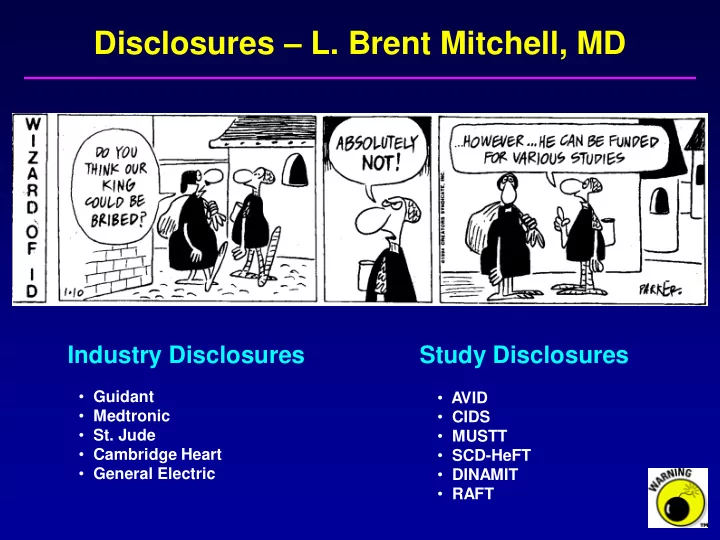
SLIDE 1 Disclosures – L. Brent Mitchell, MD
Industry Disclosures Study Disclosures
- Guidant
- Medtronic
- St. Jude
- Cambridge Heart
- General Electric
- AVID
- CIDS
- MUSTT
- SCD-HeFT
- DINAMIT
- RAFT
SLIDE 2
No ICD ICD No CRT
medical treatment ICD
CRT
CRT pacemaker CRT defibrillator
ICDs and CRTs for Dummies
Available Platforms
SLIDE 3
No ICD ICD No CRT
medical treatment ICD
CRT
CRT pacemaker CRT defibrillator
ICDs and CRTs for Dummies
Available Platforms
SLIDE 4 Mirowski M et al. N Engl J Med 303:322-4, 1980
The Implantable Defibrillator – Michel Mirowski (1980)
ICDs and CRTs for Dummies
SLIDE 5
ICDs and CRTs for Dummies
SLIDE 6
FILTER Potential ICD Patients Higher SCD Risk Lower SCD Risk
ICDs and CRTs for Dummies
Risk Stratification for ICD
SLIDE 7 Modified from Myerburg et al Ann Intern Med 119:1187-1197, 1993
10 20 30 40
Overall ASHD risk Factors Manifest ASHD EF <0.35 VT/VF survivor
Events/year (%) 100 200 300 Events/year (thousands)
ICDs and CRTs for Dummies
Sudden Cardiac Death
SLIDE 8 In meta-analysis of secondary prevention trials of ICD therapy versus medical therapy in patients with prior life-threatening ventricular tachyarrhythmias, use of the ICD is associated with a reduction in all-cause mortality of: 1. 10%
Touch Pad Question 1
ICDs and CRTs for Dummies
SLIDE 9 ICDs and CRTs for Dummies
0.5 1 1.5 2 RELATIVE RISK
STUDY N RR
AVID 1016 0.62 (0.47-0.81) CIDS 659 0.82 (0.61-1.10) CASH 191 0.83 (0.52-1.33) OVERALL 1866 0.73 (0.59-0.89)
Connolly et al: Eur Heart J 21:2071, 2000
All-Cause Mortality – ICD versus Amio
SLIDE 10 10 20 30 40 50 60 1 2 3 4 5 Years % Mortality
Amio ICD
LVEF > 35% 10 20 30 40 50 60 1 2 3 4 5 Years % Mortality LVEF 35%
Amio ICD
Secondary Prevention ICDs – Effect of LVEF
Connolly et al. Eur Heart J 21:2071-78, 2000
ICDs and CRTs for Dummies
SLIDE 11 Modified from Myerburg et al Ann Intern Med 119:1187-1197, 1993
10 20 30 40
Overall ASHD risk Factors Manifest ASHD EF <0.35 VT/VF survivor
Events/year (%) 100 200 300 Events/year (thousands)
ICDs and CRTs for Dummies
Sudden Cardiac Death
SLIDE 12 All-Cause Mortality - ICD versus Control
Nanthakumar et al. J Am Coll Cardiol 44:2166-72, 2004
STUDY N RR
MADIT 196 0.41 (0.26 – 0.69) CABG –PATCH 900 1.08 (0.84 – 1.39) MUSTT 514 0.46 (0.34 – 0.62) CAT* 104 2.16 (0.46 – 10.22) MADIT – II 1232 0.71 (0.55 – 0.92) AMIOVIRT 103 0.92 (0.51 – 1.66) COMPANION 903 0.57 (0.40 – 0.81) DEFINITE 458 0.65 (0.40 – 1.09) DINAMIT 674 1.08 (0.76 – 1.55) SCD-HeFT 1676 0.77 (0.62 – 0.96) All Trials 7253 0.76 (0.63 – 0.91)
0.4 0.2 0.6 0.8 1.0 1.4 1.2 1.6
RELATIVE RISK
heterogeneity p = 0.0005
ICDs and CRTs for Dummies
SLIDE 13 No ICD ICD No CRT
medical treatment ICD
CRT
CRT pacemaker CRT defibrillator
ICDs and CRTs for Dummies
Available Platforms
10 Trials 0.76 (0.63-0.91)
SLIDE 14
ICDs and CRTs for Dummies
Who Should Receive an ICD?
Patients at a annual risk of sudden death that exceeds the hazard of having an ICD Provided that the patient agrees with the goal of preventing sudden death Preferably in a scenario where use of the ICD has been proven effective in an RCT
SLIDE 15
No ICD ICD No CRT
medical treatment ICD
CRT
CRT pacemaker CRT defibrillator
ICDs and CRTs for Dummies
Available Platforms
SLIDE 16 Cardiac Dyssynchrony
Effects of Abnormal Activation Sequences
- atrioventricular asynchrony
- negative LA - LV: LA contraction against closed MV
- long LA - LV: late diastolic MR decreases LV filling time
- interventricular asynchrony
- decreased LV filling time
- septum recruited to RV ejection
- intraventricular asynchrony
- some LV contraction before aortic valve opening
- some LV contraction after aortic valve closure
- wasted work stretching noncontracting regions
- uncoordinated papillary muscles leads to MR
- decreased diastolic LV filling time
- intramural asynchrony
- contraction is non-transmural
SLIDE 17 STUDY N RR
MUSTIC SR 58 3.00 (0.13 – 70.7) MUSTIC AF 43 2.19 (0.09 – 50.9) MIRACLE 453 0.74 (0.36 – 1.53) COMPANION 925 0.85 (0.66 – 1.09) CARE HF 813 0.67 (0.53 – 0.86) All Trials 2292 0.76 (0.64 – 0.90)
RAFT Investigators
0.4 0.2 0.6 0.8 1.0 1.4 1.2 1.6
RELATIVE RISK
All-Cause Mortality – CRT vs Control Class III/IV Pts
ICDs and CRTs for Dummies
SLIDE 18 No ICD ICD No CRT
medical treatment ICD
CRT
CRT pacemaker CRT defibrillator
ICDs and CRTs for Dummies
Available Platforms
5 Trials 0.76 (0.64-0.90)
SLIDE 19 ICDs and CRTs for Dummies
Who Should Receive CRT?
Patients with symptomatic CHF, low LVEF and evidence of contractile dys-synchrony Unfortunately, at present, CRT response
- ccurs in only 2/3 treated patients
CRT is often associated with reversal of adverse LV remodelling (importance?)
SLIDE 20
No ICD ICD No CRT
medical treatment ICD
CRT
CRT pacemaker CRT defibrillator
ICDs and CRTs for Dummies
Available Platforms
SLIDE 21 0.5 1 1.5 2 HAZARD RATIO
STUDY N HR
COMPANION 903 0.64 (0.48-0.86)
Bristow MR et al: N Engl J Med 350:2140-50, 2004
ICDs and CRTs for Dummies
All-Cause Mortality – CRT-D versus Med Rx
SLIDE 22
No ICD ICD No CRT
medical treatment ICD
CRT
CRT pacemaker CRT defibrillator
ICDs and CRTs for Dummies
Available Platforms
SLIDE 23 STUDY N RR MIRACLE ICD II 186 1.19 (0.17-8.26) CONTAK CD 490 0.69 (0.33-1.45) MIRACLE ICD 474 0.66 (0.39-1.11) All Trials 1150 0.69 (0.45-1.04)
RAFT Investigators
0.5 1 1.5 2 RELATIVE RISK
ICDs and CRTs for Dummies
All-Cause Mortality – CRT versus CRT-D
SLIDE 24 No ICD ICD No CRT
medical treatment ICD
CRT
CRT pacemaker CRT defibrillator
ICDs and CRTs for Dummies
Available Platforms
3 Trials 0.69 (0.45-1.04)
SLIDE 25 No ICD ICD No CRT
medical treatment ICD
CRT
CRT pacemaker CRT defibrillator
ICDs and CRTs for Dummies
Available Platforms
10 Trials 0.76 (0.63-0.91) 5 Trials 0.76 (0.64-0.90) 3 Trials 0.69 (0.45-1.04)
SLIDE 26
No ICD ICD No CRT
medical treatment ICD
CRT
CRT pacemaker CRT defibrillator
ICDs and CRTs for Dummies
Available Platforms
?
SLIDE 27 Multicentre Automatic Defibrillator Implantation Trial – Cardiac Resynchronization Therapy (MADIT - CRT)
COMPARISON: composite of all-cause mortality and HF events comparing ICD with CRT versus ICD only on background of optimal medical Rx PATIENTS: ischemic (NYHA Class I or II) CCM or nonischemic (NYHA Class II) CCM LVEF ≤ 0.30, QRSd ≥ 0.13 sec in sinus rhythm for whom ICD is planned DESIGN: double-blind, randomized, parallel-group clinical trial target 1820 patients, 3:2 randomization designed as sequential monitoring trial
Moss AJ et al. N Engl J Med 361:xxx-xxx, 2009
SLIDE 28 Primary outcome – CHF event / all-cause mortality
10 20 40 30 Cumulative Incidence 1 2 3 4 Years of Follow-up ICD CRT-ICD
HR = 0.75 (95% CI: 0.62 – 0.91) p = 0.003
Multicentre Automatic Defibrillator Implantation Trial – Cardiac Resynchronization Therapy (MADIT - CRT)
Moss AJ et al. N Engl J Med 361:1329-38, 2009
SLIDE 29 COMPARISON: composite of total mortality / CHF hospitalization comparing pts receiving a CRT ICD to those receiving an ICD alone PATIENTS: planned 1800 pts with Class II / III CHF (only Class II after Feb 2006) with an indication for an ICD and LVEF ≤ 0.30 and QRSd ≥ 0.12 (≥ 0.20 if paced) on
DESIGN: “double-blind”, parallel-group RCT (1:1) 85% power for 25% RRR from 11% control rate
Resynchronization in Ambulatory Heart Failure (RAFT)
Tang AS et al. N Engl J Med 363:2385-95, 2010
SLIDE 30 Resynchronization in Ambulatory Heart Failure (RAFT)
Tang AS et al. N Engl J Med 363:2385-95, 2010
Primary outcome – CHF hospitalization / mortality
10 20 40 50 30 Cumulative Incidence 1 2 3 4 6 Years of Follow-up 5 60 ICD CRT-ICD
HR = 0.75 (95% CI: 0.64 – 0.87) p < 0.001
SLIDE 31 Resynchronization in Ambulatory Heart Failure (RAFT)
Tang AS et al. N Engl J Med 363:2385-95, 2010
Secondary outcome – all-cause mortality
10 20 40 50 30 Cumulative Incidence 1 2 3 4 6 Years of Follow-up 5 ICD CRT-ICD
HR = 0.75 (95% CI: 0.62 – 0.91) p = 0.003
SLIDE 32 Resynchronization in Ambulatory Heart Failure (RAFT)
Subgroup Analysis
permanent AF / AFL sinus / atrial paced QRSd < 150 ms QRSd ≥ 150 ms QRSd paced ≥ 200 ms LBBB RBBB IVCD PACED LVEF < 0.20 LVEF ≥ 0.20
CRT – ICD better ICD better 0.4 0.2 0.6 0.8 1.0 1.4 1.2 1.6 1.8 2.0
HR
Tang ASL et al. N Engl J Med 363:2385-95, 2010
p = 0.14 p = 0.003 p = 0.046 p = 0.05
SLIDE 33 ICDs and CRTs for Dummies
Who Should Receive CRT - Defibrillator?
Patients with symptomatic CHF, low LVEF and evidence of contractile dys-synchrony that have an annual risk of sudden death that exceeds the hazard of having an ICD Provided that the patient agrees with the goal of preventing sudden death and understands that symptom improvement
- ccurs in only 2/3 treated patients
Preferably in a scenario where use of CRT- ICD has been proven effective in an RCT
SLIDE 34 ICDs and CRTs for Dummies
With Or Without an Atrial Lead?
In the absence of a current or anticipated indication for brady pacing, ICD only pts are best treated with a VVI - ICD AV resynchronization is an important part
- f cardiac resynchronization; CRT only
pts are best treated with atrio-biV CRT Similarily, CRT-D pts are best treated with an atrio-biVentricular device
SLIDE 35
“In conclusion, this patient is being discharged from the hospital after presenting with a severe idiopathic dilated cardiomyopathy, congestive heart failure, and an LVEF of 0.22. While in hospital he was seen by EP (Dr. Mitchell) who declined to provide the patient with an CRT defibrillator. Instead, he wants the patient to be reassessed in three months time. I hope he does not die of in the interim.”
ICDs and CRTs for Dummies
When?
SLIDE 36
SLIDE 37 Secondary Prevention - Class I Indications
1. Cardiac arrest due to VF or VT not due to a transient or reversible cause. (Level of Evidence: A) 2. Spontaneous sustained VT in association with structural heart disease. whether hemodynamically stable or unstable (Level of Evidence: B) 3. Syncope of undetermined origin with clinically relevant, hemodynamically significant sustained VT or VF induced at EPS (Level of Evidence: B)
ICD Implantation ACC/AHA/HRS (2008)
Secondary Prevention - Class IIa Indications
1. Syncope of undetermined origin in pts with significant LV dysfunction and nonischemic dilated cardiomyopathy (Level of Evidence: C) 2. Sustained VT in pts with normal or near-normal LV function (Level of Evidence: C)
SLIDE 38 Primary Prevention - Class I Indications
1. LVEF ≤ 0.35 due to prior MI who are at least 40 days post-MI and are in NYHA Class II or III. (Level of Evidence: A) 2. LVEF ≤ 0.30 due to prior MI who are at least 40 days post-MI and are in NYHA Class I. (Level of Evidence: A) 3. LVEF ≤ 0.40 due to prior MI with nonsustained VT and with inducible VF or sustained VT at electrophysiologic study. (Level of Evidence B) 4. LVEF ≤ 0.35 due to nonischemic dilated cardiomyopathy who are in NYHA Class II or III. (Level of Evidence: B)
ICD Implantation ACC/AHA/HRS (2008)
Primary Prevention - Class IIa Indications
1. Non-hospitalized patients awaiting cardiac transplantation (Level of Evidence: C) 2. Uncommon cardiac conditions with risk factors for sudden cardiac death. (Level of Evidence: B or C)
SLIDE 39 Secondary Prevention - Class III Indications
1. Notwithstanding indications an ICD is not indicated for patients with no reasonable expectation of survival with acceptable function for one year. (Level of Evidence: C) 2. Pts with incessant VT / VF. (Level of Evidence: C) 3. Pts with significant psychiatric illnesses that may be aggravated by an ICD
- r that may preclude device follow-up. (Level of Evidence: C)
4. Pts with Class IV CHF symptoms who are not candidates for cardiac transplantation or CRT-D. (Level of evidence C)
ICD Implantation ACC/AHA/HRS (2008)
SLIDE 40 Class I Indications
1. Cardiac arrest due to VF or VT not due to a transient or reversible cause. (Level of Evidence: A) 2. Spontaneous sustained VT in association with structural heart disease. (Level of Evidence: B) 3. Syncope of undetermined origin with clinically relevant, hemodynamically significant sustained VT or VF induced at EPS when drug therapy is ineffective, not tolerated, or not preferred. (Level of Evidence: B) 4. Spontaneous sustained VT in patients who do not have structural heart disease that is not amenable to other treatments. (Level of Evidence: B) 5. Patients with ischemic heart disease ± mild to moderate CHF symptoms and LVEF ≤ 0.30, measured at least one month post-MI and 3 months post
- revascularization. (Level of Evidence: A)
ICD Implantation CCS Consensus (2004)
SLIDE 41 Class IIa Indications
1. Patients with ischemic heart disease and LVEF 0.31 – 0.35 measured at least
- ne month post-MI and three months post-revascularization with inducible
VF / sustained VT at EPS (Level of Evidence: B) 2. Patients with non-ischemic cardiomyopathy ≥ 9 months, LVEF ≤ 0.30, and NYHA Class II-III CHF. (Level of Evidence: B) 3. Patients with familial or inherited conditions such as but not limited to long QT syndrome, hypertrophic cardiomyopathy, Brugada syndrome, or ARVD, and at high risk for life-threatening tachyarrhythmias. (Level of Evidence B)
ICD Implantation CCS Consensus (2004)
SLIDE 42 Class IIb Indications
1. Patients with ischemic heart disease, prior MI, LVEF 0.31 – 0.35 with either no inducible VF / sust VT at EPS, or without an EPS. (Level of Evidence C) 2. Patients with non-ischemic cardiomyopathy ≥ nine months, LVEF 0.31 – 0.35 and NYHA Class II-III CHF. (Level of Evidence C) 3. Severe symptoms (e.g. syncope) attributable to sustained VT/VF while awaiting cardiac transplantation. (Level of evidence C)
ICD Implantation CCS Consensus (2004)
SLIDE 43 Class III Indications
1. Syncope of undetermined cause in a patient without structural heart
- disease. (Level of Evidence: C)
2. Incessant VT / VF (Level of Evidence: C) 3. VT / VF due to a transient or reversible disorder (e.g. AMI, electrolyte imbalance, trauma) or VT amenable to surgical catheter ablation (e.g. RV
- utflow tract VT, idiopathic LV VT) (Level of Evidence: C)
ICD Implantation CCS Consensus (2004)