Urinary Tract Infections in Women No current disclosures No past - - PDF document

urinary tract infections in women
SMART_READER_LITE
LIVE PREVIEW

Urinary Tract Infections in Women No current disclosures No past - - PDF document

Faculty Disclosure Urinary Tract Infections in Women No current disclosures No past disclosures relevant to UTIs Deborah R. Erickson, M.D. Professor of Urology In the past I consulted for 2 companies University of Kentucky College


slide-1
SLIDE 1

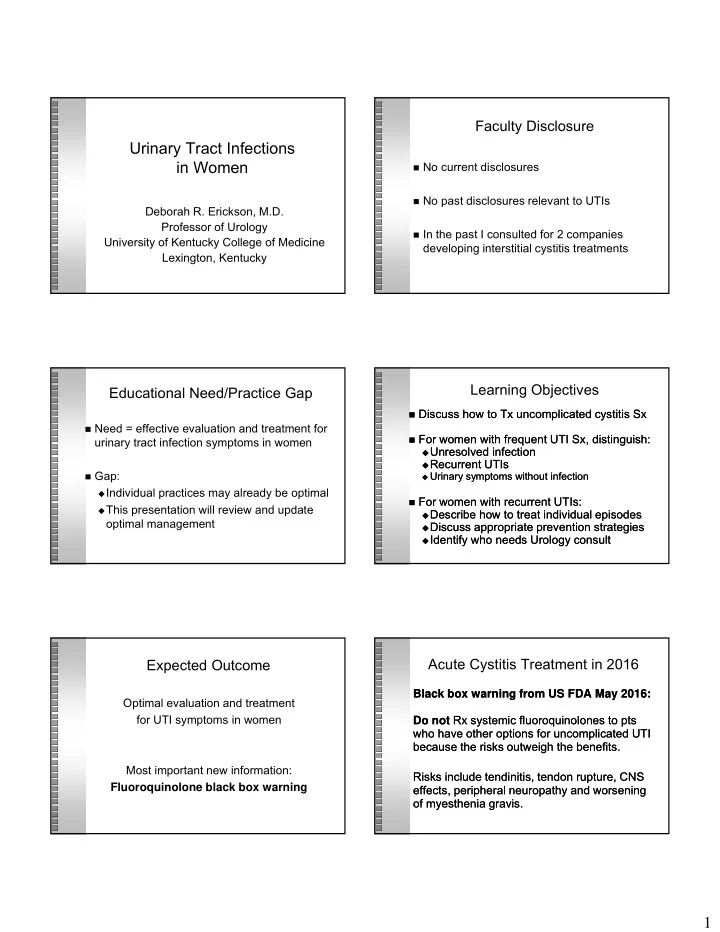
1 Urinary Tract Infections in Women

Deborah R. Erickson, M.D. Professor of Urology University of Kentucky College of Medicine Lexington, Kentucky

Faculty Disclosure

 No current disclosures  No past disclosures relevant to UTIs  In the past I consulted for 2 companies

developing interstitial cystitis treatments

Educational Need/Practice Gap

 Need = effective evaluation and treatment for

urinary tract infection symptoms in women

 Gap:

Individual practices may already be optimal This presentation will review and update

  • ptimal management

Learning Objectives

 Discuss how to Tx uncomplicated cystitis Sx  For women with frequent UTI Sx, distinguish:

Unresolved infection Recurrent UTIs

 Urinary symptoms without infection

 For women with recurrent UTIs:

Describe how to treat individual episodes Discuss appropriate prevention strategies Identify who needs Urology consult

 Discuss how to Tx uncomplicated cystitis Sx  For women with frequent UTI Sx, distinguish:

Unresolved infection Recurrent UTIs

 Urinary symptoms without infection

 For women with recurrent UTIs:

Describe how to treat individual episodes Discuss appropriate prevention strategies Identify who needs Urology consult

Expected Outcome

Optimal evaluation and treatment for UTI symptoms in women Most important new information: Fluoroquinolone black box warning

Acute Cystitis Treatment in 2016

Black box warning from US FDA May 2016: Do not Rx systemic fluoroquinolones to pts who have other options for uncomplicated UTI because the risks outweigh the benefits. Risks include tendinitis, tendon rupture, CNS effects, peripheral neuropathy and worsening

  • f myesthenia gravis.

Black box warning from US FDA May 2016: Do not Rx systemic fluoroquinolones to pts who have other options for uncomplicated UTI because the risks outweigh the benefits. Risks include tendinitis, tendon rupture, CNS effects, peripheral neuropathy and worsening

  • f myesthenia gravis.
slide-2
SLIDE 2

2

A 26 y/o healthy woman calls with acute dysuria. She has no fevers, back pain or vaginal discharge. She has an IUD in place. Before receiving Abx she needs:

  • A. Pelvic exam, UA dip

& micro, urine culture

  • B. UA dip & micro, urine

culture

  • C. UA dip & micro
  • D. UA dip only
  • E. Telephone evaluation

is sufficient

Uncomplicated Cystitis Sx in Women: Empiric Treatment

Phone protocols in primary care

Recent review: Grigoryan L, JAMA 2014 Also Shepherd AK, Med Clin N Am 2013

Compared with Tx based on self-Dx,

waiting for UA or culture is not preferred

Can ↑ cost Can ↑ # of symptomatic days Arnold JJ, Am Fam Physician 2016

Phone protocols in primary care

Recent review: Grigoryan L, JAMA 2014 Also Shepherd AK, Med Clin N Am 2013

Compared with Tx based on self-Dx,

waiting for UA or culture is not preferred

Can ↑ cost Can ↑ # of symptomatic days Arnold JJ, Am Fam Physician 2016

Antibiotic Choices in USA IDSA Guidelines Clin Inf Dis 2011

 Preferred:

Nitrofurantoin macro 100 bid x 5 days TMP/SMX 160/800 (DS) bid x 3 days Fosfomycin 3 g x 1 dose (~ $75)

 If allergic to above, alternates are:

Fluoroquinolones (??? in 2016) β lactam 3-7 days

 Preferred:

Nitrofurantoin macro 100 bid x 5 days TMP/SMX 160/800 (DS) bid x 3 days Fosfomycin 3 g x 1 dose (~ $75)

 If allergic to above, alternates are:

Fluoroquinolones (??? in 2016) β lactam 3-7 days

β lactam Options IDSA Guidelines Clin Inf Dis 2011

 Preferred:

Amoxicillin/clavulanate (not amox alone!) Cefaclor 2nd gen Cefdinir 3rd gen Cefpodoxime 3rd gen

 Cephalexin (1st gen) is less well studied  Preferred:

Amoxicillin/clavulanate (not amox alone!) Cefaclor 2nd gen Cefdinir 3rd gen Cefpodoxime 3rd gen

 Cephalexin (1st gen) is less well studied

Antibiotic Choices: Am Fam Physician 2016

 1st line

Fosfomycin 3 g x 1 Nitrofurantoin 100 mg bid x 5 days Trim/sulfa 160/800 mg bid x 3 days

 2nd line: fluoroquinolone x 3 days

(article published before FDA warning)

 3rd line: β lactam (see next slide)  1st line

Fosfomycin 3 g x 1 Nitrofurantoin 100 mg bid x 5 days Trim/sulfa 160/800 mg bid x 3 days

 2nd line: fluoroquinolone x 3 days

(article published before FDA warning)

 3rd line: β lactam (see next slide)

β lactam Options Am Fam Physician 2016

 Amox/clavulanate 500/125 mg bid x 3 days  Cefaclor 250 mg tid x 5 days  Cefdinir 300 mg bid x 5 days  Cefpodoxime 100 mg bid x 3 days  Cephalexin 500 mg bid x 7 days  Amox/clavulanate 500/125 mg bid x 3 days  Cefaclor 250 mg tid x 5 days  Cefdinir 300 mg bid x 5 days  Cefpodoxime 100 mg bid x 3 days  Cephalexin 500 mg bid x 7 days

slide-3
SLIDE 3

3

You Rx 5 days nitrofurantoin. She calls back and says UTI Sx are still present. The best next step is:

  • A. Rx a longer course of

nitrofurantoin

  • B. Change to trim/sulfa
  • C. Add phenazopyridine
  • D. Order UA dip and

micro

  • E. Order urine culture

Learning Objectives

 Discuss how to Tx uncomplicated cystitis Sx  For women with frequent UTI Sx, distinguish:

Unresolved infection Recurrent UTI Urinary symptoms without infection

 For women with recurrent UTIs:

Describe how to treat individual episodes Discuss appropriate prevention strategies Identify who needs Urology consult

 Discuss how to Tx uncomplicated cystitis Sx  For women with frequent UTI Sx, distinguish:

Unresolved infection Recurrent UTI Urinary symptoms without infection

 For women with recurrent UTIs:

Describe how to treat individual episodes Discuss appropriate prevention strategies Identify who needs Urology consult

Diff Dx for our patient

 Unresolved infection: culture stays +  Recurrent UTIs

Culture becomes negative Later, new episode with + culture

 Urinary Sx without infection

Culture distinguishes this from the other 2

 Unresolved infection: culture stays +  Recurrent UTIs

Culture becomes negative Later, new episode with + culture

 Urinary Sx without infection

Culture distinguishes this from the other 2

Urine Culture Reports

 No growth

Usually means no infection May be fastidious organisms or anaerobes

 Organism with # colony forming units/ml

Old dogma: > 100,000 = UTI Modern: > 100 = UTI

 Any other report = don’t know

(e.g. “no significant growth” or “mixed flora”)

Our patient: culture is E. coli R to nitrofurantoin, S to trim/sulfa

 Diagnosis: unresolved infection  Rx: trim/sulfa

(> 3 days since UTI going on so long?)

 All Sx resolve, hooray!

Alternate Scenarios

 Culture no growth

Many other possible reasons for Sx Pelvic exam +/- STD testing UA dip & micro, repeat culture

 Culture mixed flora

Same as above but also:

True UTI may be hidden in mixed skin flora

Collect urine by I/O cath

DE favorite: 8 Fr hydrophilic ~ painless

slide-4
SLIDE 4

4

UA + Culture Together

 Bacteria on UA, culture neg: think anaerobes  WBC on UA, culture neg:

Think Chlamydia, TB, stone, tumor, etc.

 UA has nitrites, LE, wbc +/or bacteria

but culture mixed flora: do cath specimen

 UA clear and culture no growth:

Urinary Sx without infection

 Bacteria on UA, culture neg: think anaerobes  WBC on UA, culture neg:

Think Chlamydia, TB, stone, tumor, etc.

 UA has nitrites, LE, wbc +/or bacteria

but culture mixed flora: do cath specimen

 UA clear and culture no growth:

Urinary Sx without infection

Note on Abx Sensitivity Testing

 Based on serum levels  Many Abx (except erythromycin) get much

higher levels in urine than serum, so may still work even if reported resistant

 Practical implication:

If symptoms resolve, no need to change Abx based on lab report of resistance

 Based on serum levels  Many Abx (except erythromycin) get much

higher levels in urine than serum, so may still work even if reported resistant

 Practical implication:

If symptoms resolve, no need to change Abx based on lab report of resistance

Learning Objectives

 Discuss how to Tx uncomplicated cystitis Sx  For women with frequent UTI Sx, distinguish:

Unresolved infection Recurrent UTIs Urinary symptoms without infection

 For women with recurrent UTIs:

Describe how to treat individual episodes Discuss appropriate prevention strategies Identify who needs Urology consult

 Discuss how to Tx uncomplicated cystitis Sx  For women with frequent UTI Sx, distinguish:

Unresolved infection Recurrent UTIs Urinary symptoms without infection

 For women with recurrent UTIs:

Describe how to treat individual episodes Discuss appropriate prevention strategies Identify who needs Urology consult

Recurrent UTI Definition

3 or more UTIs in 12 months

  • r

2 or more UTIs in 6 months Arnold JJ: Am Fam Physician 2016

Treatment for Individual UTI Episodes

 Abx choices and durations already discussed  For most patients,

intermittent self-start therapy is best

Fill Rx, keep at home, use when Sx occur Does not decrease UTI frequency Improves QOL Decreases cost Less Abx exposure than daily prophylaxis Arnold JJ, Am Fam Phys 2016

 Abx choices and durations already discussed  For most patients,

intermittent self-start therapy is best

Fill Rx, keep at home, use when Sx occur Does not decrease UTI frequency Improves QOL Decreases cost Less Abx exposure than daily prophylaxis Arnold JJ, Am Fam Phys 2016

Intermittent Self-Start Therapy: Caveats

 Pt must be able to clearly recognize UTI Sx  Pt must come for culture if Sx do not improve  Use careful consideration if:

UTIs excessively frequent Abx excessively risky, for example:

  • C. difficile history
  • Multiple allergies
  • Multi-drug-resistant bacteria

 Pt must be able to clearly recognize UTI Sx  Pt must come for culture if Sx do not improve  Use careful consideration if:

UTIs excessively frequent Abx excessively risky, for example:

  • C. difficile history
  • Multiple allergies
  • Multi-drug-resistant bacteria
slide-5
SLIDE 5

5

Learning Objectives

 Discuss how to Tx uncomplicated cystitis Sx  For women with frequent UTI Sx, distinguish:

Unresolved infection Recurrent UTIs Urinary symptoms without infection

 For women with recurrent UTIs:

Describe how to treat individual episodes Discuss appropriate prevention strategies Identify who needs Urology consult

 Discuss how to Tx uncomplicated cystitis Sx  For women with frequent UTI Sx, distinguish:

Unresolved infection Recurrent UTIs Urinary symptoms without infection

 For women with recurrent UTIs:

Describe how to treat individual episodes Discuss appropriate prevention strategies Identify who needs Urology consult

Steps in Typical Female Cystitis (targets for prevention)

 GI bacteria colonize vagina  Bacteria move from vagina into bladder,

evade host defenses & adhere to urothelium

Bacterial adhesins Dysfunctional voiding

 GI bacteria colonize vagina  Bacteria move from vagina into bladder,

evade host defenses & adhere to urothelium

Bacterial adhesins Dysfunctional voiding

Reasons for Vaginal Colonization

 Genetic (cells easier for bacteria to adhere)

Clues: family history +/or lifelong UTIs

 Anatomic/functional (fistula, diarrhea, etc.)  Spermicides or antibiotics

(alter normal vaginal flora)

 ↓ estrogenization  Genetic (cells easier for bacteria to adhere)

Clues: family history +/or lifelong UTIs

 Anatomic/functional (fistula, diarrhea, etc.)  Spermicides or antibiotics

(alter normal vaginal flora)

 ↓ estrogenization

Ways to ↓ Vaginal Colonization

 Genetic: can’t change  Repair fistula, improve diarrhea, etc.  Change to non-spermicide contraception  Vaginal estrogen

Postmenopausal women Women using hormonal contraception

 Genetic: can’t change  Repair fistula, improve diarrhea, etc.  Change to non-spermicide contraception  Vaginal estrogen

Postmenopausal women Women using hormonal contraception

Vaginal Estrogen: Rationale

 After menopause, ↓ lactobacilli and ↑ GI flora

colonization (estrogen reverses this)

 Estrogen ↑ vaginal epithelial defense

Antimicrobial peptides + H2O2 Proliferation, maturation → better barrier

 Estrogen ↑ urothelial defense

Proliferation, maturation Antimicrobial peptides

*Luthje P, Maturitas 2014

 After menopause, ↓ lactobacilli and ↑ GI flora

colonization (estrogen reverses this)

 Estrogen ↑ vaginal epithelial defense

Antimicrobial peptides + H2O2 Proliferation, maturation → better barrier

 Estrogen ↑ urothelial defense

Proliferation, maturation Antimicrobial peptides

*Luthje P, Maturitas 2014

Vaginal Estrogen: Evidence Summaries

 Rahn DD, Obstet Gynecol 2014

Systematic review Moderate-quality evidence that UTIs were

less frequent with use of vaginal estrogen in women with vulvovaginal atrophy

 Arnold JJ: Am Fam Physician 2016

Key recommendation (evidence rating B) Daily estrogen cream in postmenopausal

women may reduce the risk of future UTIs

 Rahn DD, Obstet Gynecol 2014

Systematic review Moderate-quality evidence that UTIs were

less frequent with use of vaginal estrogen in women with vulvovaginal atrophy

 Arnold JJ: Am Fam Physician 2016

Key recommendation (evidence rating B) Daily estrogen cream in postmenopausal

women may reduce the risk of future UTIs

slide-6
SLIDE 6

6

Types of Estrogen Used Clinically

 Conjugated equine estrogens (CEE)

from pregnant mares

 Estradiol (E2)  Estriol (E3)  Conjugated equine estrogens (CEE)

from pregnant mares

 Estradiol (E2)  Estriol (E3)

Vaginal Estrogen Methods

 Vagifem (E2 10 mcg) tablet 2x/week  Creams

Premarin (CEE) Estrace (E2) Compounded E3

 Estring: E2 silicone ring lasts 3 months  NOT Femring! That is for systemic levels!  Vagifem (E2 10 mcg) tablet 2x/week  Creams

Premarin (CEE) Estrace (E2) Compounded E3

 Estring: E2 silicone ring lasts 3 months  NOT Femring! That is for systemic levels!

Compounded Estriol Cream

 Pt takes Rx to a compounding pharmacy  Example in Lexington:

Lexington Compounding Pharmacy 276-3905 There, 1 tube costs ~ $50 Other pharmacies may do this also

 How to write:

Estriol vaginal cream 0.5 mg/1 gm

 Pt takes Rx to a compounding pharmacy  Example in Lexington:

Lexington Compounding Pharmacy 276-3905 There, 1 tube costs ~ $50 Other pharmacies may do this also

 How to write:

Estriol vaginal cream 0.5 mg/1 gm

Estrogen Cream: DE Opinions

 Premarin, Estrace or E3 same efficacy

Some pts concerned about animal source Price and insurance coverage vary

  • Discuss up front
  • UTIs are expensive too!
  • Compounded E3 ~ $50 direct pay

 How to apply

Place a pea-sized amount using fingertip Timing is debated: 2-3 x a week, or daily

 Premarin, Estrace or E3 same efficacy

Some pts concerned about animal source Price and insurance coverage vary

  • Discuss up front
  • UTIs are expensive too!
  • Compounded E3 ~ $50 direct pay

 How to apply

Place a pea-sized amount using fingertip Timing is debated: 2-3 x a week, or daily

Does vaginal estrogen increase serum levels?

 Most studies showed small or no increase

For reviews see

Moegele M, Arch Gynecol Obst 2012 2013 position statement of North American

Menopause Society (Menopause 2013)

Lindahl SH, Int J Women’s Health 2014

 Main concerns are

Breast cancer If uterus present, is progestin needed?

 Most studies showed small or no increase

For reviews see

Moegele M, Arch Gynecol Obst 2012 2013 position statement of North American

Menopause Society (Menopause 2013)

Lindahl SH, Int J Women’s Health 2014

 Main concerns are

Breast cancer If uterus present, is progestin needed?

Vaginal Estrogen and Breast Cancer ACOG Committee Opinion # 659

Should be reserved for pts unresponsive to nonhormonal Tx. Decision may be coordinated with her oncologist and should include informed consent in which she has the information and resources to consider benefits and risks. “Data do not show an increased risk of cancer recurrence among women currently undergoing Tx for breast cancer or those with a personal history of breast cancer who use vaginal estrogen to relieve urogenital symptoms.” Should be reserved for pts unresponsive to nonhormonal Tx. Decision may be coordinated with her oncologist and should include informed consent in which she has the information and resources to consider benefits and risks. “Data do not show an increased risk of cancer recurrence among women currently undergoing Tx for breast cancer or those with a personal history of breast cancer who use vaginal estrogen to relieve urogenital symptoms.”

slide-7
SLIDE 7

7

Vaginal Estrogen and the Uterus

 No hyperplasia or cancer after 1 year with

CEE cream 0.5 g twice weekly Estradiol ring Estradiol tablets 10 mcg twice weekly Lindahl SH, Ing J Women’s Health 2014

 Higher doses of cream do ↑ serum levels and

endometrial proliferation (Suckling JA, Cochrane Database 2006)

 No hyperplasia or cancer after 1 year with

CEE cream 0.5 g twice weekly Estradiol ring Estradiol tablets 10 mcg twice weekly Lindahl SH, Ing J Women’s Health 2014

 Higher doses of cream do ↑ serum levels and

endometrial proliferation (Suckling JA, Cochrane Database 2006)

Estrace Cream 1 Gram Vaginal Estrogen for Women Using Oral Contraceptives

 Systemic absorption not a concern  Pinggera GM, Eur Urol 2005

30 women using OCs Baseline mean 8 UTIs a year E3 suppository1 mg daily x 14,

then twice a week for 2 more weeks

80% of pts had zero UTIs the next year

 Systemic absorption not a concern  Pinggera GM, Eur Urol 2005

30 women using OCs Baseline mean 8 UTIs a year E3 suppository1 mg daily x 14,

then twice a week for 2 more weeks

80% of pts had zero UTIs the next year

Other Ways to ↓ UTI Frequency

 Methenamine hippurate  Cranberry pills?  D-mannose  Lactobacillus probiotic?  Post-coital Abx  Daily low-dose Abx suppression

*For review see Beerepoot M, Pathogens 2016

 Methenamine hippurate  Cranberry pills?  D-mannose  Lactobacillus probiotic?  Post-coital Abx  Daily low-dose Abx suppression

*For review see Beerepoot M, Pathogens 2016

Methenamine Hippurate

 Antiseptic (converted to formaldehyde in urine)  Dose 1 gram bid

(easier than methenamine mandelate qid)

 Cochrane review

No ∆ if abnl kidneys or neurogenic bladder If normal GU tract:

 RR 0.24 for UTI SX  RR 0.56 for bacteriuria

Lee BB: Cochrane Database 2012

 Antiseptic (converted to formaldehyde in urine)  Dose 1 gram bid

(easier than methenamine mandelate qid)

 Cochrane review

No ∆ if abnl kidneys or neurogenic bladder If normal GU tract:

 RR 0.24 for UTI SX  RR 0.56 for bacteriuria

Lee BB: Cochrane Database 2012

Cranberry Juice or Pills

 Proanthocyanidins (PAC)

↓ bacteria adherence to bladder epithelium

 Cochrane Review

Products’ cranberry content is variable Juice not beneficial Pills and powders need further study

including accurate quantification

Jepson RG: Cochrane Database 2012

 Proanthocyanidins (PAC)

↓ bacteria adherence to bladder epithelium

 Cochrane Review

Products’ cranberry content is variable Juice not beneficial Pills and powders need further study

including accurate quantification

Jepson RG: Cochrane Database 2012

slide-8
SLIDE 8

8

Cranberry Pills: Which Brand? What Dose?

 From Howell AB, BMC Infec Diseases 2010

PAC must be Type A Urine adherence assays → 72 mg PAC/day

 Type A PAC content in different brands

Most are 500 mg extract (1.5% PAC) Brands with 36 mg PAC per capsule

  • Ellura (180 pills = $226)
  • CranTec Ultra (180 pills = $135)

 From Howell AB, BMC Infec Diseases 2010

PAC must be Type A Urine adherence assays → 72 mg PAC/day

 Type A PAC content in different brands

Most are 500 mg extract (1.5% PAC) Brands with 36 mg PAC per capsule

  • Ellura (180 pills = $226)
  • CranTec Ultra (180 pills = $135)

Cranberry Pills: Hot Off the Press

 RCT (Juthani-Mehta M, JAMA 2016)

PAC 72 mg vs. placebo 1x/day for 1 year Female nursing home residents No difference in

  • Symptomatic UTIS
  • Bacteriuria + pyuria on surveillance

 Editorial comment (Nicolle LE, JAMA 2016)

Above + prior evidence → no benefit Patients are free to take these Clinicians should not promote them

 RCT (Juthani-Mehta M, JAMA 2016)

PAC 72 mg vs. placebo 1x/day for 1 year Female nursing home residents No difference in

  • Symptomatic UTIS
  • Bacteriuria + pyuria on surveillance

 Editorial comment (Nicolle LE, JAMA 2016)

Above + prior evidence → no benefit Patients are free to take these Clinicians should not promote them

D-Mannose

 Bladder epithelium has mannose residues  E. coli have pili that bind mannose residues  D-mannose in urine inhibits this binding  1 trial found (details on next slide)

The trial used 2 grams a day Cost for 2 g/day x 3 months = $51

 Bladder epithelium has mannose residues  E. coli have pili that bind mannose residues  D-mannose in urine inhibits this binding  1 trial found (details on next slide)

The trial used 2 grams a day Cost for 2 g/day x 3 months = $51

D-Mannose Randomized Trial

 Women with RUTIs, 6 month trial with 3 arms

Mannose 2 g in 200 ml water in evening Nitrofurantoin 50 mg in evening No treatment

 % of patients who had UTI during the trial

Mannose

15%

Nitrofurantoin 20% No treatment

61% Kranjcec B, World J Urol 2014

 Women with RUTIs, 6 month trial with 3 arms

Mannose 2 g in 200 ml water in evening Nitrofurantoin 50 mg in evening No treatment

 % of patients who had UTI during the trial

Mannose

15%

Nitrofurantoin 20% No treatment

61% Kranjcec B, World J Urol 2014

Lactobacillus Probiotic

 Not FDA approved, OTC supplements  Several Lactobacillus types (? significance)  Review (Beerepoot M, Pathogens 2016)

Vaginal Lactobacillus vs. placebo

  • 1 study→ no diff in UTI frequency
  • 1 study→ UTI in 15% vs. 27% at 10 wks

Oral Lactobacillus 2 trials:

  • Not better than placebo
  • Inferior to TMP-SMX SS q day

(21% vs. 31% UTI free over 1 year)

 Not FDA approved, OTC supplements  Several Lactobacillus types (? significance)  Review (Beerepoot M, Pathogens 2016)

Vaginal Lactobacillus vs. placebo

  • 1 study→ no diff in UTI frequency
  • 1 study→ UTI in 15% vs. 27% at 10 wks

Oral Lactobacillus 2 trials:

  • Not better than placebo
  • Inferior to TMP-SMX SS q day

(21% vs. 31% UTI free over 1 year)

Post-Coital Antibiotics

 If UTIs associated with coitus  Single dose after coitus

Choices from Am Fam Physician 2016:

Nitrofurantoin 100 mg Cephalexin 250 mg Trim/sulfa 40/200 mg or 80/400 mg

 If UTIs associated with coitus  Single dose after coitus

Choices from Am Fam Physician 2016:

Nitrofurantoin 100 mg Cephalexin 250 mg Trim/sulfa 40/200 mg or 80/400 mg

slide-9
SLIDE 9

9

Daily Antibiotic Suppression

 Rationale: ↓ uropathogens in bowel & vagina  Can be used qHS or every other night

Nitrofurantoin 50-100 mg Trim/sulfa 40/200 (1/2 of SS tablet) Trimethoprim alone 100 mg Cephalexin 125-250 mg

 Rationale: ↓ uropathogens in bowel & vagina  Can be used qHS or every other night

Nitrofurantoin 50-100 mg Trim/sulfa 40/200 (1/2 of SS tablet) Trimethoprim alone 100 mg Cephalexin 125-250 mg

Daily Abx Suppression: Synthesis

 From Am Fam Physician 2016:

For UTIs related to intercourse, daily Abx not superior to post-coital dosing

 DE opinions

QOL

usually good with intermittent self-start Tx

Daily Abx →

↑ cost, side effects, yeast infections, etc.

For some pts, daily Abx is the only option

 From Am Fam Physician 2016:

For UTIs related to intercourse, daily Abx not superior to post-coital dosing

 DE opinions

QOL

usually good with intermittent self-start Tx

Daily Abx →

↑ cost, side effects, yeast infections, etc.

For some pts, daily Abx is the only option

UTI Prevention: Bottom Line

 Vaginal estrogen!  Methenamine (hippurate or mandelate)  Post-coital Abx  OTC options

d-mannose 2 g a day

  • 1 published trial
  • $51 for 3 month supply

Cranberry 72 mg PAC a day

  • Several trials, benefits uncertain
  • $ 135 or more for 3 month supply

 Vaginal estrogen!  Methenamine (hippurate or mandelate)  Post-coital Abx  OTC options

d-mannose 2 g a day

  • 1 published trial
  • $51 for 3 month supply

Cranberry 72 mg PAC a day

  • Several trials, benefits uncertain
  • $ 135 or more for 3 month supply

A 73 y/o woman has frequent UTIs. She is s/p TAH/BSO and never took HRT. She has a poor

  • memory. Assuming similar cost, her best choice

for UTI prevention is:

  • A. Ciprofloxacin

suppression 250 mg po qHS

  • B. Estrace vaginal

cream qHS

  • C. Estring vaginal ring
  • D. Femring vaginal ring
  • E. Vagifem suppositories

2 x/week

Learning Objectives

 Discuss how to Tx uncomplicated cystitis Sx  For women with frequent UTI Sx, distinguish:

Unresolved infection Recurrent UTIs Urinary symptoms without infection

 For women with recurrent UTIs:

Describe how to treat individual episodes Discuss appropriate prevention strategies Identify who needs Urology consult

 Discuss how to Tx uncomplicated cystitis Sx  For women with frequent UTI Sx, distinguish:

Unresolved infection Recurrent UTIs Urinary symptoms without infection

 For women with recurrent UTIs:

Describe how to treat individual episodes Discuss appropriate prevention strategies Identify who needs Urology consult

Reasons for Urology Consult: General Themes

 Underlying problem causing unresolved

infection or rapid recurrence

Area where Abx don’t penetrate Enterovesical fistula Voiding dysfunction

 Different problem masquerading as UTIs

Bladder cancer Bladder or ureteral stone Overactive bladder, interstitial cystitis, etc.

 Underlying problem causing unresolved

infection or rapid recurrence

Area where Abx don’t penetrate Enterovesical fistula Voiding dysfunction

 Different problem masquerading as UTIs

Bladder cancer Bladder or ureteral stone Overactive bladder, interstitial cystitis, etc.

slide-10
SLIDE 10

10

Reasons for Unresolved UTI

 Resistant organism (start of Tx or acquired)  Right antibiotic but urine levels too low

Patient didn’t take Abx Poor absorption from GI tract Low GFR Papillary necrosis (Abx too dilute in urine)

 Pt needs longer course of Abx than usual  Area where Abx don’t penetrate  Resistant organism (start of Tx or acquired)  Right antibiotic but urine levels too low

Patient didn’t take Abx Poor absorption from GI tract Low GFR Papillary necrosis (Abx too dilute in urine)

 Pt needs longer course of Abx than usual  Area where Abx don’t penetrate

Areas Where Abx Don’t Penetrate

 Stone, mesh, other foreign body  Area of poor drainage, such as

Obstructed kidney or renal calyx Renal, bladder or urethral diverticulum

 Infected atrophic kidney  Stone, mesh, other foreign body  Area of poor drainage, such as

Obstructed kidney or renal calyx Renal, bladder or urethral diverticulum

 Infected atrophic kidney

Clinical Clues

 Culture no growth, but Sx or abnl UA persist

Voiding dysfunction Different problem masquerading as UTI

 Pneumaturia: enterovesical fistula  Area where Abx don’t penetrate

Culture stays + despite optimal Abx Rapid recurrence with same organism History of stones Recurrent pyelonephritis Prior pelvic XRT, renal or pelvic surgery

 Culture no growth, but Sx or abnl UA persist

Voiding dysfunction Different problem masquerading as UTI

 Pneumaturia: enterovesical fistula  Area where Abx don’t penetrate

Culture stays + despite optimal Abx Rapid recurrence with same organism History of stones Recurrent pyelonephritis Prior pelvic XRT, renal or pelvic surgery

A 68 y/o ♀ has frequent UTIs despite Estring and

  • methenamine. She notes air and particles in her
  • urine. The most common cause for enterovesical

fistula is:

  • A. Bladder cancer
  • B. Crohn’s disease
  • C. Diverticulitis
  • D. Pelvic radiation
  • E. Rectal cancer

Happy to take questions, thanks!

 Discuss how to Tx uncomplicated cystitis Sx  For women with frequent UTI Sx, distinguish:

Unresolved infection Recurrent UTIs

 Urinary symptoms without infection

 For women with recurrent UTIs:

Describe how to treat individual episodes Discuss appropriate prevention strategies Identify who needs Urology consult

 Discuss how to Tx uncomplicated cystitis Sx  For women with frequent UTI Sx, distinguish:

Unresolved infection Recurrent UTIs

 Urinary symptoms without infection

 For women with recurrent UTIs:

Describe how to treat individual episodes Discuss appropriate prevention strategies Identify who needs Urology consult