
SLIDE 1
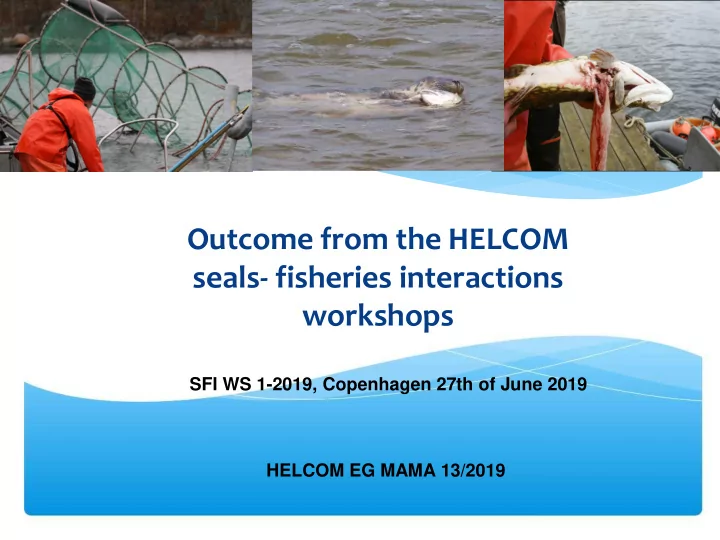
Outcome from the HELCOM seals- fisheries interactions workshops
SFI WS 1-2019, Copenhagen 27th of June 2019 HELCOM EG MAMA 13/2019
Outcome from the HELCOM seals- fisheries interactions workshops - - PowerPoint PPT Presentation
Outcome from the HELCOM seals- fisheries interactions workshops SFI WS 1-2019, Copenhagen 27th of June 2019 HELCOM EG MAMA 13/2019 HELCOM SEAL RECOMMENDATION 27-28/21: CONSERVATION OF SEALS IN THE BALTIC SEA AREA, thresholds for GES
SFI WS 1-2019, Copenhagen 27th of June 2019 HELCOM EG MAMA 13/2019
2
4
5
7
The fishery problem The biodiversity problem The ecosystem problem What is it that managers really want to achieve?
∗ 4 subgroups (8-9 people each) Formulated under one expert for each subgroup: ∗ Anders Galatius; ∗ Mart Jüssi; ∗ Sven Gunnar Lunneryd; ∗ Nils Höglund Two groups dealing with solutions to mitigate seals-fisheries interactions; Two groups dealing with questions regarding population status
All groups dealing with next steps and proposals concerning update of the HELCOM Baltic Sea Action Plan.
8
9
Mirosław Daniluk, Polish fisherman
∗ Seal safe gears: ∗ Non-lethal mitigation: Compensation systems Limiting protection measures Benefits from having seals ∗ Hunting and culling: Background document: Protocol for the scientific evaluation of proposals to cull marine mammals.
10
Iwona Psuty, NFMRI Mirosław Daniluk, Polish fisherman
11
Katarzyna Stepanowska, ZUT, Poland
∗ Seal population status – do we have enough knowledge? ∗ What do you think about set reference points in HELCOM
∗ Knowing the different status of seals in different BS regions should they be managed in subregions? ∗ Would a cull can cause that seals will move to another areas? ∗ Can by-catch pose a treat to populations’ status of seals? Background document also to be used: English translation of a Soviet study on infection of the liver of Baltic cod with roundworms
12
GROUP 1 ∗ HELCOM Recommendation 27-28/2 serves its role including Limit Reference Precautionary Approach and Target Reference Level; ∗ More data on seal parasites are needed and integration of data on an ecosystem basis is also lacking; ∗ Seal distribution monitoring is limited in scope, meaning that it is not possible to assess the impact of management actions for several years.
13
GROUP 2 ∗ More knowledge on seal movements year round; ∗ An international telemetry study could assess the monitoring results and population status more adequately; ∗ Workshops such as this are useful in kicking off discussions and involving various stakeholders, but more regular meetings would be needed in order to make progress in addressing the issue.
GROUP 3
∗ Little is known about the relationship between seal abundance and parasite prevalence in fish; ∗ Complete post mortem investigations on fish (histology, parasitology, toxicology, chemical biomarkers); parallel parasitological survey on seals and fish in certain areas) is needed; ∗ With regard to hunting and culling there is the need for a wider biodiversity view about protection, recognizing also the protection success story of increasing seal populations
15
∗ GROUP 4 ∗ Better knowledge on the food web dynamics, the links between
seal foraging behaviour and distribution are needed; ∗ Need for setting aside a part of EMFF funding specifically for gear development and cooperation (although outside the remit
∗ Need to involve relevant HELCOM groups into cooperation; ∗ Deeper involvement of fishermen directly into the gear development, new structures are potentially needed to help
16
Abundance data is available, but spatial and temporal distribution
Involvement from all stakeholders would be needed, including fishermen and nature conservation stakeholders. The issue of how to tackle the interactions between seals and fisheries may need to be divided into tangible portions (e.g. ecology, fisheries management, depredation and technical
portion. The Workshop was seen as a useful start to the discussions in addressing seal-fisheries interactions in the Baltic Sea, but more work, including involvement of, e.g. the HELCOM Fish Group, State & Conservation, EG MAMA, EN-Noise, the HELCOM-VASAB Working Group on MSP is evident, including the process of updating Baltic Sea Action Plan.
17
18
Polish conference on seals- fisheries interactions June 2017